The Supreme Court on Monday declined to entertain the Bengal government’s plea to direct the 19 appellate tribunals to pass interim orders allowing at least certain categories of excluded voters to vote, saying “we do not want to rush it”.
The state government had sought the interim relief, particularly for the deleted but “mapped” voters, citing a purported 20 lakh-plus exclusions and the shortage of time for the tribunals to dispose of all the appeals.
Monday’s court decision means that if the tribunals do not dispose of the appeals of those deleted before the expiry of the deadline for fresh inclusions, these voters cannot vote in the April Assembly elections.
This deadline for excluded voters from the 152 first-phase constituencies expired on Monday, while that for voters from the 142 second-phase constituencies will end on Thursday, April 9.
The next hearing is on April 13.
So far, none of the 19 tribunals has heard a single appeal from an ordinary voter. All they have heard — under Supreme Court directives — are two special, urgent cases. Both these appellants are election candidates and have been cleared.
“The tribunals will proceed with the hearings. We do not want to rush it, but we need to freeze the list somewhere,” the bench of Chief Justice Surya Kant, Justice Joymalya Bagchi and Justice Vipul M. Pancholi orally said.
“Already one layer of adjudication is being done by the judicial officers,” the bench told senior advocates Kapil Sibal and Shyam Divan, representing the Bengal government and chief minister Mamata Banerjee, respectively.
Divan suggested that the top court fix a deadline of April 15 for the tribunals to speedily dispose of the cases so that the final supplementary voter list can be published by April 18, five days before the first phase of voting.
“Some of the voters who are excluded were all in the ‘mapped’ category,” Divan said, pleading that at least their appeals be speeded up.
“In case of mapped electors whose appeals remain pending beyond 15th April, the court should consider them to be included in the roll so that no elector is disenfranchised.”
However, the Bengal government says the tribunals are yet to be functional. So far, the tribunals have not heard any appeals barring two special cases that the apex court had directed them to hear urgently.
A mapped voter is one who was able to link themselves or their parents or grandparents to the previous post-SIR rolls of 2002.
“Out of the 60 lakh cases, data of 44 lakh cases is available. (The) inclusion rate is about 55 per cent while the ejection rate is 45 per cent, (which means the exclusion of) about 20 lakh cases, which seems quite high despite the judicial safeguard,” Divan told the bench.
“Of the 20 lakh published cases of deleted electors, seven lakh have already filed their appeals before the tribunals and several appeals are in the process of being filed. The court notified the appellate tribunal on the 10th of March but they are yet to be operational.”
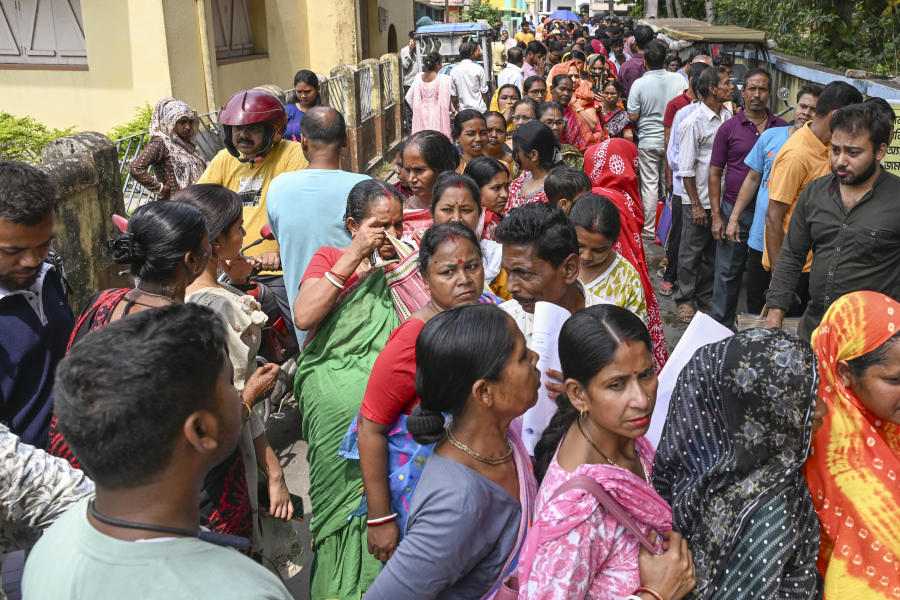
Divan said long, meandering queues had been forming outside the tribunals, and the voters were facing great difficulty in filing their appeals.
Sibal said that since the tribunals were not fully functional, the court should pass some interim orders for the inclusion of voters who had appealed before thetribunal.
“As an interim measure it can be done by your Lordships,” Sibal said.
He argued that the tribunals should themselves pass interim orders, at least, in favour of those found prima facie to have been wrongly excluded.
Justice Bagchi, however, observed: “We will not interfere. The appellate tribunals will formulate procedure and ensure that natural justice is followed and the final order will take a month or maybe even 60 days. We cannot on that apprehension alone allow some people to be included because they were earlier mapped.”
He added: “We are conscious of your concern. We had said that the appellate tribunals would look into the continuation of the constitutional right.”
Justice Kant later dictated an order saying the judicial officers should complete the adjudication process by Monday night in keeping with an earlier assurance given by the Election Commission.
The bench requested Calcutta High Court Chief Justice Sujoy Paul to form a three-member panel of former high court judges by Tuesday to evolve the procedure for the 19 tribunals to deal with the appeals against the exclusion and inclusion of voters.