ADVERTISEMENT

El Mencho death: Inside the US-Mexico operation and violence that followed

The White House confirmed intelligence support and praised Mexico’s army for taking down one of the most wanted criminals in both countries

Our Web Desk, Agencies
Published 23.02.26, 10:49 PM
1 5
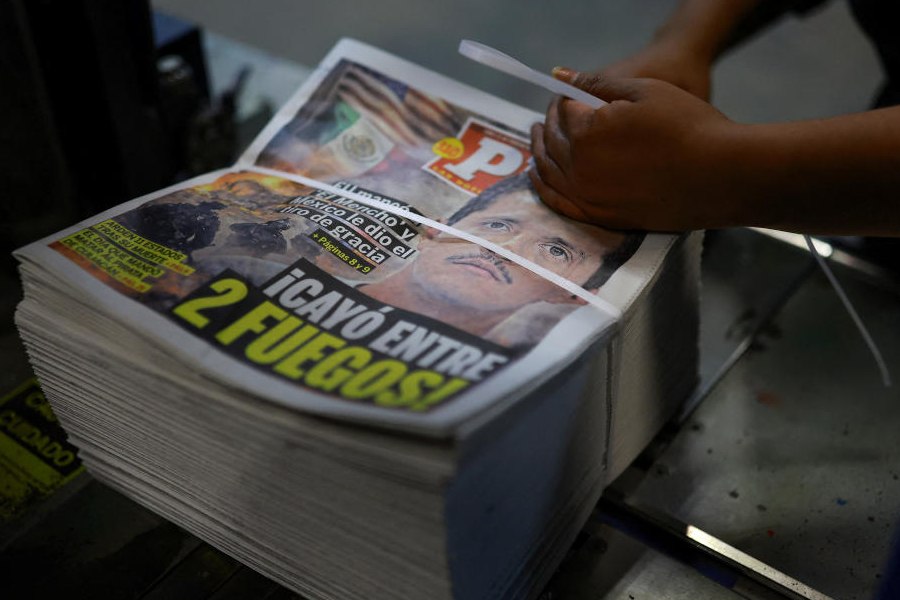
A worker sorts freshly printed copies of the newspaper PM bearing the headline "U.S. mapped ‘El Mencho’ and Mexico delivered the final blow, Caught between two fires," following the killing of drug lord Nemesio Oseguera, known as 'El Mencho,' in a military operation on Sunday, in Ciudad Juarez, Mexico, February 22, 2026. (Reuters)
ADVERTISEMENT

The killing of Nemesio Oseguera Cervantes, better known as ‘El Mencho’, has redrawn the security map of Mexico and injected new urgency into US-Mexico cooperation against drug cartels.

A US defence official told Reuters that a newly formed US-military-led task force played a role in the Mexican military raid on Sunday that killed the 59-year-old cartel leader.

The Joint Interagency Task Force-Counter Cartel (JITF-CC), formally launched last month, focuses on intelligence collection and mapping cartel networks on both sides of the US-Mexico border.

2 5
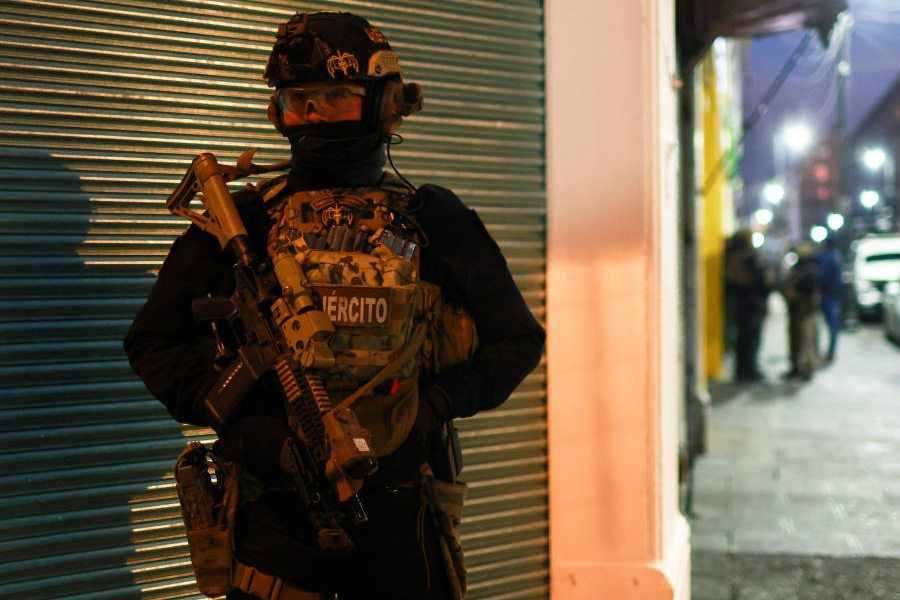
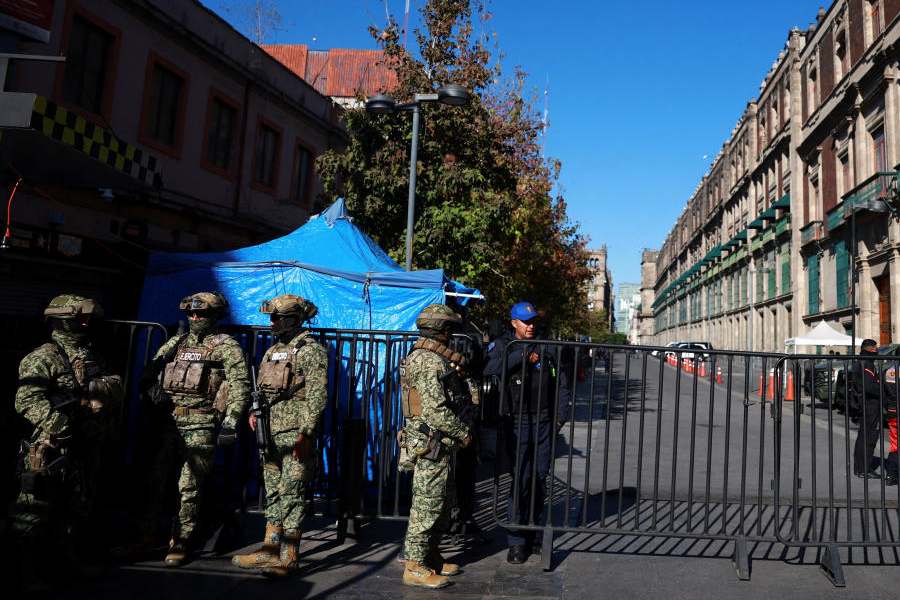
Members of the army patrol the perimeter of Palacio Nacional, where President Claudia Sheinbaum held her daily morning press conference about the wave of violence in Mexico, following the killing of drug lord Nemesio Oseguera, known as 'El Mencho,' in a military operation on Sunday, in Mexico City, Mexico, February 23, 2026. (Reuters)

The official, speaking on condition of anonymity, did not offer details on the information shared and stressed that the raid itself was a Mexican military operation.

A former US official said the US compiled a detailed target package for El Mencho and provided it to the Mexican government. The dossier included inputs from US law enforcement and intelligence agencies.

El Mencho, the former official added, was very high, if not at the top, of a US target list in Mexico.

3 5
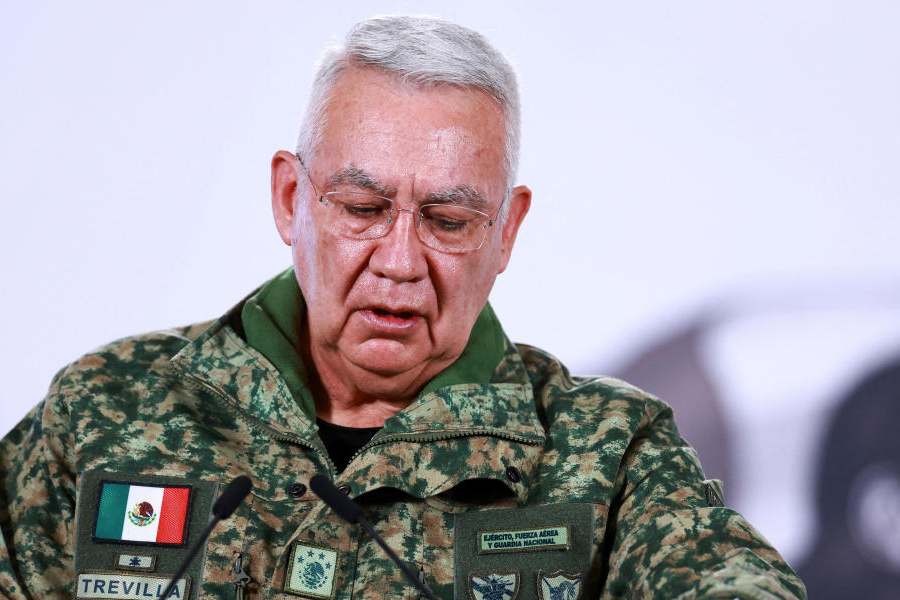
Mexico's Defense Minister Ricardo Trevilla Trejo attends a press conference about the wave of violence in Mexico, following the killing of Mexican drug lord Nemesio Oseguera, known as 'El Mencho', in a military operation on Sunday, at Palacio Nacional, in Mexico City, Mexico, February 23, 2026. (Reuters)

Mexican operation, US intelligence

Mexico’s defence ministry said US authorities had provided “complementary information,” without elaborating.

A Mexican government source familiar with the operation said it was designed and executed by Mexico and that no US military personnel were physically involved.

The White House confirmed intelligence support and praised Mexico’s army for taking down one of the most wanted criminals in both countries.

4 5
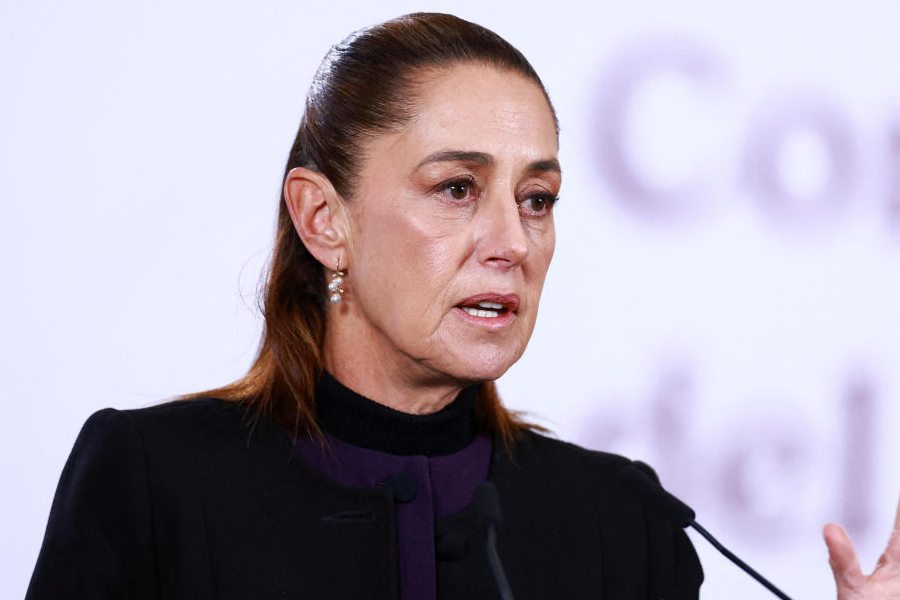
Mexico's President Claudia Sheinbaum speaks during a press conference about the wave of violence in Mexico, following the killing of Mexican drug lord Nemesio Oseguera, known as 'El Mencho', in a military operation on Sunday, at Palacio Nacional, in Mexico City, Mexico, February 23, 2026. (Reuters)

El Mencho was killed during an operation intended to capture him in Tapalpa, Jalisco, about two hours from Guadalajara. He was wounded in a shoot-out and died while being flown to Mexico City, the defence department said.

During the operation, troops came under fire and killed four people at the location. Three more, including Oseguera Cervantes, were wounded and later died.

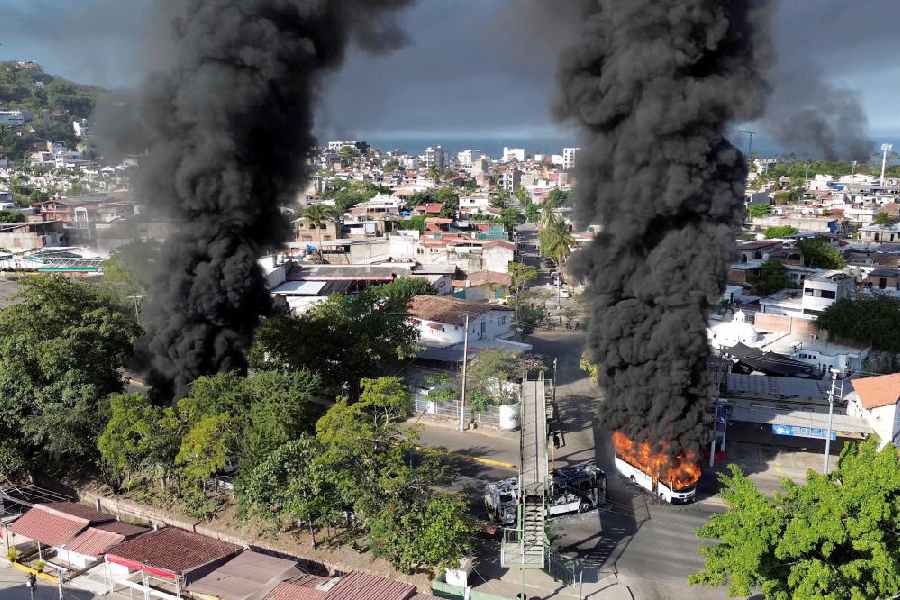
The operation triggered a wave of coordinated violence. Vehicles were set on fire, highways were blocked and gunmen appeared in more than half a dozen states.

5 5
A member of the army patrols the perimeter of Palacio Nacional, where President Claudia Sheinbaum will hold her daily morning press conference about the wave of violence in Mexico, following the killing of drug lord Nemesio Oseguera, known as 'El Mencho,' in a military operation on Sunday, in Mexico City, Mexico, February 23, 2026. (Reuters)

Over 250 cartel roadblocks were reported across 20 states before authorities said they had been cleared.

Mexico Security Secretary Omar García Harfuch said 25 members of the National Guard were killed in Jalisco in six separate attacks after the cartel leader’s death.

Authorities in Jalisco, Michoacán and Guanajuato reported at least 14 other people killed, including seven National Guard troops.

A prison guard, a state prosecutor’s office agent and a woman were also killed. Around 30 criminal suspects were killed in Jalisco and four more in Michoacán.

Several states cancelled school. The US Embassy said its personnel in eight cities and Michoacán would shelter in place and work remotely. It advised US citizens in several parts of Mexico to do the same.

In Guadalajara, more than 1,000 people were stranded overnight inside the city zoo as violence erupted. “We decided to let people stay inside the zoo for their safety,” director Luis Soto Rendón said. “There are small children and senior citizens.”

“I am worried because I don't know how to get home if something happens,” said Irma Hernández, a hotel security guard who struggled to commute as public transport halted.

President Claudia Sheinbaum urged calm and was expected to address the situation in her daily briefing.

Who was El Mencho?

El Mencho was the leader of the Jalisco New Generation Cartel (CJNG), one of Mexico’s most powerful criminal organisations.

A former police officer, he built the cartel into a global trafficking network moving fentanyl, methamphetamine and cocaine into the United States.

The US State Department had offered a reward of up to $15 million for information leading to his arrest. The CJNG began operating around 2009 and quickly gained a reputation for direct confrontations with security forces.

It has attacked helicopters, used explosives dropped from drones and planted mines. In 2020, it carried out an assassination attempt in Mexico City against then police chief Omar García Harfuch using grenades and high-powered rifles.

In February 2025, the administration of US President Donald Trump designated the cartel as a foreign terrorist organisation. Former DEA official Jack Riley said that move unlocked new forms of US military assistance, particularly in intelligence, surveillance and reconnaissance.

“Our surveillance capabilities are going to be probably unlimited, and that will really help with real-time stuff,” Riley told Reuters. “But these guys are extremely astute at being able to cover their tracks, cover who's in charge and where those people are.”

Mapping the cartels

There is little public information on the JITF-CC. Its website states that its goal is to “identify, disrupt, and dismantle cartel operations posing a threat to the United States along the US-Mexico border.”

US Brigadier General Maurizio Calabrese, who leads the task force, said the military is applying lessons from campaigns against jihadist groups to understand cartel networks.

“The cartels operate differently than al Qaeda or ISIS, different motivations, which makes it even more important for us to identify entire networks so that we can disrupt and dismantle (them),” Calabrese told Reuters.

He added that while there may be a few hundred core members at the top, the broader support structure is vast. “But then you have anywhere from 200,000 to 250,000 independent contractors that will help you move these drugs,” Calabrese said.

A second US defence official said the task force is part of a broader strategy that has seen the US military take increasing operational control of the border with Mexico.

It includes regular US strikes on suspected drug boats in Caribbean and Pacific waters, moves that have drawn criticism from some Democratic lawmakers and legal experts.

“The whole idea of creating an interagency effort is to not have stray voltage, is to bring it all together, synchronize it,” the second official said.

Diplomatic stakes and what comes next

For President Sheinbaum, the killing is both an opportunity and a risk. US pressure has mounted over fentanyl flows, with President Trump threatening tariffs and even unilateral military action if Mexico did not show results.

US Ambassador Ron Johnson called the operation a success and said bilateral cooperation had reached unprecedented levels.

David Mora of the International Crisis Group said the killing marks an inflection point in Sheinbaum’s security policy. Mexico may use it to argue that closer intelligence-sharing works and that US troops are unnecessary on Mexican soil.

At the same time, the power vacuum inside the CJNG could trigger internal fractures or open space for rival groups. The immediate violence after El Mencho’s death shows how quickly cartels can mobilise.

Sheinbaum has criticised the “kingpin” strategy of eliminating cartel leaders, arguing that it often leads to splintering and more bloodshed. Her government now faces the test of containing reprisals and preventing a wider escalation.

MORE IN PICTURES

ADVERTISEMENT