
In a non-smoking room of a luxury hotel in Bangalore, Calcutta-based entrepreneur Kishor Zavery and his business partner Vijay Vora are going over the fine print of a contract they have inked this week with Airbus Helicopters for two choppers. It is one step closer to giving wings to Zav Airways, a regional airline from Calcutta that will cater to the east and Northeast.
"It is a dream come true," says the affable Zavery, who was once in the aluminium business. It has taken him over eight years, since he first applied for a permit to fly, to see a take-off in sight. In 2009, plans slid to a temporary halt with the death of one of Zav's directors who had a fatal heart attack at Heathrow Airport.
But now, Zav expects to launch in June as the country's first scheduled helicopter service, complete with boarding pass (unlike a charter or air taxi service), with a flight to Itanagar in Arunachal Pradesh. The total fleet order is for 12 helicopters, including the two Dauphin AS365 N3+ expected to arrive next month.
Beating Zav to it will be Air Pegasus, a Bangalore-based airline that launches today with flights from Bangalore to Hubli. A second route, Bangalore to Thiruvananthapuram, will start in August. Pegasus is looking at flying to tier-2 and tier-3 cities, with an eye on pilgrim towns and business hubs.
"We are aggressively sticking to south India. There are 30 airports but only one-third are connected and not too well," says Ashwin Thomas, director, Air Pegasus, which will eventually fly to Kochi, Chennai, Tuticorin, Belgaum, Rajahmundry, Madurai and Pondicherry. Pegasus is in talks with Pondicherry airport which has had fitful flight operations and currently is not active since Spicejet stopped its flights there last year.
The ninth scheduled airline in the country, Air Pegasus is the third new entrant, after Air Asia and Vistara, in less than a year.
And there are more to come.

Flyeasy, a regional airline based in Bangalore and promoted by ABC Aviation and Training, is ready to take wing, as are Turbo Megha, based in Hyderabad, for primarily the Andhra and Telangana regions, and Premier Airways, from Chennai and promoted by non-resident Indian engineer Umapathy Pinaghapani, and two charter services, Air One and Air Carnival.
"Premier Airways, a new pan India LCC (low cost carrier), will start by the end of this fiscal year. Next fiscal year, it is possible to see one or two more regional airlines start operations. India will have 10 airlines operating by next fiscal," says Kapil Kaul, CEO, South Asia, CAPA-Centre for Aviation, a global aviation research and consulting practice.
Most of the airlines see opportunity in regional routes that are under-serviced at present. Zav is eyeing a long ambitious wish list - including Aizawl, Bagdogra, Dimapur, Bhubaneswar, Rourkela, Lilabari, Jorhat, Silchar, Tezpur, Dibrugarh, Shillong, Gaya, Ranchi and Port Blair. Zavery says his airline will eventually fly all 22 sectors of the region and have 108 flights daily. It will also import 75-seater and 130-seater Embraer and Airbus aircraft in the future.
With a national footprint, another airline service, Air Costa, is also hoping to fly to Lucknow, Indore, Varanasi, Pune and Amritsar.
Industry observers agree there is scope for "well-capitalised regionals" with proven management as the market remains under-penetrated in many parts of the country. India's domestic and international market growth will continue to increase significantly in the medium to long-term, they say. But the airline industry has to contend with what remains a negative fiscal and regulatory regime which hampers feasibility.
"This, coupled with airlines' continuing with below cost pricing, makes it extremely difficult to ensure sustained viability," Kaul points out.
However, the new entrants are not deterred. They point to cost pruning through several factors. Zav, for instance, will start with a 12-seater, followed by 16 to 20-seater Dauphins with short-haul flights of under 30 minutes that will enable it to use shorter runways or helipads, consume less fuel, fly with minimal crew and ground staff, have quicker turnarounds and offer no frills.
"Right now we are spending on training our pilots to fly these helicopters. Over time, that cost will also come down," Zavery points out.
Thomas, too, believes that Pegasus will be "scale and pricing efficient" for regional travel. "Filling up 45-50 seats on our ATR-72s (72 seats with two pilots) is not a challenge," he says.
But with the travails of Kingfisher, Deccan Air and Sahara still fresh in the traveller's mind, there is consternation. Any new venture seems to be foolhardy at best, and throwing caution to the winds, at worst.
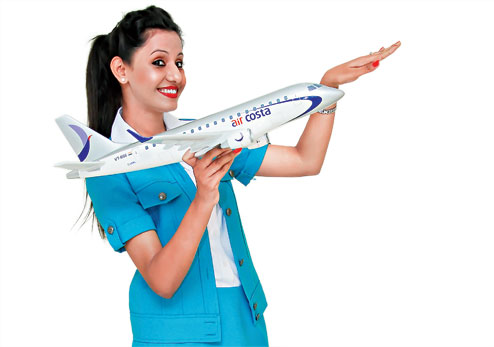
Air Costa's chief financial officer, Vivek Choudhary, doesn't think so. Less than two years old, it is primarily a regional airline that forays out to Jaipur and Ahmedabad as well. It has been flying a fleet of four aircraft since it started services in October 2013 with a Bangalore-Vijayawada flight, and runs what it dubs a hybrid service. It deploys the Embraer E-170 (60 economy and seven business class seats) and E-190 (112 economy seats) aircraft. By 2018, it plans on taking delivery of 50 Embraer Jets E2, a deal worth $2.94 billion.
To put the numbers in context, according to a CAPA profile of India's fleet database, Air India currently has 99 aircraft, Jet Airways 96 and Indigo 91. India's current domestic fleet is 388 aircraft. On order is a fleet of 694, up by almost two-thirds. A national airline costs over a $100 million to make it work while a regional airline requires $40 million, says CAPA.
The regional airlines and even the new national ones all appear to be exploring the small-is-nifty model. A Boeing Airbus with 180 seats is not viable between smaller cities and feeder destinations, says one spokesperson. Smaller aircraft are more viable.
"We were the first airline to debut after a gap of eight years and have a first mover advantage. We have stabilised with a load factor of 75 per cent and are doing pretty well," Choudhary says. Their USP is to address the connectivity among cities such as Tirupati, Vijayawada, Hyderabad, Visakhapatnam and Coimbatore, with rows of two seats on either side of the aisle.
Most of the new entrants, while leveraging parent company experience - for instance, Pegasus is an offshoot of ground services handles Décor Aviation Private Ltd, and Air Costa of LEPL, a real estate development company - are also planning to de-merge from the parent company. Eventually, some say, they will seek to raise private equity investments and funding in order to scale up. Three years down the line, if conditions are favourable, Air Costa may go public with an IPO.

Given that the airline business has been a mixed bag in India, what is its draw?
"Frankly, I don't know why we continue to attract new players despite an extremely difficult market," says Kaul. "Easy availability of capital and lower barriers to entry are possible reasons. More important, I don't think the promoters of new start-ups are fully aware of the extent of the challenges."
Airline owners claim they are aware of the challenges but hope conditions on the ground will change. For one, they would like the central government to chip in by upgrading smaller airports. They also agree that part of the solution lies in good management - and in tempering expansion.
"Zav will scale up gradually. We won't be like Kingfisher - their chemistry was something different. Their establishment expenditure was very high. We want to earn something and make a profitable balance sheet," Zavery says.
The North-East Council (NEC) is also supporting Zav Airways with a subsidy, subject to the airlines fulfilling its destination needs. Zav's hub will be in Calcutta but its services will start from Guwahati.
"There is a heavy demand. The NEC also did a survey and came to us and said start soon. Even our Prime Minister Narendra Modi went there and said we will start services there. So every day there are phone calls, when are you going to start? There is heavy pressure," Zavery says.
Spokespersons of the new airlines expect consolidation, mergers and code sharing as the way of the future. "We are creating a new market on routes that are dormant. The market will expand. There will be no cannibalisation," Thomas adds.
While more flights take off, air travellers can hope for a sweet ride. "More airlines means lower fares and capacity induction will place more pressure on fares. With lower ATF (aviation turbine fuel) prices likely to continue, I see a lower fare regime," Kaul says.
Helicopter, anyone?
Taxiing on the tarmac
Air Pegasus, based in Bangalore, to launch on April 12, 2015
Zav Airways, based in Calcutta, to start in June 2015 with chopper flights to the east and Northeast
Flyeasy, based in Bangalore, to start in 2015
Turbo Megha, primarily in Andhra Pradesh and Telangana, to start in 2015
Premier Airways, based in Chennai, to start in 2015
Air Carnival charter service, based in Mumbai, to start in 2015
Air One to start in 2015
Air Costa, operating mostly in south India, launched in 2013