TT Epaper
The Telegraph
 
IN TODAY'S PAPER
WEEKLY FEATURES
CITIES AND REGIONS
ARCHIVES
Since 1st March, 1999
 
THE TELEGRAPH
 
 
CIMA Gallary

Modi tears into ‘termites’ but takes US blow
Full-throated hit at Cong

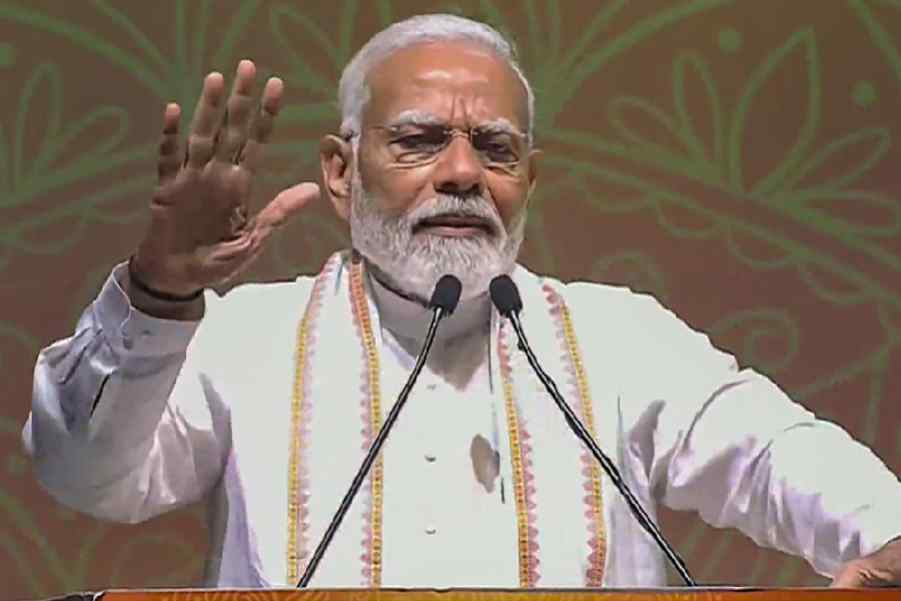
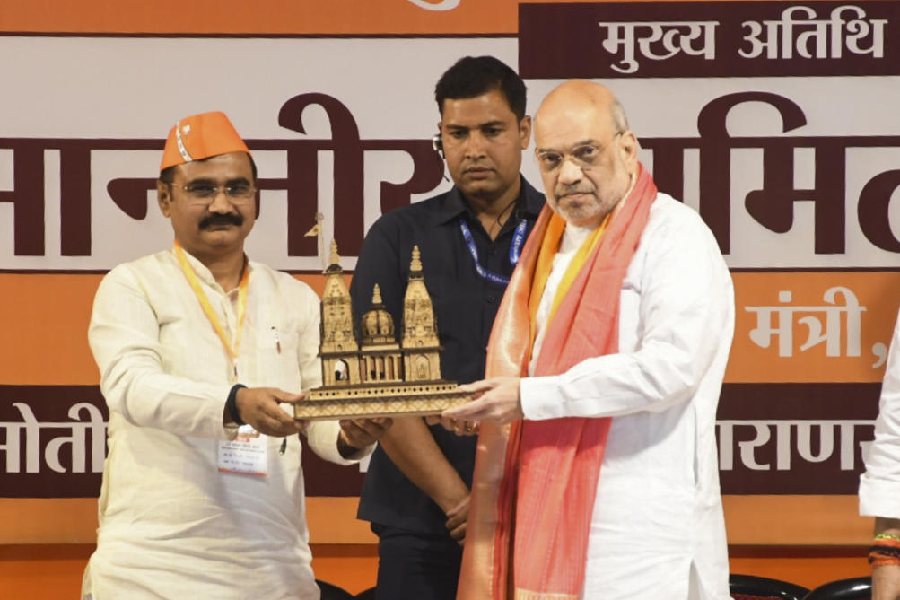
New Delhi, March 3: Narendra Modi today singled out the the Gandhi-Nehru dynasty for attack, compared the Congress to “termites” that had corroded India’s “insides” and projected the BJP as the logical political option in a 55-minute speech that drew a round of applause after every second line.

Bestowing pride of place to the BJP’s cadres at the national council meet, Modi said it did not matter who led the party or who its prime-ministerial face in 2014 was.

The refusal to bite the leadership bait was a political calculation, sources said. Modi, they claimed, did not want to show himself as “power hungry”—“not after Sonia Gandhi’s renunciation act”— and upset the NDA apple cart. “Appearing overly ambitious sends a bad message in India. He knows that when the time comes, the BJP will announce his name or anoint him,” a source said.

Modi focused on the run-up to that moment. “The country has made up its mind to throw the Congress out. We have to fill the vacuum with the right people and hand it over to the right hands. Who says it cannot be done?

“It is important to create a sense of hope. Hope will lead to confidence. Confidence will fire the desire to take the first footstep. One billion footsteps will take the country forward. We (the BJP) can be the catalyst to usher in a change of government but the critical input is people’s participation. The Congress has finished the people’s participation,” he said.

Modi claimed that his objective was not to get entangled in thorny questions of leadership because it was incumbent on the BJP to fulfil a bigger “mission”: that was to take the country out of the miasma the UPA had shrouded around it.

“Maana ki andhera ghana hai, par diya jalana kahan mana hai?” (Agreed the darkness hangs heavy, but who is stopping us from lighting a lamp?), he asked, signing off by likening “progress and development” to the “lamp” and the “lotus”. The lamp was the symbol of the Jan Sangh, the BJP’s predecessor and the lotus is the BJP’s emblem.

The “mission”— described as India’s “second Independence” movement — was to “liberate” the country from the Congress “in the spirit of a true patriot”.

For the RSS, which had a dubious record in the Independence movement, and the BJP, the Emergency was the closest equivalent of their tryst with “history”.

The Gujarat chief minister sought to lift the discourse from the tedium of his government’s “achievements” in governance and development. He transplanted it on a far broader political canvas, sweeping through the Congress’s history as he counselled the BJP’s cadres to do an Arjuna and focus only on the 2014 elections, without breaking their heads over who from the BJP will lead it or who its prime-ministerial candidate would be.

But Modi’s laboured effort to undermine his pre-eminence in the run-up did not matter to the listeners. “It was like an acceptance speech of his position as the first among equals,” said a delegate from Uttar Pradesh.

Modi said: “Who the leader is or who is not, who the (PM) candidate is or who is not, does not matter in the BJP. We have to take the plunge and get things right because we have no right to let the country down. The country’s innards are being eaten by the termites bred by the Congress. The trouble with termites is if you destroy one mound, another will be seen. There is only one way to exterminate the Congress termites. That is by the sweat shed by each party worker, the sweat has untapped strength.”

However, the larger political points he made often became an excuse for self-projection.

“The BJP is a party with a mission and the Congress, a party to take commissions. You should call the Congress party a commission party because the sons, daughters, nieces, nephews of leaders have taken commissions on 2G, CWG, helicopters and what not,” Modi said.

Somebody shouted: “What about the son-in-law?”

“Ah, the son-in-law. Look, I am not a family man. So, sometimes such relationships don’t readily occur to me,” Modi said, playing on a perception that because he is unmarried and keeps his close relatives at arm’s length, he is “incorruptible”.

Alleging that it was not in the Congress’s “bloodline and character” to “do something for the country”, Modi said it “sacrificed India’s interests for the family’s interests”.

“Sitaram Kesri was made the president once but it was like installing a night watchman. The family does not want anyone competent and credible because it feels threatened. When the time came, Kesri was kicked out of office. Then when the Congress formed a government (in 2004), it picked another night watchman as the PM. We never dreamt that the night would be so long and dark,” he said.

Giving a twist to the Congress’s “darbari” politics, Modi said Pranab Mukherjee would have made a “far better PM” because he is “political, rooted and has solutions for problems”. “But if Pranabda was successful, what would have happened to the family? So it continued with the night watchman.”

Persisting with the “family-versus-non-family” leitmotif, Modi said the Congress leaders who sparkled were those who either worked out of the family’s shadow or left the party.

“Lal Bahadur Shastri chanted the ‘mantra’ of ‘Jai Jawan, Jai Kisan’ and gave a sense of confidence and purposefulness to our farmers. Morarji Desai, Charan Singh, V.P. Singh and H.D. Deve Gowda could become PMs when they were out of the Congress. If you are inside the party, you surrender to one family.”

His allusion to the BJP’s history centred around Atal Bihari Vajpayee, who wanted Modi to be removed after the Gujarat riots. “The Vajpayee government conducted a nuclear test (on May 11, 1998). The world was up in arms, economic sanctions were promptly imposed. Undeterred, two days later, Atalji conducted another test to prove to the world India would not be cowed down. Such is the BJP’s character, it is not put down easily,” Modi said.


" "