|
Anjan Dutt’s deliberate exit from theatre 20 years ago deprived the Bengali stage of a potential game-changer, a young, thoughtful, cosmopolitan voice that could have transformed the scene as he matured. His comeback does not arrive too late to achieve this end, for he now has the wisdom of years to turn things around if he continues in this medium, which we hope he does. It also serves as another example of performers who made it in theatre, then became famous in cinema, yet returned because they longed to experience the magic of the stage again, though they had no materialistic reason to do so. Such journeys give theatre a shot in the arm by catching the attention of youth. Additionally, Dutt has outspokenly, and very honestly, expressed his disillusionment with the artistic mediocrity in the celebrity world, which should (but of course never will) make the media take note.
As one can tell, I see Anjan Dutt Production’s Galileo, translated by him from Charles Laughton’s English version, as a cultural marker, not just as another play to review. In this context, I wonder how many Bengali theatre workers watched it, now that it has completed its run. I did not notice too many when I went — maybe they had seen it already; but I have my doubts. Because Dutt has become associated with film and music, many theatre people probably stayed away. He staged it in Gyan Manch, which Bengalis peculiarly avoid. Had they come, they might have learnt a lesson or two in how to approach their common master, Brecht.
Simultaneously, they would have appreciated the topical relevance of Dutt’s interpretation of this classic as the crisis of the individual against the establishment: “The true intellectual will always be doomed to be an individual. They will never subscribe to the majority and it is this handful of misunderstood intellectuals who make a difference to our society”.
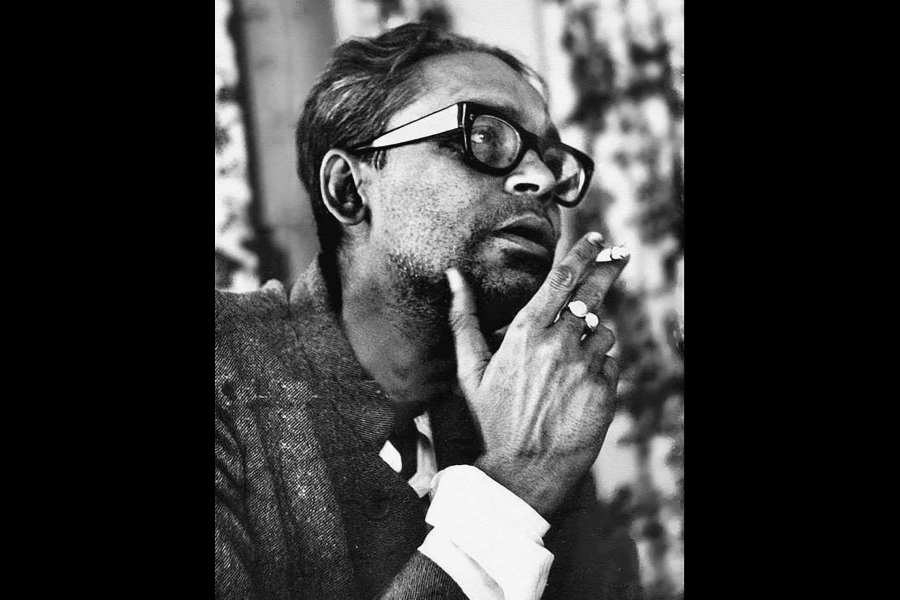
For the most part, Dutt deals with Galileo intellectually and clinically, in his words, “aimed at a scientific audience that goes to the theatre for argument and not a conclusion.” This attitude is in stark opposition to the predominant Indian tendency of either emotionalizing Brecht’s storylines, or adapting them into local scenarios, or both. Dutt enacts Galileo applying Brecht’s “distanced” precepts, but does not portray him as the sensualist Brecht depicts — though he gets inordinately physical with the boy Andrea. The only crack in his characterization appears at the end, when tears trickle down his cheeks — whereas Brecht’s Galileo gluttonously carried on eating, unconcerned.
Dutt maintains the Brechtian method of “alienation effects”, from a live rock quartet to clown makeup (though I could not understand why Andrea had it on, and would have preferred the liberal use of half-masks). Innovatively, he converted the verse captions beginning each scene into songs, which arranger Neel Dutt suitably set to familiar Brecht tunes. In place of the captions, he had frames on which actors hung scrolls containing appropriate commentary instead of projecting them on screen, pleasantly confounding expectations from Dutt as a cineaste. Although he did what I always advocate, take the advice of a dramaturge, Samik Bandyopadhyay failed to spot glaringly misspelt or wrong captions: “Openheimer” and “House of Un-American Activity” for “House Un-American Activities Committee”.
At the same time, Dutt implemented some quite Artaudian and non-Brechtian practices, such as actors making an obscene ruckus in the auditorium, then rushing onto the stage in pre-performance pretence. To quote him, “Theatre is a place to disturb and not to lull, to attack and not to cooperate.” I heartily agree. Chanda Dutt designed inventive décor of crumpled newspapers for Galileo’s scientific calculations strewn all over his study.
All the other characters in Galileo play supporting parts, which the cast fulfil adequately. Following Laughton’s instruction, two actors perform Andrea the boy and man, respectively, but Dutt also has two actresses as Galileo’s daughter, which seems unnecessary, since they do not establish an age difference. And we anticipated more from Daminee Basu as Andrea’s mother: she behaves more detached than even Brecht would have wanted.
As director, Dutt takes one backward step, allowing all and sundry to smoke indiscriminately. He should realize that this is an actor’s worst habit, exposing an inability to find anything to do with his hands and, worse, inflicting carcinogens on unwilling colleagues and viewers. If actors can drink whisky that is not really whisky (we hope), why can’t they mime smoking, without the fumes? If absolutely essential, Western actors use non-tobacco cigarettes. Otherwise, not much separates the church displaying the weapons of torture to Galileo from the group puffing a smoking gun before us.
|