|
Prashanta Basu, 44, suffered multiple fractures, hip dislocation and chest injury when a truck rammed into the taxi he was travelling by in the dead of night. Two colleagues who were travelling with the engineer died. An ambulance reached the spot within eight minutes of the accident and took him to hospital in two minutes flat.
A man lost consciousness and collapsed in the middle of Old Court House Street around 9pm. Pedestrians carried him to a footpath and a constable alerted the traffic control room. Within minutes, an ambulance took the man to hospital.
Many Calcuttans who needed emergency medical attention on the road over the past year have a joint project of Calcutta police and Medica Superspecialty Hospital to thank for saving their lives.
Under the project, Karma (Kolkata Accident Rescue and Medical Attention), trained personnel on ambulances assess the condition of those in need of help, provide basic treatment and ferry them to a hospital with the facilities needed to take care of them.
As many as 3,300 people have been attended to since Karma was launched on March 5 last year. Over 2,600 of them required hospitalisation. Each ambulance that took them to hospital had two or three medical technicians apart from a homeguard and a driver. The technicians are deployed in different areas every day so that they become familiar with the entire city.
In 2010, Calcutta police had first started stationing ambulances at intersections where accidents occur regularly but could not continue the service in the absence of medical expertise. Last year, the cops invited leading hospitals to support them. But none took up the responsibility. Medica though changed its mind after a feasibility study and decided to provide the medical expertise needed for all 18 ambulances in the fleet.
The police provide the vehicles and pay for their fuel and maintenance. They also pay the salaries of the 25 drivers. The hospital pays the salaries of the 72 emergency medical executives, who have been trained by it for two months, and runs a command centre with 24 medical executives conversant with the locations of hospitals and the facilities available there.
“Once the traffic control room gets to know of an accident, it contacts the Medica command centre. Personnel there alert the ambulance stationed nearest to the spot and guide it to the hospital with the facilities to treat the accident victim(s),” said Alok Roy, chairman, Medica.
The ambulances receive five to 15 calls daily. The hospital spends about Rs 10 lakh per month on the project.
The team is guided by Sudeep Bhattacharjee of Medica, who had worked with commercial ambulance services in New York for 17 years, after completing a programme in paramedical studies.
“While the thrust is on taking the patients to hospital as quickly as possible, how the victim is lifted up and positioned is also vital. We train the technicians for all possible scenarios before they join the fleet,” said Sanjit Saha, who heads the department of emergency medicine at the hospital.
“In accident cases, there is the golden hour and the platinum 10 minutes. The victims are in pain and often there is heavy blood loss. Every second is vital,” he added.
During training, the medical executives are asked to remember three things — circulation, airway and breathing. Firstly, they have to ensure the blood is circulating, the airway is clear and straight and the victim is breathing. “For example, if blood is entering the mouth, the victim might choke. Just turning the victim over can save his life,” said Saha.
Apart from an oxygen cylinder, the ambulances have suction devices to clear the airway of accident victims. “Another gadget in the ambulances is the scoop, which is a stretcher that can be split. It allows patients to be lifted with minimal movement,” said Saha.
The hospital maintains a log of timings — when it received an alert, an ambulance reached the spot, the patient reached an hospital and the ambulance returned to the spot where it was stationed. All the calls are recorded and internal audits carried out.
“We need corporate houses to donate more ambulances to the fleet. More vehicles are required because the jurisdiction of Calcutta police has increased. Also, we would like to extend our services to cardiac patients and elderly people living alone,” said Udayan Lahiri, CEO, Medica.
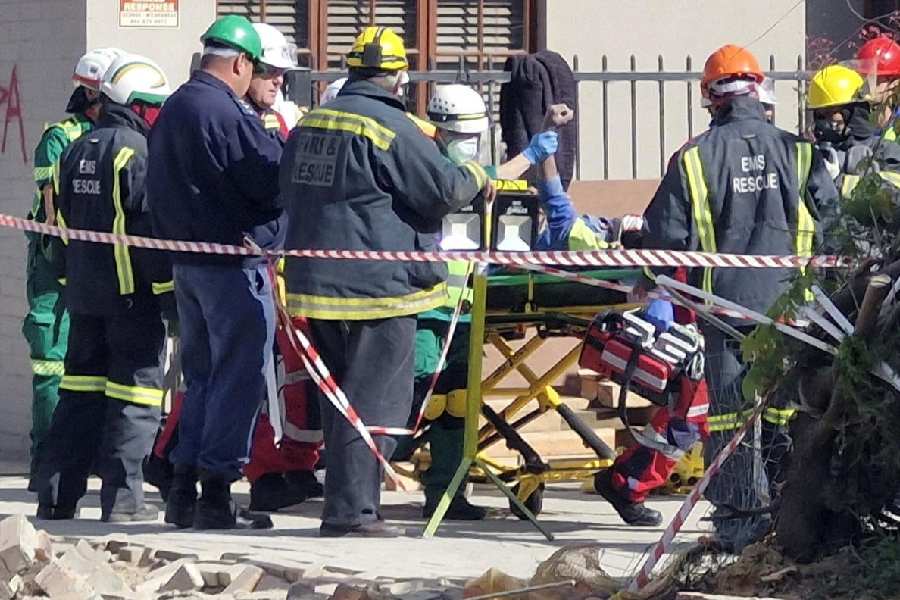
Many would vouch for the efficacy of the service. Basu, for instance, believes he would have died had the service not existed. The truck had mounted his taxi from one side near the Park Circus crossing, crushing his colleagues seated at the back. The driver was carried to a police car with great difficulty and a disaster management team used a steel cutter to free the others.
“The nearest Karma ambulance was at Beleghata. We reached the spot in eight minutes, just as Basu was being pulled out. In two minutes, he was at Calcutta National Medical College,” said Subrata Halder, one of the technicians who had rescued the engineer.
After surgeries, Basu now leads a normal life.
The phone number of the Karma command centre is 033-66070707. Calcutta police toll-free number is 1073 and the traffic control room number is 033-22143644.
|