TT Epaper
The Telegraph
 
IN TODAY'S PAPER
WEEKLY FEATURES
CITIES AND REGIONS
ARCHIVES
Since 1st March, 1999
 
THE TELEGRAPH
 
Calcutta Weather
WeatherTemperature
Min : 13.40°C (-4)
Max : 29.00°C (+0)
Rainfall : 0.00 mm
Relative Humidity:
Max : 25.00% Min : 80.00%
Sunrise : 6:10 AM
Sunset : 5:33 PM
Today
Partly cloudy sky. Minimum temperature is likely to be 14°C.
 
CIMA Gallary

Jogen Chowdhury’s path to pre-eminence

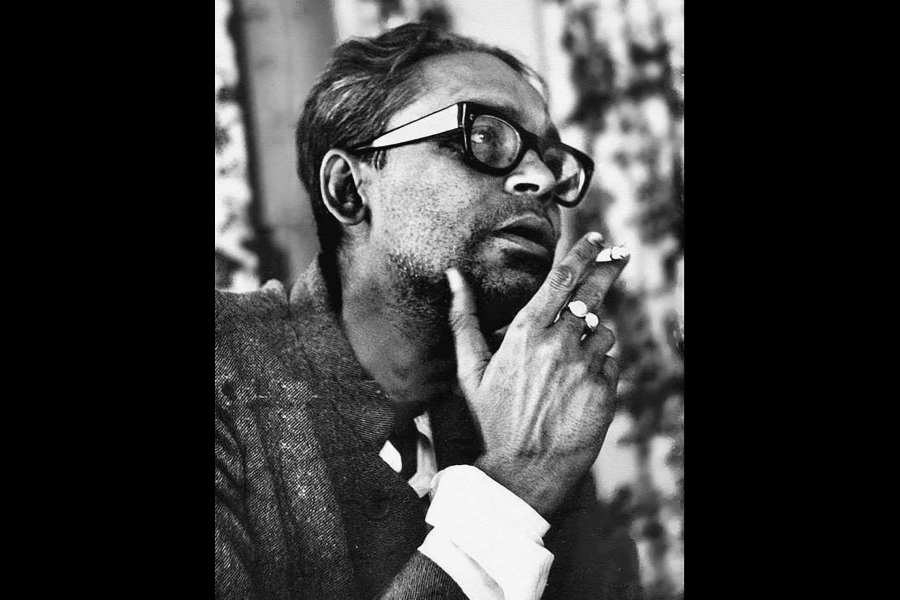
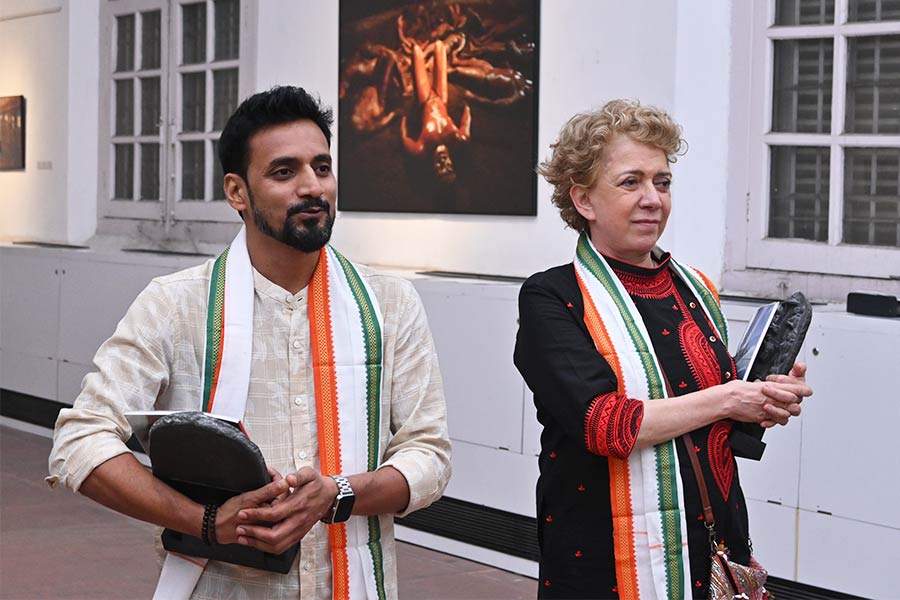
The first retrospective exhibition of Jogen Chowdhury displaying 179 works going back to 1955, when he was a student at the Government College of Art & Craft, up to his latest drawings of 2011, some heavily spangled, opened at Nandan, Kala Bhavan, Santiniketan on Monday evening.

A cream-coloured carpet, matching cushion covers, all of which were designed by the artist born in 1939 at Faridpur in Bangladesh, and a bedsheet which he himself painted with a thick brush were also on display at this exhibition. It was curated by Sushobhan Adhikary, curator of Kala Bhavan. All these works are from Chowdhury’s personal collection.

Although the walls are a little too crammed and the lighting is far from ideal, it is a treat for all art lovers as it traces his development from a highly talented student to one of India’s major contemporary artists. His work presents a darkly beautiful vision — often nightmarish and grotesque — of corruption and latent violence in society today, stylistically drawing heavily on traditional and even folk forms of expression and decoration like the alpana. Not the arty alpana style made popular by Santiniketan, but the more spontaneous form once seen in hutments, which re-emerges in Chowdhury’s mature work.

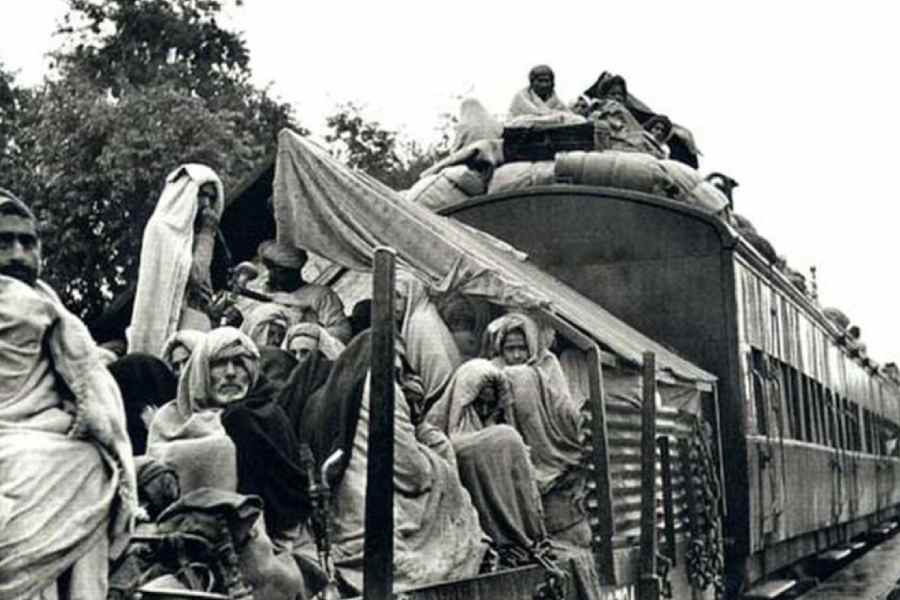
The artist, who is now professor emeritus at Visva-Bharati, and was principal and professor of Kala Bhavan between 1987-99, had sought refuge in Calcutta along with his family in 1947 just before the Partition.

Along with the work he did in his class — still life, botanical drawings and pretty Bengal Schoolish paintings of rural idylls — there are some powerful drawings of refugee women and children, who had turned Sealdah railway station into their home, hellish with the stench of rotting food and excreta.

Chowdhury had around the same time executed a series of fine portraits of himself as an angry young man with an angular face and intense, glowering eyes. But it could not have been doom and gloom all the time. For there are some posters here that he had done in 1964 for World Theatre (on the occasion of Shakespeare’s 400th birth anniversary), and another one with a pretty face and a Tagore song for the Book Fair. There are photocopies of pages from his notebook, where, in one he jotted down some details of an encounter with M.F. Husain at the Taj in Mumbai, and in another, he drew the maps of the train route back to his birthplace.

In 1965-67, he was awarded a French government scholarship for higher studies in Paris, when his drawings acquired a distinctive European flavour but at the same time, saw the emergence of the flaccid, heavy torso that became associated with his work. The exhibition affords interesting glimpses of his personal life --- his encounter with Jimi Hendrix and his girlfriend in London when he did several portraits of the rock star.

There are many early oil paintings as well and those huge paintings of amorous couples and dreamscapes which have become acquired iconic value. The exhibition continues till February 28. There is a catalogue on offer.