|
Guwahati, Feb. 10: Assam’s tea industry is upbeat about mechanisation of gardens yet apprehensive about the quality of teas getting compromised in the process.
Mechanisation, which is being welcomed by the industry as a way out of the labour shortage problem, has also become a source for worry because of the high cost of the machinery.
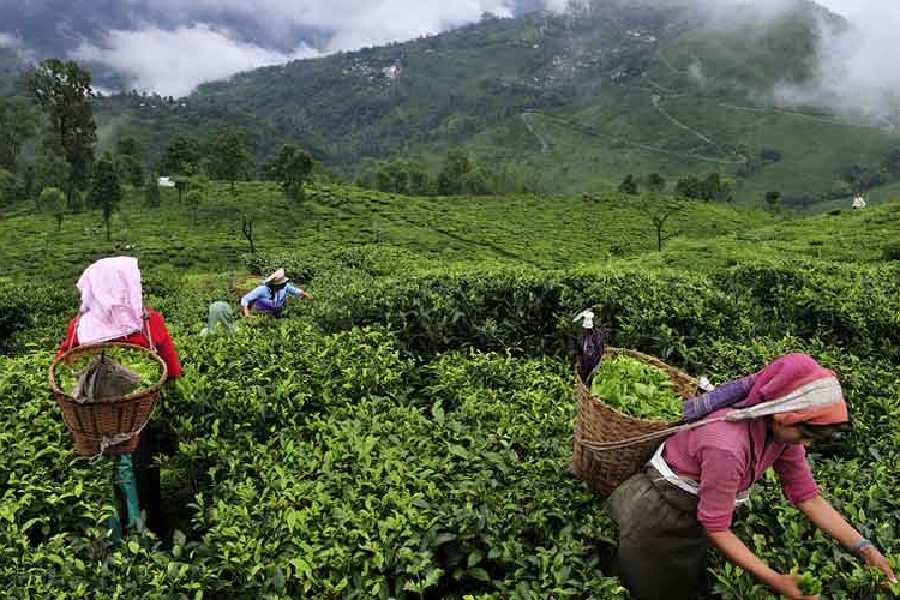
Assam Branch Indian Tea Association secretary Dhiraj Kakati told The Telegraph: “There are apprehensions about quality variation after mechanisation.” He said machines could never replicate the fineness of hand plucking.
Though the aim of mechanisation of gardens is to save on labour, it does not necessarily mean reduction of manpower alone. Enhancement of productivity and quality of work, better life for the garden workers and their health will also be kept in mind.
The parliamentary standing committee on commerce had suggested that mechanisation of all operations of tea gardens was imperative for their growth in light of the scarcity of labour and increase in labour costs, which alone accounted for about 60 per cent of the total cost of production.
The committee asked the commerce department to prepare a blueprint for mechanisation and modernisation of operations of the tea industry under a time-bound programme, for which the expertise of other institutions or agencies should also be taken into consideration.
Plucking is the most important area of mechanisation as it accounts for nearly 25 per cent of the total cost of tea production and over 60 per cent of the labour deployment in a tea estate. These figures are much higher for the small tea growers.
In its new policy initiatives in the tea sector, the Tea Board of India says it is proposing to incentivise use of field mechanisation equipment like harvesters, pruning machines and others.
North Eastern Tea Association chairman Bidyanand Barkakoty said as most machines were imported, these were expensive and getting spare parts was difficult. “The ideal thing would be to have local low cost machines, for which spare parts will be easily available,” he said.
“Technology has developed and it is not impossible to have machines which can take care of quality,” he added.
He said three tea producers’ associations — Assam Tea Planters’ Association, North Eastern Tea Association and Bharatiya Cha Parishad — had submitted before the parliamentary standing committee on commerce that mechanisation was one approach to overcome the crisis of labour shortage and had requested that a special project on mechanisation be given to IIT Guwahati or an institute of repute to develop user-friendly, economical machinery for harvesting, pruning and other activities.
“IIT Guwahati is one of the best IITs in India and had shown keen interest in this project during our interaction with them a few months back,” he said. He said they had taken an IIT team to the various locations in Upper Assam and showed them the machines.
The committee strongly emphasised the need for developing harvesting machines compatible with the terrain on which tea is grown as no substantial savings of labour had been noticed from the existing machines.
“Mechanisation of all operations is the only alternative to overcome this emerging situation. The main constraining factor for growers in going for mechanisation is the cost of the machines, which are prohibitively expensive for an average plantation. There is a need to encourage the machinery suppliers to come up with innovative mechanical equipment to suit the local situation,” United Planters’ Association of Southern India secretary general Ullas Menon told The Telegraph.
Menon said despite paying high wages, the plantation industry was unable to get adequate labour.
|