TT Epaper
The Telegraph
 
IN TODAY'S PAPER
WEEKLY FEATURES
CITIES AND REGIONS
ARCHIVES
Since 1st March, 1999
 
THE TELEGRAPH
 
 
CIMA Gallary

WAIT AND WATCH

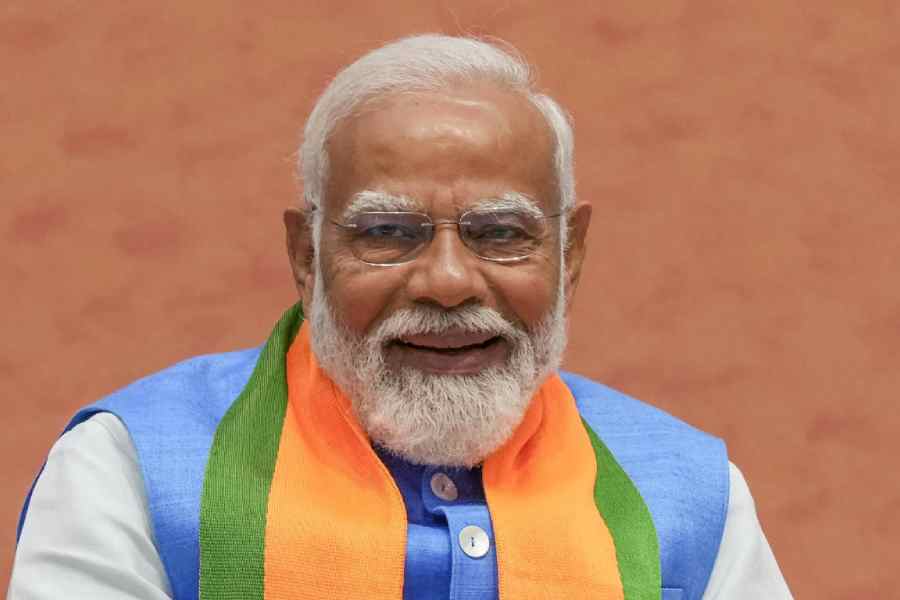
In the 65 years since Independence, no individual has been discussed so much in the public domain as Narendra Modi, the chief minister of Gujarat and the man who many think might be the Bharatiya Janata Party’s prime ministerial candidate for the 2014 general elections — and that too when his name has not been officially proposed for the top post by his party. Whether he actually becomes the prime minister or not is a different issue. He has the distinction of being the most talked about figure in the Indian political scene.

From 1952 to 1977, for obvious dynastic reasons, there was hardly any need to propose the name of a candidate for the prime minister’s post before a parliamentary election. Jawaharlal Nehru and Indira Gandhi were the Indian National Congress’s natural choices. There was hardly any scope to discuss or debate the legitimacy of their candidature on public fora. After Nehru’s death on May 27, 1964, Gulzarilal Nanda was the interim prime minister before Lal Bahadur Shastri got the post. Shastri did not face any election as he died on January 11, 1966, a year before the polls were due.

It was after the election held during the Emergency in March 1977 that Morarji Desai — who, like Modi, hailed from Gujarat — became the prime minister. But that election was held in a totally different atmosphere. The priority then was to get rid of Indira Gandhi’s dictatorial regime. There was no talk of Gujarati pride or asmita when Desai became prime minister. Interestingly, it was in 1946 that the most crucial battle for prime ministership took place. An interim government was to be formed, which was to be headed by the Congress president as the party had won the maximum number of seats. During the election for the post of Congress president that year, 13 of the 16 states proposed the name of Vallabhbhai Patel — a Gujarati, like Mahatma Gandhi — for the post. Three states did not propose any name.

Not enough

But Gandhi’s choice was Nehru. He instructed J.B. Kripalani — a Sindhi who later became the party president on the eve of Independence — to get some members of the Congress Working Committee to propose Nehru’s name for the post of the party president, even though he knew fully well that only Pradesh Congress Committees were authorized to nominate the party chief. Kripalani convinced a few CWC members to propose Nehru’s name for the posts of both party president and interim prime minister. Thus both Patel and Kripalani obeyed Gandhi and let Nehru become the prime minister.

Six and a half decades later, Modi, L.K. Advani — who are Gujarati and Sindhi, respectively — and a young scion bearing the name, Gandhi, may be in the race for the post of prime minister before the 2014 election. In many post-Independence parliamentary elections, the names of prime ministerial candidates have not been announced by parties or alliances in the fray. Apart from Atal Bihari Vajpayee — or, possibly, Advani in 2009 — no politician has been projected as a contender for the post of prime minister after 1991. Nobody imagined that P.V. Narasimha Rao would win the berth in 1992. Neither did H.D. Deve Gowda, I.K. Gujral or Manmohan Singh dream that they would head the government.

A party or alliance does not win simply because it has announced its prime ministerial or even chief ministerial candidate before the election. In 2004, Vajpayee was a very strong candidate for the National Democratic Alliance. But he lost to the United Progressive Alliance, which fought under the leadership of Sonia Gandhi, even though her own party had not declared her as its prime ministerial candidate. After the polls she chose Manmohan Singh for the post. The BJP may officially announce Modi’s name for the post of prime minister. But this alone will not ensure victory for any party or alliance.


" "