|
|
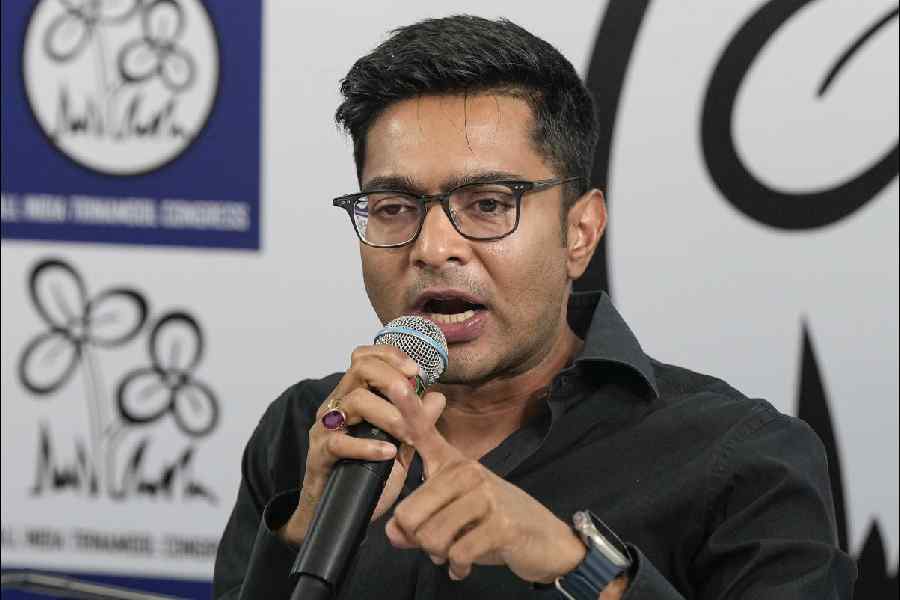
Debtosh Kar in Calcutta. Picture by Sayantan Ghosh
|
Calcutta, Oct. 19: Pandal-hoppers here are being introduced to the Japanese art of kirigami by an artiste from Assam’s Tinsukia district.
Debtosh Kar, who hails from the picturesque town of Margherita, is the man in charge of the Rs 12lakh Dum Dum Park Yubak Brinda pandal. He does a second pandal in neighbouring Kalindi, where he lives now.
“Kirigami is a Japanese paper art like the better-known origami but involves cutting of the paper and use of adhesives. You only see it used as streamers behind Saraswati idols in schools or clubs. I thought of reintroducing it in Bengal through a puja pandal, which is one of the biggest platforms possible to showcase an object of art,” says the theme maker.
The pandal he has built resembles a beehive from the outside. Inside, Kar has devised innovative ways to fashion kirigami to his needs. The result is gorgeous. Near the ceiling are panels depicting popular rhymes and fables. Below, at eye level, are depictions of Lord Krishna’s frolics – makhan chori, Kaliya daman and frolic with gopinis, among others. A central pillar stands for a tree with birds on its branches spreading out to the sky as rays of the sun. An arch of sunflowers leads to the goddess, whose ornaments are also in kirigami. She has vanquished the demon and has only flames on her palms.
In between directing the craftsmen installing the kirigami pieces, Kar introduces himself as an Assam boy. “I may be living in Calcutta today but my heart is in the tea gardens surrounded by hillocks and the banks of Dihing river which flows through our pretty-as-a-picture town,” smiles Kar.
Son of a retired Coal India doctor, Kar had his life turned upside down by Ulfa’s armed movement. “It was around the time that I passed madhyamik when boys I knew started wielding arms. Soon after, one Russian engineer working for Coal India was abducted. My father decided to pack me off to my maternal grandfather’s place in Calcutta. As an 18-year-old I did not know what to do here. I used to paint and had heard of Santiniketan. On enquiry, I learnt of the arts department of Rabindra Bharati University and signed up for a sculpture course. Had I stayed home, I was unlikely to have become an artiste.”
When he graduated, it was the pull of his native land that made him want to submit a piece of sculpture of his own making for installation on the Oil India premises in Digboi. “I had heard they were looking for one.” But he got a threat call from Ulfa that forbade him from participating in the tender process. “They must have mistaken me for an outsider. Later, I heard their misconception was cleared but I was too scared for the safety of my sister’s family that still lives there to want to go ahead.”
His first brush with a pandal was in 2002 when he took charge of the Saraswati puja in the neighbourhood where he had settled. “People queued up to see my 18-foot Saraswati idol made of plaster of Paris,” he smiles.
Emboldened, he started working on the modest Durga puja under the Nabadiganta banner in the neighbourhood. “I introduced the concept of a theme. It is because I do not work professionally here that the puja can still maintain a small budget despite being a big name in the area.”
This time, at Kalindi, he has made a mushroom cloud that follows a nuclear blast. “It is as terrible as it is beautiful,” he says. About 20,000 white plastic balls have been cut in half to give shape to the 35-foot structure. Terracotta birds and insects, painted white, perch on the pandal wall.
In 2008, he undertook his first professional Durga puja assignment — in the well-known south Calcutta puja, Hindusthan Park Sarbojanin. “For the next three years I was too busy to get involved in any puja except my own.”
Taking on puja work means not being able to visit Margherita in the festive season. “We had five or six pujas. Compared to Calcutta, they were modest but the joy of participation there was unparalleled,” reminisces the father of a five-year-old.
|