|
|
Forward Bloc’s symbol
|
New Delhi, Sept. 7: A lack of MPs may not always place a political party in a numerical disadvantage.
Rules have been stretched to grant the All India Forward Bloc a prime plot in the capital to build a new office, thanks largely to the numbers it has clocked in years as “one of the oldest parties” in the country.
Under urban development ministry rules, formulated in 2006, a political party can be given land in one of three designated upscale areas in New Delhi only if it meets two conditions.
One, it must have been declared a national party by the Election Commission, a criterion the Bloc fulfils. Two, it should have at least 11 MPs across both Houses, which the party doesn’t even come close to meeting.
The Bloc has three MPs, two in the Lok Sabha and one in the Rajya Sabha. The last time the party had more than ten MPs was half a century ago, in the 1960s.
“We have allotted the land in exception to the rule taking into account the historical background of the party,” said an official of the urban development ministry, which has given in-principle approval to the Bloc request pending final clearance from the cabinet.
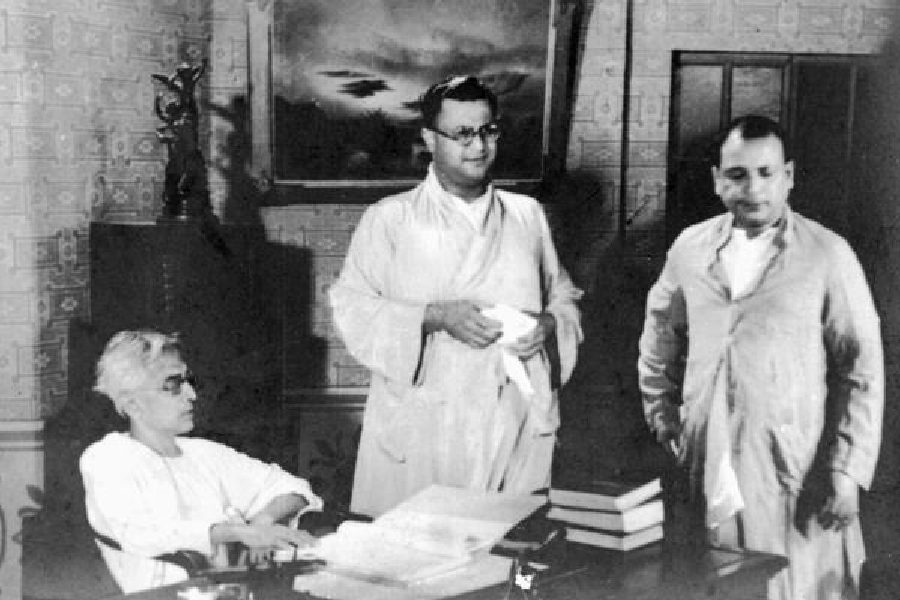
The Bloc’s “historical background” includes the legacy of its creator, Netaji Subhas Chandra Bose, but what weighed heaviest in its favour seems to be its date of birth.
“It is one of the oldest parties in the country,” the ministry official said.
“We are not ‘one’ of the oldest but ‘the’ oldest party in the country,” Bloc general secretary Debabrata Biswas insisted.
“The Forward Bloc was formed in 1939 after Subhas Chandra Bose led a split from the Congress, and since then our identity has remained intact. The Congress has split several times since then. So has the communist party.”
The Congress was formed in 1885 but Biswas’s logic seems to be that its current avatar should be seen as owing its birth to the 1977 split following Indira Gandhi’s lifting of the Emergency and subsequent electoral defeat.
Similarly, the Communist Party of India was established in the 1920s but broke up into the CPM and the current CPI in 1964. The DMK came into being just after Independence.
Biswas had a grouse, though. “More than the party office, we want the government to provide land for the Subhas Chandra Bose Foundation (run by the Bloc). So far, the government has not given a single piece of land to commemorate Bose in India’s capital,” he said.
The application seeking land for the foundation is more than a decade old, while that for the office plot was forwarded about four years ago.
Most parties now have their Delhi headquarters in the Lutyens Bungalow Zone, functioning out of houses allotted to some MP or the other ages ago. The Bloc is no exception, being run from 28 Gurdwara Rakabganj Road, allotted almost 25 years ago to a former MP whose name no one in the party now remembers.
It was to drive the parties out of Lutyens Delhi that the government had, following a Supreme Court order, formulated the 2006 policy of granting plots outside the zone.
If a party had 11 MPs, it was to be allotted a minimum 500sqm. The Congress, with over 200 MPs, has been given 15,000sqm. The Bloc’s plot has not been identified yet but the size will be 500sqm.
Even if a party later loses seats and its strength falls below 11, the land is not taken away. “There has been no known case of a plot being retrieved by the ministry,” a senior official said.
Although many parties have been allotted new plots and are using them, none has shifted its headquarters from Lutyens Zone. The Congress still operates out of 24 Akbar Road and the BJP out of 10 Ashoka Road.
|