|
|
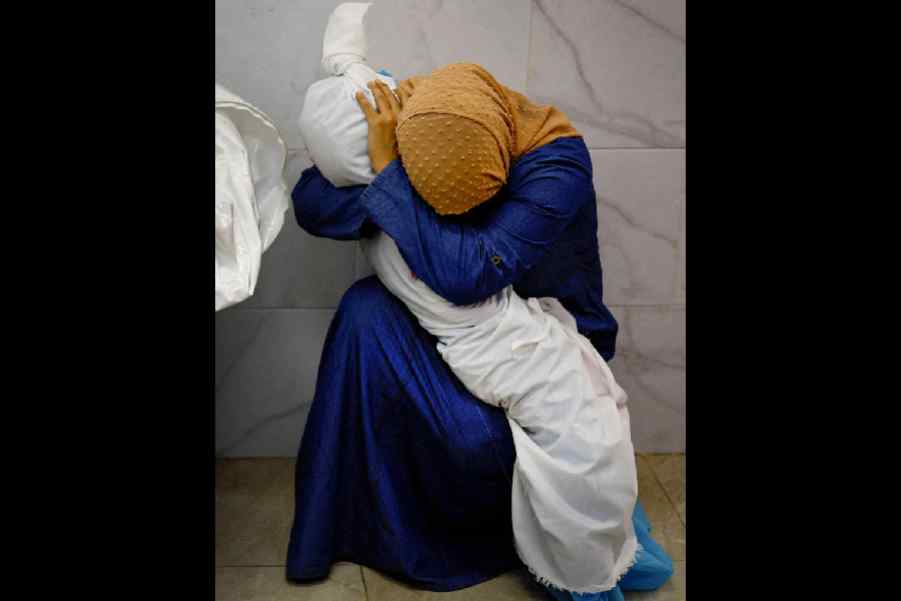
Neighbours and kin take Bole Oraon’s body to his native village in Ranchi for his last rites on Tuesday. (Hardeep Singh)
|
The body of Bole Oraon, who was crushed under a water cannon during the JVM rally stampede in Ranchi on Monday, was brought to his Dibdih residence in a closed white coffin around 1pm on Tuesday, just 16 days after he had welcomed his newborn granddaughter home.
JVM chief Babulal Marandi, accompanied by his party workers and Ranchi Municipal Corporation deputy mayor Ajay Nath Shahdeo was present with the Oraon family and their neighbours at the deceased’s home — just 100m from JVM state office — when the body reached after post-mortem at RIMS.
“It is unfortunate that the innocent man was killed. Our party is always with this family,” Marandi said as Shahdeo supported him.
Marandi offered the family as Rs 50,000 as aid to the family and assured of “proper help in the future”.
But the present was a sad one for the family of the innocent bystander who became an unwitting fodder of a political rally near Satellite Colony aimed to generate mass mobilisation for the JVM’s “battle against displacement and for the rights of the displaced”. The Grade IV road construction department employee (not PWD as reported earlier) was returning home from work when he was trapped in the mob mayhem. He was hit by the water cannon deployed by the administration to control the crowd led by Marandi that was hell-bent on breaking barricades to get its way.
Oraon is survived by his wife Kanti Devi, two daughters Rani and Ragini, son Rajesh, daughter-in-law Sunita Devi and grandchildren. He was also a popular man in the neighbourhood. His five-roomed single-storey home, swarming with shocked and grieving neighbours and friends bore testimony to his character.
Watching Kanti Devi, Ragini and Sunita Devi crying inconsolably, Oraon’s two-year-old grandson Saurya Raj asked in amazement: “Why is grandma crying and why are so many people here?”
He was yet to realise that grandpa was in the coffin. Father Rajesh, busy making arrangements for the funeral, kept quiet.
Oroan’s colleague Anandmani Kacchap recalled: “I knew Oraon since he joined service at a labourer on June 5, 1977 when the office of road construction department was at Ashok Nagar and T.T. Ghosh used to be the chief engineer of the department. Oraon was a hardworking man. At present he was an orderly. I used to help him file returns and in any written departmental work.”
After around half an hour, Oraon’s coffin was sent to his ancestral residence at Udaypur in Latehar, a village about 100km from the capital. He was born there in 1956.
Shahdeo provided vehicles to take the body safely. Over 25 people accompanied the body.
“Burial will take place late in the evening in the land of Oraon’s birth,” said Bhikhu Oraon, eyes moist.
|