|
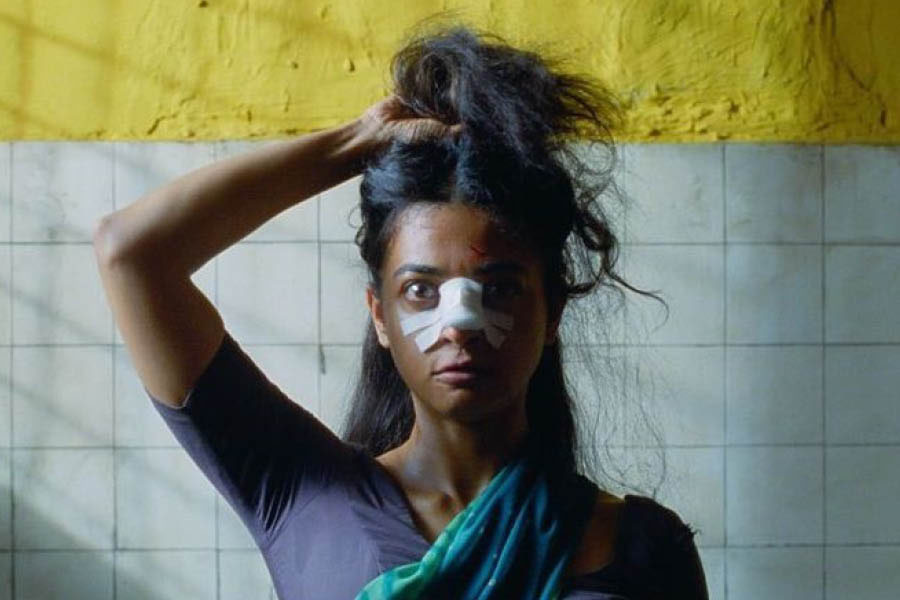
| Actress Prastuti Parashar along with other artistes in a scene from Hengool Theatre’s play, Ostro. Picture by UB Photos |
Assam’s mobile theatre has started shows from August. Every group will travel to different parts of the state to enthral the audience with their plays and techniques till April. Some snapshots from the mobile theatre industry:
Songs of Bhupen Hazarika
As a tribute to Bhupen Hazarika,
Abahan Theatre has incorporated three of his songs in its hit play, Tej.
While staging shows at its home ground, Pathsala, producer Krishna Roy said, “The crowd loved the concept of the play and Bhupenda’s songs. They suited the script perfectly. The reaction was overwhelming.”
The three songs are Manuhe manuhor babe, Bistrino parore and Prosondo dhumuhai prosno korile.
Written by playwright Abhijit Bhattacharjya, Tej is a family drama. “A positive element added to the daily grind of life revives the play and gives it an extra charm,” Roy said.
Advancing from Pathsala, the mobile theatre group has shortlisted 76 venues across the state.
Apart from Tej, Abahan has two other plays, Griha Judha and Prasanta Phukanor Prem Potro.
Trauma of molestation
This might remind you of the GS Road incident. Rajtilok Theatre has come up with a story of the trauma that a girl faces after being molested in its play, Ranahunkar.
Producer of the theatre group,
Dulumoni Das, however, denies any connection of the play with the GS Road molestation.
“It is a mere coincidence. The play was drafted early this year, way before the incident occurred. The story talks about the situations a girl has to go through as she fights against molestation and the police force.”
Besides this suspense thriller, Rajtilok has two other plays, Majonir Monor Manuh and Xoponor Xekh Nai.
All the three plays will be showcased in 79 venues across the state.
Prastuti with Hengool
Hengool Theatre is known for using the most advanced techniques on stage. And indeed, it has lived up to its reputation this season by presenting a suspense thriller, Baro Maah Baro Din (Twelve months and twelve days), with superb methods.
The producer of the group, Sankalpajit Hazarika, called the play “an experiment” with new technical aspect.
We have made an attempt to add a different touch to this particular play because of the suspense. The light and the songs in this play have a new flavour,” Hazarika said.
Written by Chitaranjan Parashar, the story, featuring actress Prastuti Parashar in a lead role, is based on what a sister goes through after she finds out the reason behind her brother’s death.
“Not only the unique storyline, but people have also acknowledged the changes that we have brought in our techniques,” Hazarika said.
Besides this play, the mobile theatre group is showing two other plays, Munin Borua’s political play, Ostro and Abhjijeet Bhattacharjya’s Bijaya Daxami.
The three plays have 10 songs. Zubeen
Garg and Jubilee, among others, have lent their voices.
The mobile theatre group has shortlisted around 80 venues across the state
VOICES
Actor Jatin Bora will bid adieu to mobile theatre this year.
“I will be ending my association with mobile theatre. But I will not let my audience to miss me. I want to concentrate more on films as the industry has witnessed a lean phase over the years,” Bora said.
This year, Bora will enthral the audience in three plays under Bhagyadevi Theatre, Jonak, Morom Ejak Dhumuha and Dusoku.
“My characters in the three plays are quite challenging. I play a double role in Jonak, which is quite a difficult task in a theatre. It is very exciting that Dusoku has broken the seven-year record on the opening day at Morowa in Nalbari,” Bora added.
A versatile actor, Bora began his tryst with acting in 1989 with Uttarkaal. He entered the mobile theatre scene in 1994 through Hengool.
“When I get a character I look for the demand of the character in the scripts. There should be something new in the content. I always try to do justice to a character,” he said.
Playwright Abhijit Bhattacharjya contributes around 20 plays every year to the vibrant mobile theatre industry in Assam.
Being closely associated with the industry, he understands taste of the audience and has his own notion on mobile theatres. He shares his ideas with Manashree Goswami:
A perceptible change occurred in his life after he penned his first play in the nineties, based on a short story, Samiran Barua Ahi Ase (by Manoj Goswami), for Abahon Theatre. It happened when, one day, he suggested that the producer of the Abahon theatre, Krishna Roy, stage a play based on Samiran Barua Ahi Ase. He suggested names of other eminent playwrights to adapt the story in a play. But Roy’s reply was “Tumi likha (you write)”.
“Those words changed my life unexpectedly and I entered into a world of creative pursuits,” Bhattacharjya said.
Roy’s offer and faith worked wonders on Bhattacharjya and there was no looking back. He started writing plays for Abahon.
“Though I earned brownie points for my work, I feel writing for mobile theatres is a different ball game. You need to keep a plethora of aspects in mind. Initially, I started writing one play every year for Abahon. And, it took me six years to be well versed in the nitty-gritties of mobile theatre.”
Era bator xur, Tej, Majonir monor manuh and Hiyat epahi golap are some of the plays he has written this year.
Bhattacharjya said of late there was a big chasm with few playwrights to meet the growing demand of the industry.
GenX needs to take up writing for mobile theatre. A playwright can earn a decent livelihood these days.
“Standards are high. Earlier, it catered to the rural audience as an effective medium of communication and entertainment. Today, it has an urban audience, thereby doing good business in the city,” he said.
Bhattacharjya said mobile theatre had
become more commercial as a group targeted
a turnover of Rs 2 crore to Rs 3 crore
annually. “But presentations should be appealing to the common man as well as new generations. A touch of modernity is required to keep the industry alive.”
Bhattacharjya said he mostly highlighted human sentiment and emotion in his plays so that the audience could relate to them. “Sometime unconventional topics can add a dash of variety. One of my plays, Bhul nubujiba Bupenda, was based on one of Bhupenda Hazarika’s fans. It was well received. The audience has become conscious and educated.
You cannot hoodwink them with cheap things.”
Bhattacharjya said using technology had an advantage in mobile theatres but it should be limited. “The outcome would not be effective if technology is given much importance.”
|