|
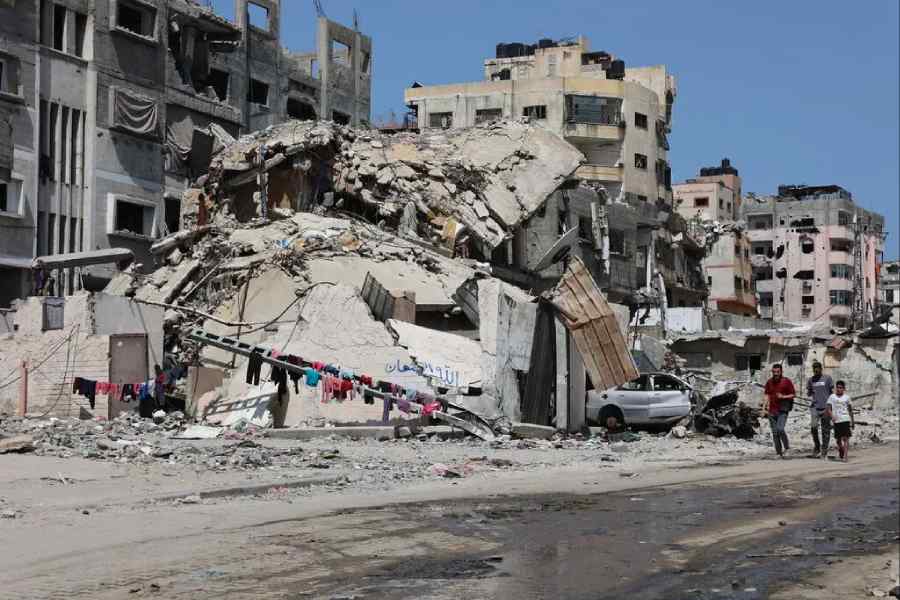
| Shelters of flood-affected people on the embankment at Solmari in Sonitpur district and (right) Sahidur Rahman stands at the place where his home stood two months ago. Pictures by UB Photos and Rajiv Konwar |
Solmari (Sonitpur), Sept. 2: It was a matter of just a few minutes for Sahidur Rahman to get a new address — embankment of the Brahmaputra in Sonitpur’s Solmari area.
For the past two months, records have shown the name of his village as Solmari embankment.
Till June 27, Sahidur had a home at Solmari 1 village — small, but own. But the river washed it away in minutes. Thanks to his alertness and the alarm raised by the guards on the embankment, however, he and his family are safe.
Since the onset of monsoon fear was looming large among the villagers of Solmari area, 90km from Tezpur, that the feeble embankment along which they lived might fail to resist the surging floodwater of the Brahmaputra for long.
Before the breach, they had seen roaring tides incessantly buffeting the embankment, which bends at that point, as if seeking to break free.
At 2am on June 27, the river finally broke through, catching the sleeping villagers unawares.
Within minutes, nearly 1km of the embankment went under water. “Next morning people who were carried away by the water were recovered from bamboo groves and tree tops, while a few were even found holding on to betel nut trees for hours with the water rushing past below. Those who died in the flood were mostly ones who could not swim,” Sahidur said.
“My house was here. There were a few more houses near mine,” he said, being able to return to the place where his house once stood, with much of the water gone now.
The breach in the embankment has since become 2km wide, with the river swallowing it bit by bit, bringing uncertainty to the lives of more people.
A stream of the Brahmaputra now flows through the area where Sahidur’s village was. Sand has buried the nearby Borkola Beel.
He is one of the 2lakh flood-affected people in the state, which has been ravaged by three consecutive waves of flood this year, taking more than 120 lives.
Like most other fathers in the 500 families on the embankment, 38-year-old Sahidur, too, has a large family — two wives and seven children — to feed, and no work in hand.
Their 10-by-5feet reed-walled abodes now stretch over 2km on the embankment where children playing with gay abandon, elders idling or fishing in the river with nets and hooks, fish drying on salonis (bamboo sieves), people collecting firewood floating down the river are common scenes.
It’s a new life.
“When the water subsided people dug out the tin sheets found partially buried under the sand and brought them to the embankment to erect their temporary houses,” said Nazir Ahmed, another affected person.
“Local MLA Prabin Deka visited us only once. But when people asked him whether he would bring anything for them, he just fled, not to appear again. Is it because we are miyas? The people’s suffering would have been much more had former MLA Nurjamal Sarkar not sent mechanised boats and some sira (flattened rice) to eat,” said an indignant Sur Mohammad, another affected person.
The only visible presence of an agency working for the people here was Oxfam, an NGO, which gave each family a kit constituting a 14-litre bucket, a tarpaulin, a 1-litre mug, three bars each of bathing and washing soap, sanitary napkins, 60 chlorine tablets and two combs. “But as our resources were limited we could provide only one latrine for 20 families,” said an official of the organisation.
The NGO’s thrust was to prevent the outbreak of any waterborne diseases.
Besides the 3,000 families in Sonitpur district, including the 500 in Solmari, the NGO also brought relief to 3,500 flood-hit families in Morigaon and another 1,500 in Nagaon district.
“Though the government has initiated a response, there are still critical humanitarian needs which require addressing. There are vital water sanitation needs in the affected areas,” said Zubin Zaman, India humanitarian program manager of the organisation.
For a few weeks relief material came in, may be from the Rs 500 crore announced by Prime Minister Manmohan Singh after his aerial survey of flood-affected areas.
Singh promised to take measures to rebuild damaged infrastructure and wipe away the people’s misery.
The Sahidur Rahmans, the Nazir Ahmeds and the Sur Mohammads would like nothing better.
|