TT Epaper
The Telegraph
TT Photogallery
 
IN TODAY'S PAPER
WEEKLY FEATURES
CITIES AND REGIONS
ARCHIVES
Since 1st March, 1999
 
THE TELEGRAPH
 
 
CIMA Gallary
Overthere
Research rules
shiv nadar university

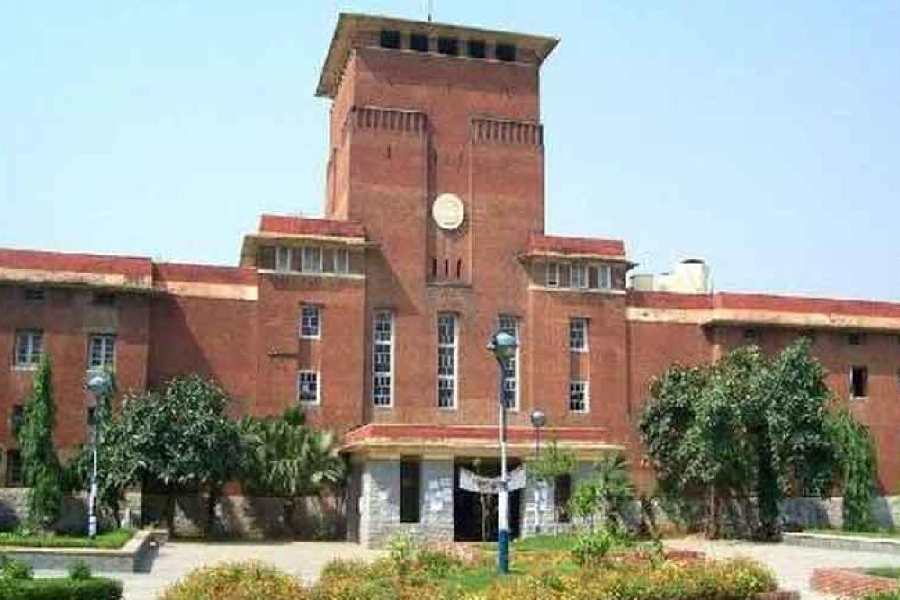
The opening of a new institute — or even a new university — is no longer news. But the recently established Shiv Nadar University (SNU) has triggered an interest in academic and student circles.

Set up under the aegis of the Shiv Nadar Foundation, SNU reinforces the vision of “transformational education” professed by the founder of IT giant HCL and the Shiv Nadar Foundation, Shiv Nadar. The foundation seeks to introduce educational initiatives capable of providing quality education, on a par with international standards — which is possibly why it has incorporated traits from the Western academic structure. The university, for instance, has a credits system in place and takes an interdisciplinary approach towards higher learning.

SNU, established under U.P. Act No. 12 in 2011, is a University Grants Commission approved private university. Situated in Greater Noida, on the outskirts of Delhi, the university is spread over an area of 286 acres and boasts of superb infrastructure.

In its founding year, the School of Engineering was started. The school has 300 seats across five streams of engineering — computer science, electronics and communication, electrical, mechanical and civil. There are 60 seats in every stream. A total of 274 students were enrolled in the school last year. In the coming academic session that is set to commence from August, two new schools — School of Natural Sciences and School of Humanities and Social Sciences — will start functioning with bachelors, masters and doctoral programmes. The School of Natural Sciences focuses on pure science subjects such as physics, chemistry and mathematics. The School of Humanities and Social Sciences is rolling out programmes in economics and English in its debut year. The application deadline was June 15.

The procedure to get admitted to the university is rigorous and requires high merit. A student is assessed on several parameters such as marks obtained in subjects, a statement of purpose to judge the applicant’s motivation to pursue the course, the candidate’s leadership skills and participation in extra-curricular activities and so on. The eligibility criteria — ranging from a minimum of 80 per cent to as high as 90 per cent for CBSE students — underlines the standards it seeks to promote.

Every undergraduate programme is of four years’ duration. The fees are on the higher side. For the undergraduate courses, the total fee payable in four years for engineering students is Rs 11.75 lakh (Rs 3.3 lakh to be paid in the first year). For the School of Humanities and Social Sciences and the School of Natural Sciences, it is Rs 8.35 lakh (Rs 2.45 lakh to be paid in the first year). The university, however, provides scholarships. There are several merit and need-based scholarships, provision for sports and arts scholarships as well as fellowship opportunities for those pursuing a masters or a PhD.

The founding batch of the university seems content with their choice. Geethika, an engineering student, says she opted for SNU primarily because of the interdisciplinary academic structure. “I am quite happy with the teaching methodology here,” she says.

The university has excellent sports and cultural facilities. Earlier this year it held its first annual festival —Breeze 2012 — with competitions in music, dance and other events, as well as a performance by the band Parikrama.

The university aims to establish itself as a leading research institution of higher learning. “We are a research-led institute, and that is why our focus is on research right from the undergraduate level,” says Dr M. Gopal, a former professor at IIT Delhi and the director of SNU’s School of Engineering.

The focus on the interdisciplinary structure, he says, has been nurtured by SNU vice-chancellor Nikhil Sinha. “He firmly believes that students are better able to recognise their goals after spending one year in college rather than straight out of school,” he says.

Under the interdisciplinary course, every student follows a core curriculum which comprises subjects that are a part of his or her academic programme. However, at a later stage the student is given an option to choose subjects that belong to other streams. After the course is done, a student can get a degree with a major in her or his prime subject and a minor specialisation.

It’s still to be seen how students fare once they graduate. Placements are still a grey area, though Dr Gopal states that HCL would be just one of the many companies that would “mark their presence”. Only time will tell how successful the university will be in its mission. Next year, three more schools are set to open.

Vital Statistics

WHAT IS IT? A UGC recognised, research-oriented private university

WHO’S THE BOSS? Nikhil Sinha is the vice-chancellor

Where is it? Dadri, Gautam Budh Nagar, Uttar Pradesh-203207 Phone: 0120-4617541/42/43 Website: www.snu.edu.in

Pros
Highly qualified faculty, good infrastructure and interdisciplinary approach

CONS
The location is remote, most of the schools are still to open

AYAN JOSHI