New Delhi, June 25: Nitish Kumar, Narendra Modi, Sharad Yadav and Sushil Modi honed their political skills in the movement launched by Jaya Prakash Narayan in the early seventies that culminated in the Emergency. Thirty-seven years and long stints in power later, these children of the Emergency have pulled in different directions: for reasons political and personal.
The contrarian compulsions of power were at play in a function organised by an RSS outfit, the Deendayal Research Institute, to commemorate the 37th anniversary of Emergency — in the early hours of June 26, 1975, then President Fakhruddin Ali Ahmed signed the decree that ushered in one of Independent India’s darkest phases though the crackdown on the JP movement leaders had begun a day earlier.
Sharad Yadav, the Janata Dal (United) chief, was to be the chief guest today in what was billed as a mixed gathering of swayamsevaks and socialists who had banded together to uproot Indira Gandhi.
But a stony-faced organiser announced from the dais, “Current political circumstances are such that Yadavji cannot be present with us on this occasion.”
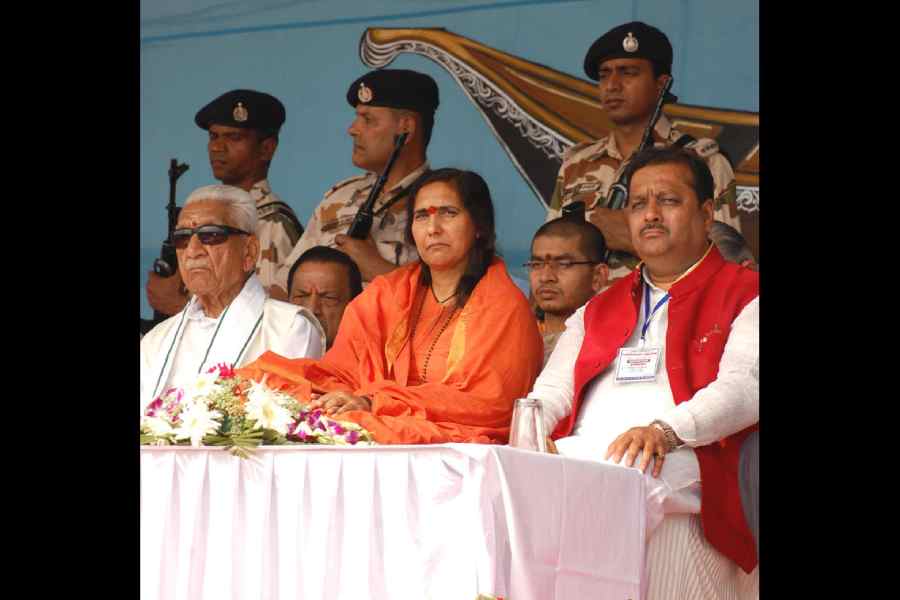
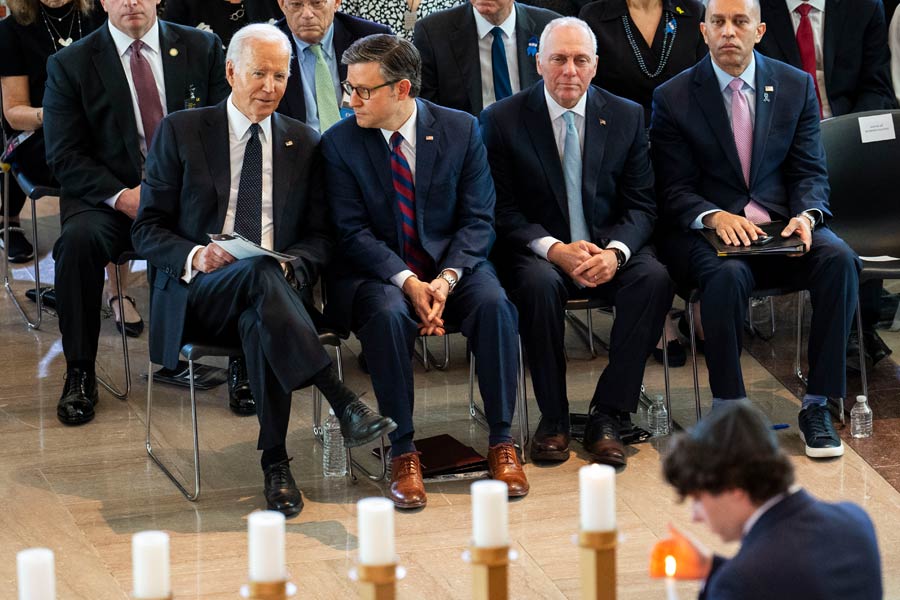
Sushil Kumar Modi, the Bihar deputy chief minister who was seated with two of his Emergency era comrades, journalist Ram Bahadur Rai and Rajkumar Bhatia, turned his face away from the audience that consisted solely of RSS members and sympathisers as these words were spoken.
Sources said Sharad Yadav apparently couldn’t make up his mind until this noon. His staff kept assuring the organisers he would come.
Even Modi wasn’t sure if he could keep his date. Luckily for the event managers, Nitish’s “darbar” with BJP and JD(U) workers, held on the last Monday of every month, was deferred and Sushil Modi took the afternoon flight to Delhi.
Sources stressed that Sushil Modi made it a point to inform the Bihar chief minister that he would attend the function. Sources said they were “given to understand” that Nitish told his deputy he wouldn’t have a “problem” with that.
So what do these bumps portend for the road ahead of the BJP-JD(U) alliance? “Not too good,” a BJP source said.
Rajya Sabha MP and Gujarat in-charge Balbir Punj’s praise of Narendra Modi at Vadodara on Sunday, calling him Prime Minister-worthy, ostensibly nettled the JD(U) after the truce both sides called on Saturday and agreed not to issue statements of recrimination.
Through the press, Sharad Yadav conveyed to the BJP that as the “nucleus” of the NDA “parivar”, it was incumbent on it to keep the coalition together and ensure that partners did not “stray”. There was no official response to the counsel but a BJP source argued, “What was Punj expected to say in Gujarat? That (Narendra) Modi is unfit to become a PM and undermine him before the Assembly elections?”
The JD(U)’s “preoccupation” with the secular-communal polemics was something the BJP cannot “fathom”, sources said.
Sushil Modi, in his speech, did not directly allude to the developments but dropped hints that suggested that in the crunch moments in recent history, the divide never came into play.
“Deendayal Upadhayaya (the Jan Sangh icon) and Ram Manohar Lohia (founder of the Congress Socialist Party) came together and gave India nine non-Congress governments for the first time after Independence,” Modi said, referring to the non- Congress governments that were formed in states like Madhya Pradesh, Rajasthan, Uttar Pradesh and Bihar in the sixties. “Together they shattered the myth that no party, barring the Congress, could rule the country anywhere. After the Emergency, the Congress was comprehensively routed and India got its first non-Congress government at the Centre through a peaceful ballot.”
Sushil Modi also emphasised that the Congress alone was responsible for “all the ills plaguing” the country then and now. “We have to fight unitedly against this scourge,” he added.
The crowd of 50-plus, who had seen and gone through the Emergency in various ways, looked unimpressed.
“What unity? Let Sushil Modi ask his chief minister if he will unite,” a swayamsevak remarked, adding that whenever the Congress was toppled at the Centre, the communal-secular divide was never an issue: after the Emergency or in 1989 when VP Singh happily used the Left and the BJP to install himself as the Prime Minister.
|