|
June 9: The Justice Shyamal Sen committee has recommended that five out of 398 mouzas demanded by the Gorkha Janmutki Morcha be brought within the ambit of a proposed authority that will run the Darjeeling hills and some fringe areas of the plains.
The Morcha has described the recommendation as “humiliating” and warned of the possibility of “a drastic change” in the situation, fuelling fears of a fresh agitation after over a year of normality in the hills although the plains have been restive.
Chief minister Mamata Banerjee has appealed for calm (excerpts below), laying stress on the independent nature of the 10-member committee and reminding all stakeholders of a promise to accept such a panel’s suggestions.
The Morcha, which was expecting the inclusion of at least 150 mouzas (cluster of villages) and is now facing intense pressure to address disappointment on the ground, has called an emergency meeting tomorrow to take the final decision on its course of action. A decision is also expected on whether the Morcha would take part in the GTA elections scheduled next month.
On the Morcha’s public pronouncement will hinge the fate of the year-long peace. Darjeeling was quiet today and no celebrations were staged in the plains where the Adivasis have been opposing the inclusion of any of their villages in the proposed GTA.
|
|
Morcha general secretary Roshan Giri. Picture by Suman Tamang
|
The Darjeeling district administration posted armed police in riot gear at Chowk Bazar, the political hub of the hill town. Jalpaiguri police also stationed armed personnel in the Dooars. Both districts remained free of any untoward incident.
“The tourists will be affected only if the Morcha calls for a shutdown or a strike tomorrow,” a Darjeeling official said.
The five Gorkha-dominated mouzas the Sen committee has recommended for inclusion are Samsing and Chalauni in Jalpaiguri district and MM Terai, Purba Karaibari and Gulmakhari in Darjeeling district. (See map)
The recommendation was made public at Writers’ Buildings by chief secretary Samar Ghosh who underscored that he was merely announcing what the committee had recommended.
Later, the chief minister made more or less clear that the state government would stick to its word and accept the “genuine report”, although she added that “I am yet to go through the report in its entirety”.
Chief secretary Ghosh listed the four key parameters used by the committee to arrive at its conclusion — contiguity, homogeneity, compactness and ground realities (see chart on left). Contiguity was an intractable problem the committee grappled with as many mouzas were scattered from one another as the map illustrates.
Ghosh said of the 199 mouzas demanded from Jalpaiguri district, two had been recommended for inclusion. From Darjeeling district, three had been recommended from the 199 sought by the Morcha.
Within an hour of Ghosh’s announcement, Morcha general secretary Roshan Giri told a news conference in Darjeeling: “The report is a humiliation for us and we will not accept it. Till now, there is peace in the hills but the situation could drastically change soon. The time has also come to rethink the formation of the GTA.”
The committee has drawn criticism in the hills on two counts.
The principal criticism is that the panel did not go for “field visits” to the Dooars and the Terai, the two regions where the 398 mouzas are located. Instead, the committee relied on reports from the district magistrates of Jalpaiguri and Darjeeling, both members of the committee.
The 10-member committee comprised of four representatives each from the state government and the Morcha, one from the Centre and Justice Sen who chaired it.
Another factor that has upset the hills is the reliance of the committee on the 2001 census to establish the demographic pattern of the areas demanded by the Morcha. Sources said the related 2011 census data were still being enumerated.
Besides, L.P. Pariyar, one of the four Morcha representatives in the committee, complained that the “all-important” census report on the linguistic pattern in the Dooars was not shown to the rest of the committee members.
A state government official said the Union home ministry had specified that only Justice Sen should have access to what the administration felt was “sensitive” data.
The Congress and the CPM have complained that none of their representatives from the plains was included in the committee that had four Morcha nominees. The committee had met delegations from political parties.
Chief secretary Ghosh said “each member participated in the discussions and offered their inputs, but the decision-making power lay solely with the chairman, Justice Sen, as agreed upon by all”.
Ghosh stressed that the Morcha had signed a bipartite agreement with the state government on March 24 this year, which makes it binding on both parties to abide by the committee’s recommendations in letter and spirit, irrespective of what they are.
But Morcha’s Giri said: “We had agreed in the hope that the recommendations would be fair. We cannot accept such a humiliating recommendation. We are being forced to wonder whether the committee was merely an eyewash.”
four factors
The 10-member
high-powered committee headed by Justice Shyamal Sen based
its recommendations
on the mouzas on the following parameters
Contiguity
Whether the mouzas
are in direct physical contact with the existing Darjeeling Gorkha Hill Council (DGHC) area
Homogeneity
Whether at least 50%
of the population in
the mouzas share a common language
and lifestyle
Compactness
Whether the mouzas require to be split to be included in the GTA, the Gorkhaland Territorial Administration that will replace the DGHC. If a mouza requires to be
split to be included
in the GTA, it would
not be considered for inclusion
Ground reality Miscellaneous factors
like administrative
reasons (mouzas
housing gram panchayat headquarters cannot
be included),
accessibility and connectivity (whether
a mouza can be easily accessed from the
existing DGHC area), source of staple
supplies (whether the essential supplies for
a mouza come from the existing DGHC areas).
If the DGHC areas are
not a source of sustenance for a
mouza, it would not be considered for inclusion.
CM’S APPEAL
The following are excerpts from chief minister Mamata Banerjee’s appeal to
all stakeholders in the
hills and the plains of
north Bengal
 |
|
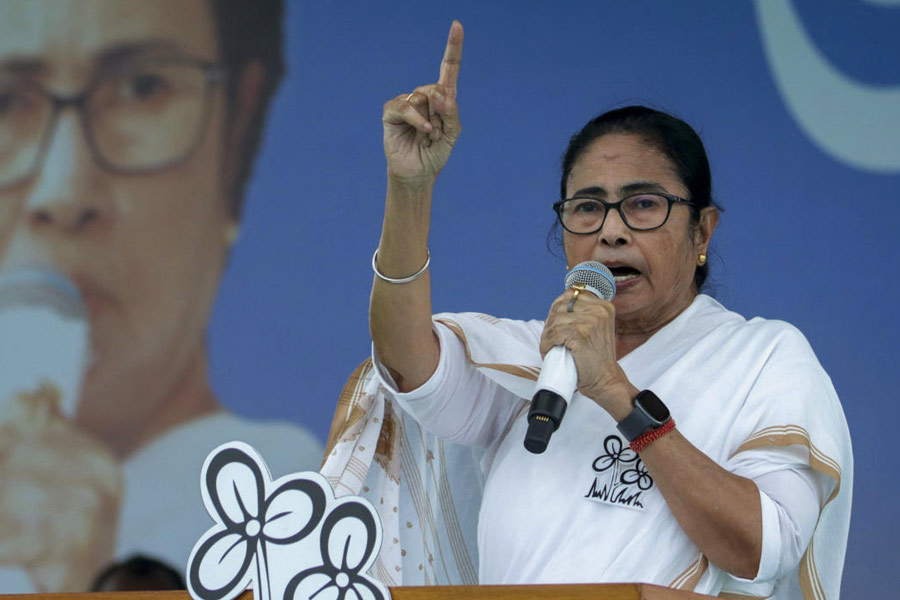
Mamata Banerjee at
Writers’ before she made the
appeal Saturday.
Picture by Pradip Sanyal
|
There was an open
agreement that the
high-powered committee’s
recommendation would
be accepted by all. The
committee was an
important one and was
impartial and autonomous. The state, the Centre and the Morcha gave their opinion but the decision was left entirely with the chairman. We didn’t take the decisions. Everyone was involved in the process, their opinion
was taken. I will appeal
to everybody to go by the agreement. A burning problem has been solved.
With the tabling of this
report, we have achieved
a great deal. This will help us in moving forward. Even Bimal Gurung and other Morcha leaders wanted the report to come before the elections (to the GTA).
I wasn’t expecting the
report to come so early.
(In response to a
question if she was
happy with the report) The question of my
being happy or
unhappy does not
arise. We had agreed
on the high-powered
committee and formed
it jointly. The report
may go for or against someone. But this is a genuine report. I am
yet to go through the
report entirely. I will be happiest the day when peaceful atmosphere would bring
development to the
region. I will be happy when tourists flock to Darjeeling, Kalimpong, Mirik, Sandakphu, Dooars and Terai.
We haven’t received
any report that the
Morcha is unhappy
with the report.
There should be no
differences. When the elections are held, they should participate in it. Once the elections are completed, funds will start flowing in and
bring development.
I don't want any
disturbance in the hills. Those who are trying
to play politics on this issue should stop it.
Everybody loves
Darjeeling, Dooars,
Terai. The business
community could not
pay taxes when the movement was on.
We have waived it. Once Darjeeling is free from trouble, business and
development will reach the hills. We have
started repair of roads. We are going to develop Mirik and Sandakphu. There are other projects in the pipeline, including
power project. |