|
Beth A. Payne’s love for photography dates back to her years in school. The outgoing American consul-general of Calcutta was her school’s yearbook photographer, and loved nothing more than capturing people’s profiles with her treasured gift, a Minolta SLR. Her passion for photography grew, and she spent considerable time at university shooting the various localities in and around Washington DC, experimenting with the medium, learning about the nitty-gritty of technique, composition and light.
Then, inevitably, the camera was put by. Later, her work took her to war-torn Iraq. As she struggled to cope with the trauma, she discovered the therapeutic qualities of photography. She took to wandering the streets, capturing the myriad vignettes of life and people in cities. She brought her love for walking and for photography to Calcutta, where she took up her posting three years ago. The camera — now a Canon digital SLR — served as a useful tool as Payne explored the city— its alleys, boulevards and avenues — as well as the countryside to develop a familiarity with Bengal’s culture and aesthetics.
|
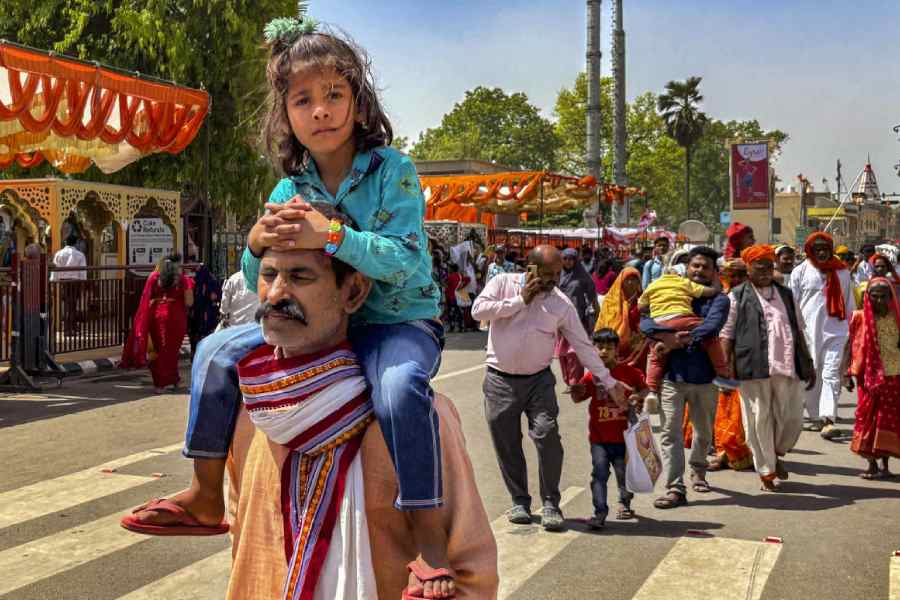
The exhibition, Face of Bengal, (The Harrington Street Arts Centre, June 10-24) brought together the fruits of Payne’s labour. Everything in Bengal and Calcutta that appeals to visitors from outside has found a place in this collection of photographs — idols of the goddess, ageing rickshawpullers, the bridge over the Hooghly and the grey, sullen river with its ghats littered with flowers after immersion, smiling roadside vendors, football players on the Maidan, and so on.
Cynical residents may secretly agree that Calcutta’s gloom is best symbolized by its greyness. But Payne, free from the burden of history and cynicism, would like to believe that the city is a riot of colours. The photograph of the smiling, podgy man, sitting in front of a row of colourful fabric in Chitpur, captures Payne’s fascination with Calcutta’s vibrant hues adequately.
It is imperative for a diplomat to forge close bonds with a people. Therefore, it does not come as a surprise that a majority of Payne’s subjects smile as they pose, whether they are children with balloons during Durga Puja, or a woman in all her finery on the balcony of a house in North Calcutta. But again, one woman, sipping tea at a dhaba gazes into the distance, and there is a rare photograph of a garlic-seller, frowning. Another photograph that breaks this monotony of clichéd smiles and poses is that of a washerman working at a furious pace in the city’s oldest dhobi ghat. The sensitive lens catches the pattern of water droplets flying up around his head. It is a candid moment: engaging because not posed.
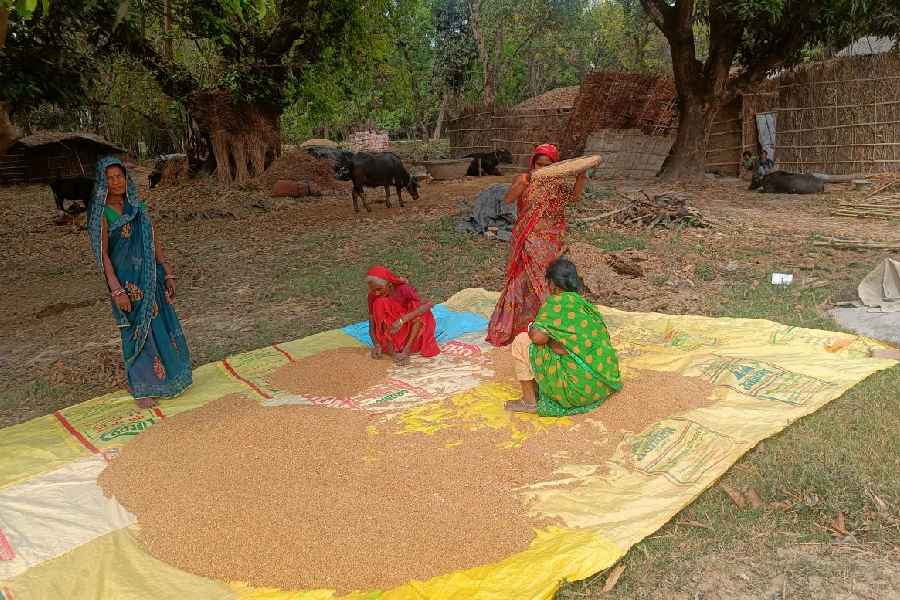
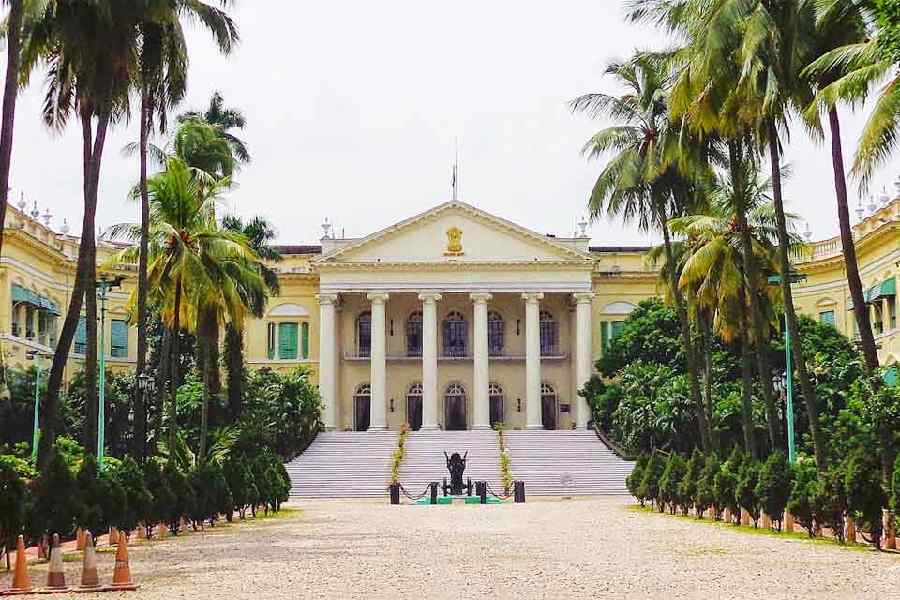
Payne is also enchanted by the beauty and the artistic traditions of rural Bengal. In one photograph, we can see a child peeking through scrolls of mint-fresh pat paintings. A woman in a bright red sari smiles (again) in front of a swaying green rice field. The symbolism of red and green, given Bengal’s current political situation, has not been lost on the photographer. But my favourite photograph is that of the weaver couple in Phulia (picture, top). A half-smile lights up the woman’s face, and the man, who is a little out of focus, seems to share his wife’s contentment. The man and his wife exude warmth and a quiet dignity, and the two, together, seem to convey the message that they have managed to survive the vagaries that inform the harsh life in Bengal’s villages. Payne displays an occasional artistic touch. This is evident in a photograph of an adivasi girl, her face turned away from the camera, who stands against a date-palm tree (picture, bottom). The prickly, uneven bark serves as a metaphor for the difficulties that await her. A surprising omission in these photographs is the legacy of Calcutta’s architecture. Perhaps Payne ought to have devoted more time to these grand, but crumbling, buildings that need to be preserved urgently.
Although pretty, the images cannot be considered to be representative of the diverse, and complex, iconography of Bengal. Vast areas of riverine South Bengal have gone unrepresented. The north has a dim presence too: school girls smiling in a tea plantation in Darjeeling. But it is possible that Payne will include what she has left out if she were to return to shoot another set of pretty pictures of this land that she loves so much.
|