|
|
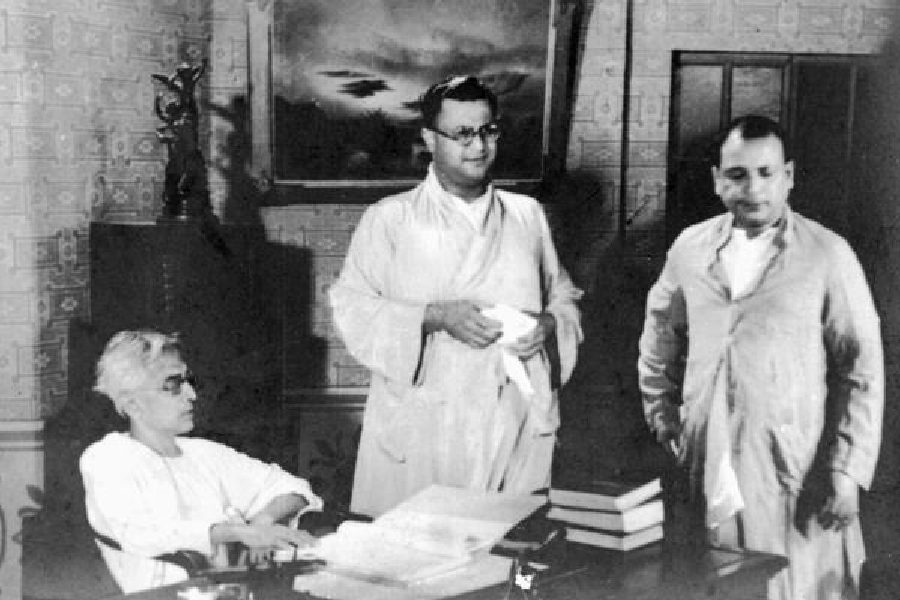
| Grossman; Rao |
Washington, May 8: When the dust has settled on Osama bin Ladens killing, one crucial question will beg an answer: did Marc Grossman, President Barack Obamas special representative for Afghanistan and Pakistan, give top Indian officials any inkling about the momentous events in Abbottabad on the night of May 1?
Grossman, a former US under-secretary of state for political affairs, under whom the Next Steps in Strategic Partnership (NSSP), the precursor of the Indo-US nuclear deal, actually began, spent an hour with foreign secretary Nirupama Rao in her office barely 48 hours before Osama was killed.
Grossman, on his first visit to New Delhi as successor to the late Richard Holbrooke, also met his Indian counterpart, S.K. Lambah, and national security adviser Shiv Shankar Menon.
It is naive to expect that Grossman would have shared with any Indian official information that Osama had been traced to a location in Pakistan or revealed in advance details of any plans to attack the al Qaida leaders hiding place.
But Presidents and Prime Ministers appoint special envoys to act as troubleshooters, to anticipate challenges in bilateral and multilateral engagements and, as the proverb goes, to ensure that a stitch in time saves nine in diplomatic relations.
Similarly, officials in host countries who receive such special envoys are trained to read between the lines and connect the dots in what such envoys hint at and leave unsaid.
So, the situation is as follows: New Delhi does not encourage visits by any Af-Pak envoy from Washington for fear that the envoy will inject himself into issues of exclusive Indian concern. However, India and the US being natural allies, did Grossman use the rare opportunity of his visit to New Delhi to work on any regional road map for the post-Osama era?
Officials in the Obama administration dealing with South Asia insist that they have been working on Grossmans trip well before the attack on Osama had reached any critical point.
But the fact is that Grossmans visit was revealed by the state department on April 28 only after he had actually left stateside the previous day. In addition to New Delhi, Kabul and Islamabad, the special envoys itinerary included Riyadh.
Significantly, Saudi Arabia, it is now known, played a role in persuading Pakistan to give up its most valuable trump card in dealings with the US, namely the Saudi billionaire-turned-architect of September 11.
If Grossman gave no inkling to India at least that the nature of US-Pakistan relations were to change soon, without, of course, mentioning that Osama was about to be attacked, it is only an example of history repeating itself.
When Colin Powell, who was George W. Bushs secretary of state, announced in Islamabad in March 2004 that the Americans had made Pakistan a major non-Nato ally, Indians felt severely let down.
Not so much because the US had elevated ties with Pakistan, but because Powell had travelled to Islamabad from New Delhi where he gave the Indians no indication that he would make such an announcement when he met General Pervez Musharraf. Relations between Powell and his Indian interlocutors never recovered from that slight.
However, after Condoleezza Rice, Powells successor, went to New Delhi in March 2005 to give India some assurances of defence co-operation, Bush telephoned Prime Minister Manmohan Singh to tell him in advance that the Pentagon was planning to sell F-16 military planes to Pakistan.
Grossman was already in Islamabad, and clearly not by coincidence, when Osama was killed. He held detailed discussions with all the key players , including President Asif Ali Zardari, Prime Minister Yousaf Raza Gilani, the chief of army staff General Ashfaq Parvez Kayani, and most crucially, the Inter-Services Intelligence (ISI) chief Ahmad Shuja Pasha.
Behind the barbs and taunts in public between Washington and Islamabad following the assault on Osamas compound, the picture that is emerging following Grossmans intense meetings in Islamabad is one of deepening co-operation between the two sides.
This is contrary to the general belief in India that US-Pakistan relations are severely frayed on account of the way Osamas hideout was attacked by the Americans in a spectacular operation.
For example, it is understood that secretary of state Hillary Clinton will visit Pakistan later this month, although there is no official word yet about such a visit. In fact, sources in the Obama administration said any announcement of a Clinton visit was likely to be made only just before she left for Islamabad in view of heightened security risks in Pakistan after the US raid on Abbottabad.
The secretary of state neatly summed up the state of ties between the US and Pakistan four days ago. It is not always an easy relationship. But, on the other hand, it is a productive one for both of our countries, and we are going to continue to co-operate.
These sources went so far as to speculate that if all goes well in the coming months, Obama may visit Pakistan later this year in what is tantamount to rewarding Islamabad for its co-operation with the Americans in tackling al Qaida and in killing Osama.
Going along with the demands by the Secret Service protecting Obama, however, the administration is likely to continuously spread disinformation that a presidential visit to Pakistan is unlikely. Until the Secret Service feels confident that everything is securely in place for such a trip.
Much will depend on talks between the ISI chief, who is here now, and the Americans. Shuja Pashas presence in Washington has not been officially confirmed either by the Pakistanis or the Americans.
The impression here is that the US would like some form of mea culpa for forms sake by Pakistan for Osamas presence within its borders so that both sides can move on.
Such a gesture is considered necessary on Capitol Hill in order for the $1.3-billion annual bilateral aid to continue. Pakistans finance minister Hafeez Shaikh categorically said yesterday that there is no threat to the assistance from the US.
Shaikh, who was in Washington recently for a US-Pakistan Strategic Dialogue Working Group On Economics and Finance, could not have made such a statement without assurances from the Americans about their continued commitment to economic and military aid.
The American need for a mea culpa by Pakistan yesterday prompted a section of the US media to suggest that the ISI chiefs head would roll. This would also satisfy the need to appease Pakistani public opinion which is stunned by the events in Abbottabad and its fallout on Pakistans domestic temperature.
The army hit back today, however, using its proxy, recently dismissed foreign minister Shah Mahmood Qureshi, in backhanded defence of the ISI and Kayani.
Qureshi said President Zardari and Prime Minister Gilani should resign over the failures of the government connected with the Osama episode.
There is worry in Washington that the political firefight developing over this issue could affect Islamabads civilian government or the army and create further instability in Pakistan at this critical time.
|