|
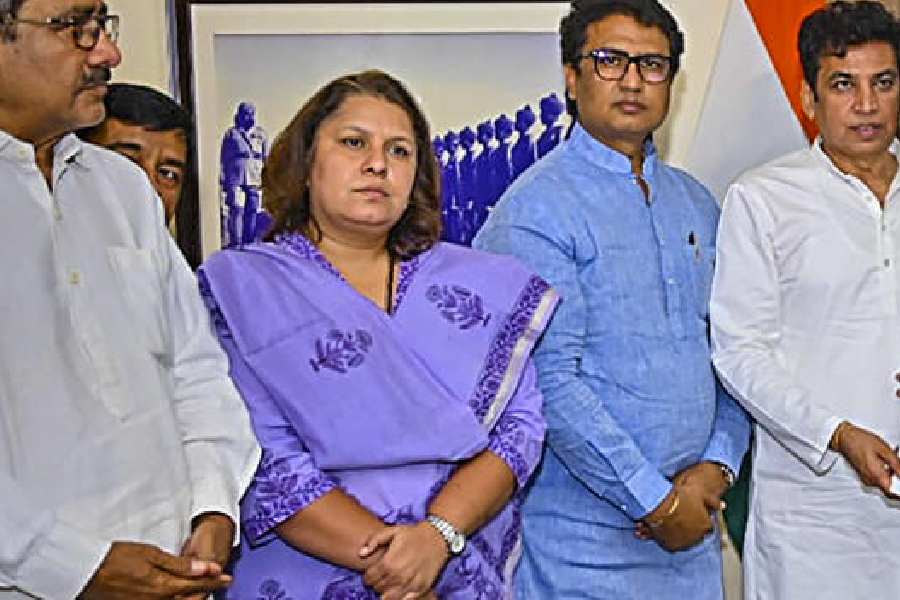
| Sonia Gandhi with Motilal Vohra at the AICC headquarters in New Delhi on Tuesday. Picture by Rajesh Kumar |
New Delhi, Dec. 28: As the Congress celebrated the completion of 125 years today, the grand old party appears to be getting ready to accept Rahul Gandhi as its supreme leader.
So, will 2011 be the year of Rahul Gandhi?
The Burari AICC plenary saw general secretary Digvijay Singh calling himself and his generation of leaders as having an expiry date; all eyes are now peeled on whether the impending cabinet shuffle and AICC secretariat revamp will reflect that.
At present, Digvijays generation, or Congress leaders in their 60s, are calling the shots as UPA ministers, chief ministers, AICC functionaries and state Congress chiefs.
Some of these leaders, who were handpicked by Sanjay and Rajiv Gandhi, are Ahmad Patel, Ambika Soni, Vayalar Ravi, Janardhan Dwivedi, Oscar Fernandes, Ghulam Nabi Azad, Kamal Nath, Sushil Kumar Shinde, Bhoopinder Singh Hooda, Ashok Gehlot, B.K. Hariprasad, Suresh Pachauri and Ramesh Chenninthala.
Digvijay was barely 37 when Rajiv made him Madhya Pradesh chief amid loud protests from Arjun Singh, Madhavrao Scindia, the Shukla brothers and others. Ahmad was crowned head of the Gujarat unit while Hooda was picked for Haryana in spite of opposition from the old guard.
The buzz at 24 Akbar Road, the Congress headquarters, is whether Sonia will try experimenting with Jyotiraditya Scindia, Meenakshi Natrajan, Sachin Pilot, Jitin Prasada and others to prepare them for future challenges.
But unlike Rajiv, Sonia and Rahul do not have the kind of talent that was produced in the 1970s. Nowadays, Youth Congress activities include holding periodic demonstrations at Jantar Mantar. At times, the venue shifts to auditoriums where workshops and seminars are held. Streetfights and social work play only a token role on its agenda.
Unlike his father or uncle who used the youth wing to counter Jaiprakash Narayan, V.P. Singh and the Bofors allegations, Rahul appears to be a reluctant leader who prefers playing cricket with the National Students Union of India and the Youth Congress to foster team spirit.
While Rahuls bid to build the Youth Congress and the NSUI on the basis of academic record and inner party democracy are not showing results, 24 Akbar Road is contributing little in terms of either generating new ideas or sending any concrete proposal to the government.
Some old-timers even wonder if the Congress has assumed a negative role, with officials acting more to kill or blunt initiative than utilising the talent at its command.
As UPA chairperson and Congress head, Sonia is spending most of her time intervening in crises and doing firefighting without disturbing protocol and hierarchy. As head of the National Advisory Council (NAC), she is trying to cater to rural and urban aspirations by blending the experience of NGOs with that of professionals at the NAC. But the success of the NAC has been a telling commentary on the efficacy of traditional Congress leaders.
For them, it is disappointing that the NAC, not the party, showcased her as a political leader and her vision for the country. The absence of the Congresss intellectual capability to influence government and bureaucracy was a clear departure from the past.
In its first avatar from 2004-2006, the NAC earned credit for pushing the National Rural Employment Guarantee Act, Right to Information Act and the domestic violence bill, which were largely responsible for the UPA retaining power in 2009.
The dual power-centre model and coalition dharma also pose problems for Sonia. When the UPA was formed in 2004, Sonia had earmarked a political role for herself as UPA chairperson while the executive role of running the government was assigned to her appointee Manmohan Singh.
But in practice, the Westminster model of parliamentary democracy was designed to function as prime ministerial democracy. The Prime Minister being the shining moon among lesser stars was expected to act swiftly and often secretly, as demonstrated by Indira Gandhi on numerous occasions.
In the present-day UPA, the decision-making process envisages a huge consultation route involving meetings between the Big Two and their set of advisers who often work at cross-purposes.
In spite of these handicaps, Rahuls political ascendancy has prompted the BJP and other opponents to claim that Sonias act of renunciation in 2004 was a ploy to keep the seat warm for Rahul, run the Manmohan Singh regime by remote control and reward loyalty at all levels.
Such a theory, however plausible, is flawed. Politics is too complex a field, filled with too many imponderables, to be guided by a script.
One need only take a closer look at Sonias life to confirm it.
|