|
|
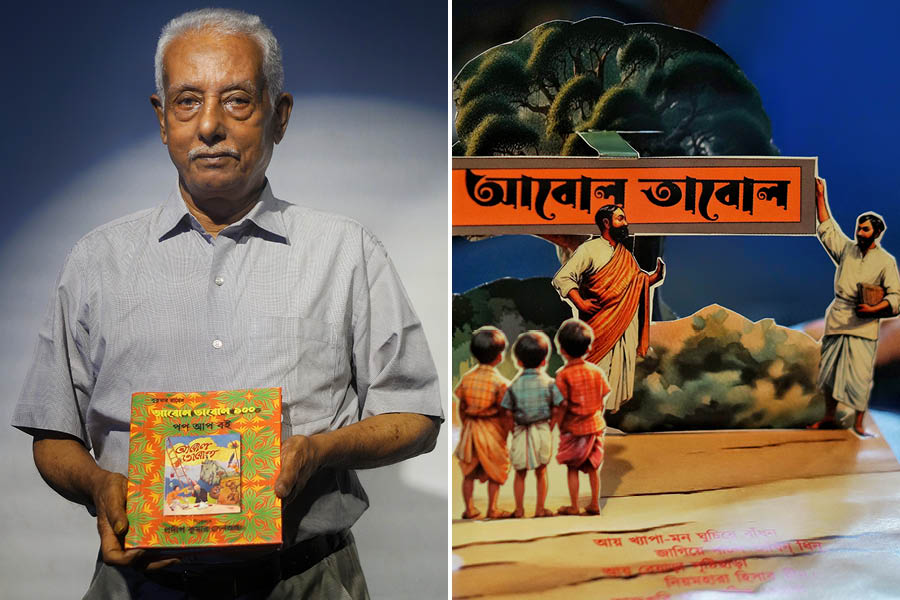
Ramachandra Guha at the launch of Makers of Modern India on Thursday evening. Picture by Pradip Sanyal
|
One thing you can’t accuse Ramachandra Guha of is mincing his words. Asked what he made of Bengal today, on the cusp of political change, he told Metro: “I think it is unhealthy for any party to stay in power for 33 years. It is unhealthy for the state, it is unhealthy for the party.”
But was the alternative a healthy option? “There are a lot of questions about what kind of governance Trinamul will provide, whether they are suited to govern or not or even about their leadership. There is Mamata Banerjee and then no one else. But even then, the change is necessary. Even if the CPM comes back, it will be a less arrogant CPM. The change in leadership should have happened 10 years ago.”
Hours later, at the Calcutta launch of Makers of Modern India, his latest book published by Penguin, The Telegraph columnist was just as blunt when asked about omitting some of the celebrated political thinkers from Bengal.
“I found the views of Vivekananda and Aurobindo archaic and stiff,” was the reply to a variation of the question that he is asked the most about his book.
The 537-pager comprises the writings of 19 thinkers picked by Guha as having shaped modern Indian thought. Starting with Rammohan Roy, the tome travels through the likes of Gokhale, Tagore, Tilak, Jinnah, Gandhi, Nehru and JP Narayan to stop at Hamid Dalwai.
Sitting on a podium in the Crystal Room at Taj Bengal, the author-historian-sociologist-cricket expert-environmentalist was in conversation with Rudrangshu Mukherjee, of The Telegraph, on Thursday evening.
“For me, the criteria for including a thinker was whether his thought was original, whether he left behind a large body of writing and whether his ideas transcended his generation,” explained Guha.
So while it was a tough call to exclude Vivekananda, Guha was convinced about the choice of Rammohan Roy, whom he calls “the first liberal” in his book. “Rammohan’s ideas are relevant even today,” he said to a silk-and-suit audience.
In the book, Guha introduces each of the 19 thinkers and then leaves the stage to them to do their talking, the combination making for a compelling read. On the podium, the author had to talk more about the people he had left out. “When a friend heard I was coming to Calcutta after including just two Bengalis in my list of 19, he advised I carry a crash helmet,” Guha said, setting the mood for the evening.
Admitting to an editor’s bias towards politics and political thinkers in Makers of Modern India, Guha claimed that modern political discourse had come to a standstill in India with the 1970s.
Guha dwelt at length on one of his pet topics — and the subject of his previous and widely successful book — India after Gandhi and the pragmatic state-maker called Nehru. Calling himself a Nehruvian Indian — a tag that elicited as many smiles as frowns — Guha drew titters when he said: “A Nehruvian Indian is one who thinks he’s at home anywhere in India and whose enemies think he’s at home nowhere in India.”
“Nehru takes me back to Gandhi and Gandhi takes me back to Tagore. Tagore had a profound influence on both,” said Guha, who has included Rabindranath Tagore as a political thinker and not a poet-novelist in his book.
Moving beyond the book, Guha was asked to draw up his list of “makers of Indian cricket”.
“Only cricketers, or administrators too? Well, then it would have to be called Makers and Breakers of Indian Cricket! I’d start with Ranji and end with Lalit Modi,” came the straight drive from the author of A Corner of a Foreign Field — An Indian History of a British Sport.
|