|
 |
 |
| THE TAKEOVER: (From top) Poster of a Korean actor in Dimapur; a Korean performer in Kohima; postcards of Korean actors in a Dimapur shop Pix: Caisii Mao |
The Lemturs are glued to their plasma screen. After all, its the moment theyve all been waiting for: Go Min Nam, so far disguised as a boy, is going to reveal her true identity. She is a member of a popular Asian boy band, so clearly the disclosure is going to cause some serious ripples. She walks up to the stage to face the ire of the media and her bandmates ahead of a press conference.
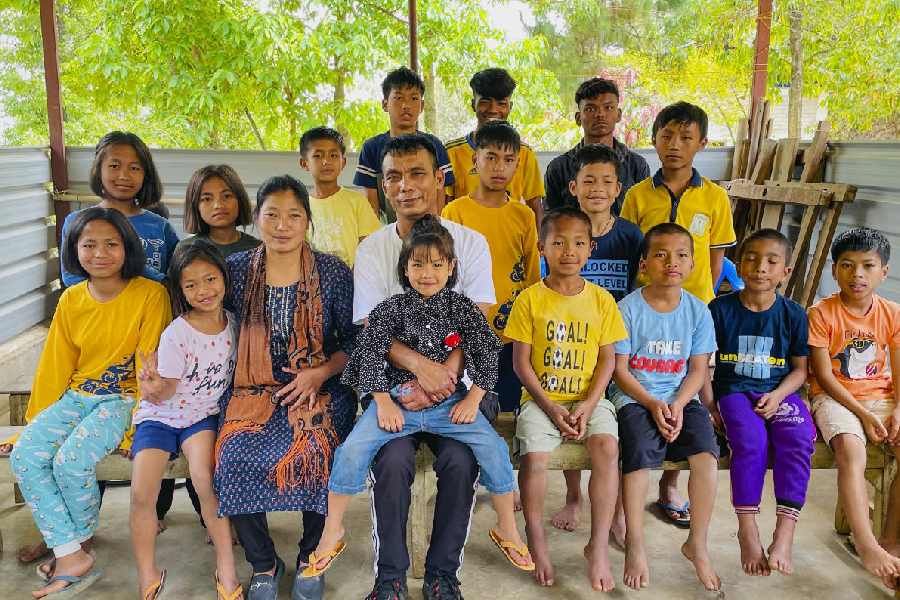
The family of five cant wait for the story of Youre Beautiful to unfurl. There is high excitement at home as subtitles of the serial are translated into English, or a scene explained to somebody whos missed a cue. I often have to repeat the dialogues to my mother in our native language, says beautician Sumongilo Lemtur.
Thats because the serial they are watching is in Korean. And though the Lemturs live in Dimapur in Nagaland, its the serial from another Asian country that provides them with their daily diet of entertainment.
Popular culture has often crossed boundaries. There was a time when all of Russia danced to Raj Kapoors Mera joota hai Japani. In parts of Asia and Africa, the sight of an Indian still prompts locals to recall Amitabh Bachchan. In the Eighties in India, before satellite television changed the face of the serial, Indian homes were flooded with videos of Pakistani soaps.
Today, its Korean culture and its spreading like wildfire through the northeast. From Nagaland and Arunachal Pradesh to Manipur and Mizoram, everything that is Korean is hot and fast selling. The Korean wave or hallyu, as it is popularly known hit the states a few years ago and is now at its peak. Hallyu refers to popular Korean culture ranging from music, soaps and cinema to online games and food.
Markets in Dimapur, in the Sikkimese capital of Gangtok and in Imphal in Manipur are full of DVDs sometimes pirated of popular Korean films and television serials, being sold at anything from Rs 80 to Rs 250. Posters of Korean actors sell like hot cakes and fashion is straight off Korean serials. There are Korean competitions in cultural festivals. Even local dialects across the region are interspersed with Korean phrases. And the youth are lapping it all up.
A new teen culture is developing, says sociologist Otojit Kshetrimayum from Sikkim University.
He could be talking about Gangtok resident Chandana Sharma, who has watched innumerable re-runs of Youre Beautiful on her DVD player. The 16-year-old student says komapsumnida the Korean word for thanks when she needs to express gratitude, styles her hair straight with coloured fringes the kind that Korean heroines sport and is mostly dressed in balloon tees and skinny jeans or anything else thats trendy in South Korea. Her friends understand her language and they all text each other using Korean phrases. Its slowly becoming a part of our lingo, Sharma says.
The Koreanisation of the youth happened gradually. The earliest indication of the considerable interest in Korean ways of life came in late 2007 in the form of a Korean film festival, says Al Ngullie, youth commentator and a senior editor at The Morung Express in Dimapur. In 2008, the first ever Korea-India Music Festival was held in Kohima under the joint partnership of the Nagaland government and the South Korean government. Last year, the biggest cultural gala of Nagaland the Hornbill Festival featured Korean singers and wrestlers and there were stalls selling Korean food. Many of the songs that young Naga boys and girls belted out at the festival were Korean.
The reason, says Ngullie, is the growing identification with new cultures, especially Korean and Japanese. States like Nagaland has been experiencing a shift in cultural assimilation this time away from the generally Americanised ethos and ways of living, he says. The boom took place when Korean entertainment was at its peak and the media was singing paeans to hallyu. There were even MoUs being signed by northeastern states with South Korea for creating employment opportunities, says Ngullie.
Many stress that one reason Korean culture has taken off is that its easy to absorb. We relate to Korean drama owing to its simplicity, says Vidya Sharma, a 29-year-old lecturer from Gangtok, who has an impressive collection of Korean DVDs. The dramas are mostly family-oriented sagas or teen romantic musicals. Women find the tragic stories appealing, while the young swear by the romances.
Helping in the spread of Korean culture is Arirang TV, a state-run South Korean channel on the lines of Doordarshan, which launched in India in 2005. Over the years the popularity of the channel has grown to such an extent that it even has a fan club in Nagaland. The channel now runs a popular Learn Korean show.
Korean TV got a boost as militant groups in parts of the northeast called for banning Indian television channels and Hindi cinema. Indian TV channels, many complained, anyway hardly covered the northeast.
Also, the people here could never identify with the soaps shown on Hindi entertainment channels, says Theja Meru, cultural promoter and president of the Arirang TV club in Dimapur. Even now, while characters from different parts of the country often find meaty roles in the soaps that flood Indian channels, hardly anybody from the northeast is featured. Do we ever matter to people in the rest of the country, asks Mohen Naorem, a Manipuri filmmaker.
The filmmaker believes that Korean television filled that gap because of the physical similarities between Koreans and sections of people in the northeast. People found solace in Korean entertainment because of the likeness in physical appearances, he holds. Korean entertainment also succeeded in making a big impact because of easy availability and accessibility, adds Naorem, who says he is producing a Korean-style film with Manipuri actors.
The popularity of Arirang TV in the northeast has spawned an increased interest in Korean culture. There is a weekly Korean language class for members at our fan club in Kohima, says Meru.
The Korean government has also been trying to foster the ties. After all, the cultural spread has economic benefits too. Jung Sang-Won, cultural attachι at the embassy of South Korea in Delhi, says the money that the country makes from its DVDs and television exceeds in millions what it makes from selling cars, though he adds that he doesnt have the figures. 'The Korean cultural boom helps us in creating confidence in the people when it comes to experimenting with Korean products. So because of hallyu we benefit economically as well, says Sang-Won.
Sang-Won believes that government-private initiatives have helped in the cultural promotion. If the entertainment industry produced high quality soap operas, the government gave them infrastructural support such as providing state-of-the-art sets etc, he says.
South Korea, which has 400 companies in India, clearly hopes to extend its reach. In 2003, trade ties between the two nations stood at $4 billion which rose to $15 billion by 2008. Korea also hopes to work out feasible investment options in the northeast, says Sang-Won.
In 2008, the Government of Nagaland inked a deal with CONA International, a Seoul-based company that sought to place Naga youths in Korea for jobs. There is a proposal to employ our youth in Korean companies in different locations in both skilled and unskilled sectors. Korean companies have also shown some interest in investing in various sectors in the state like manufacturing, says Abu Metha, press secretary to the chief minister of Nagaland.
The year 2011 will be the Year of Korea in India and vice versa. There is a proposal to set up Korean language schools in many of the northeastern states. A Korean cultural centre is expected to come up in Delhi. The cultural boom helps the Koreans in two ways it promotes cultural ties and business deals follow, says Kshetrimayum, who visited Seoul as part of a delegation in 2009.
Observers agree that the influx has moved beyond a fad and is here to stay. But not many are worried about the consequences of the Korean cultural invasion. They reason that it will get assimilated into peoples lives the way American jeans, music and Hollywood did a generation ago. There is no loss of identity here, says Nguille.
Kshetrimayum, however, voices a note of caution. Though there is no major threat to the northeast culture, there is still some worry about the teen culture being passed on to subsequent generations, he says.
But the Lemturs arent complaining. Cultural assimilation can take its own twists and turns. They are more worried about the fate of Go Min Nam. |