|
|
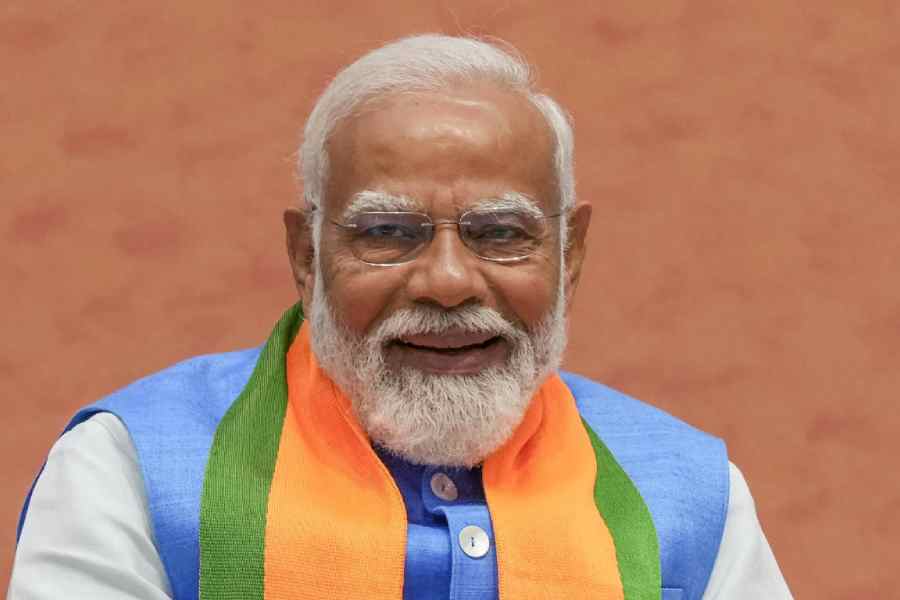
Narendra Modi
|
New Delhi, July 28: On the day the CBI was hot on Amit Shahs trail, Narendra Modi is learnt to have told the BJP top brass: Aap log unke daawat pe jayeeye, hum Gujarat ko sambhalenge (You people go to the banquet, I shall handle Gujarat).
The Gujarat chief minister was alluding to Prime Minister Manmohan Singhs lunch invite to L.K. Advani and other central BJP leaders that they had initially accepted. Modis one-liner rattled them so much that Arun Jaitley and Sushma Swaraj were told to immediately declare that they had spurned the invite.
Spokespersons were marshalled to hold eloquent briefs for Modi and Shah, his junior home minister, on TV. But some privately admitted it was tough defending the indefensible. That is why the BJP decided that rather than sacrifice the modicum of unity it had managed to forge with the Opposition over food price rise for Modi-Shahs sake, it ought to relegate the matter of the CBIs politicisation to second, if not third, place in Parliament.
The party knew that allies like the Janata Dal (U) had no love lost for the Gujarat duo. Indeed, the Dal (U) wanted to club the CBI issue with a larger discussion on the 1984 Bhopal gas tragedy and the Congresss alleged role in freeing Union Carbide ex-boss Warren Andersen. But the spectre of Modi forced the BJP leaders to list the CBIs politicisation on their parliamentary agenda even if this meant undermining Opposition oneness.
The Modi-Delhi equation encapsulates a dilemma the BJP has lived with since 2002. It recognises the reality that while Modi may have won Hindu middle-class hearts in Gujarat following the reprisals to the Godhra carnage, those outside had mixed feelings of admiration and repulsion towards him. The Indian middle class is just the constituency the BJP desperately wants to win back to regain the critical mass of support it requires before spreading itself out electorally.
But sources admitted the efforts have been stymied over the past few weeks. A perception has gained ground that the party wilfully backed elements the middle-class wouldnt openly consort with. First, the Bellary brothers who are Karnataka ministers and face allegations of illegal mining. Second, the BJPs office manager Shyam Jaju was implicated in financial fraud and accused of trying to flee the country. Last, there was Shah.
Part of the back Modi-Shah strategy is grounded in the importance Gujarat holds for the BJP. The state is hailed as the jewel in its crown — a description in sync with the partys image as a harbinger of infrastructure and economic reforms long before Manmohan and Montek Singh Ahulwalia were fashionable. That is one aspect of the thinking that crafted this strategy.
The other is that Gujarat has proved the best laboratory for practising the RSSs world-view — a peculiar blend Hinduism (exclude the other faiths) and development (fast track reforms and minimal state intervention). Modi, more than his predecessors Keshubhai Patel and Suresh Mehta, successfully translated this vision into action.
Has the Shah episode punctured the aura of invincibility shrouding Modi? The jury is still out. A Gujarat BJP MP, claiming to be neutral, said: Its early days. But one thing is certain. The structures of power are chipping away. The police force drew its strength from Modi. People feel that he is becoming weak and so is the police. The reason is that the court has shown nobody, not even Modi, is above the law.
Some compared Modis current situation to the body blow the fodder scam dealt Lalu Prasad. That every second person in the BJP has a grudge against Modi and would love to see him go down has not made life easier for him. You are as nice to a person as he is to you. Modi has not been nice to most of us, said another MP, who was nearly denied his Lok Sabha ticket in Gujarat by the chief minister.
|