TT Epaper
The Telegraph
 
  This website is ACAP-enabled
IN TODAY'S PAPER
WEEKLY FEATURES
CITIES AND REGIONS
SEARCH
 
ARCHIVES
Since 1st March, 1999
 
THE TELEGRAPH
 
Calcutta Weather
WeatherTemperature
Min : 26.9°C (+1)
Max : 36.1°C (+0)
Rainfall : 14.1 mm
Relative Humidity:
Max : 94% Min : 72%
Sunrise : 5:3 AM
Sunset : 6:22 PM
Today
Generally cloudy sky with rain or thundershower.
 
CIMA Gallary
Email This Page
Rocket today, Isro eyes 2013
- Unmanned space mission in two years but no timetable for launching astronauts
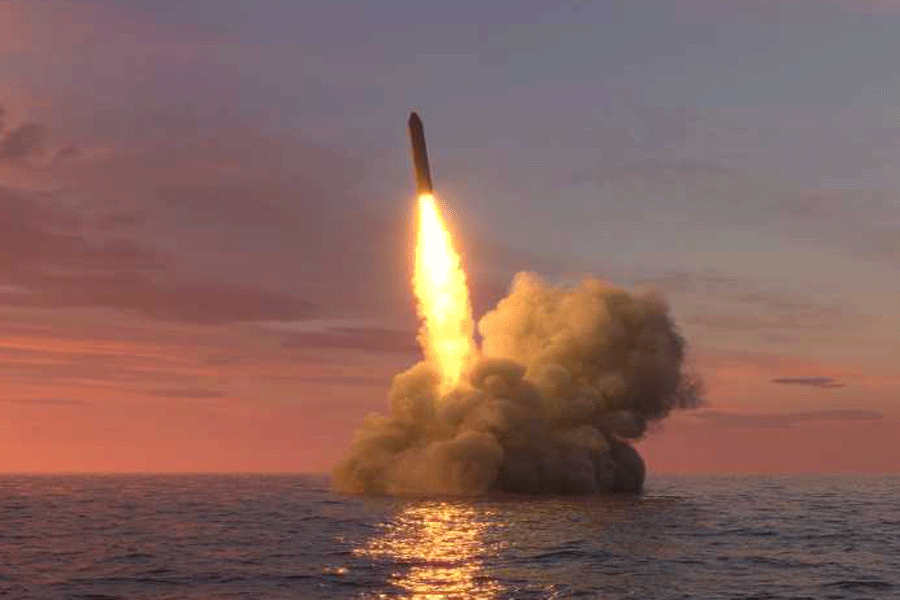
SMOKE...

Sriharikota, July 12: The Indian Space Research Organisation plans to launch its first unmanned but potentially habitable space capsule in 2013 in a key test of technologies for sending two astronauts into space.

Isro officials have in the past said the space agency would like to launch a manned space mission between 2015 and 2020, but were non-committal on a timetable today.

The officials said the space capsule, which they are calling a “test crew module”, would be launched on the Polar Satellite Launch Vehicle (PSLV), India’s workhorse rocket that ferried satellites into space today in its 16th consecutive successful launch.

“The crew module with a habitable system (environment) and an escape system is the most crucial technology of a manned mission,” Isro chairman K. Radhakrishnan said after the PSLV-C15 put two Indian and three foreign satellites into orbit.

A thermal shield will protect the space capsule’s interiors from extreme high temperatures that it will encounter during re-entry into Earth’s atmosphere for splashdown.

A senior Isro official told The Telegraph: “The mission would also test a crew ejection system that might be needed in an emergency.”

... AFTER FIRE

Isro had three years ago successfully conducted its first space recovery experiment, launching a tiny conical capsule into a low Earth orbit for several days and recovering it from the Bay of Bengal after a parachute-aided splashdown. A second space recovery experiment is expected next year.

A question mark has emerged over Isro’s timetable for a manned mission, though. While the test crew module will fly on a PSLV, the two-astronaut capsule is intended to ride into space on top of the bigger Geosynchronous Satellite Launch Vehicle (GSLV).

The failure of the indigenous cryogenic engine on the GSLV in April this year may contribute to a delay. Isro has said it might take a year to flight-test the next indigenous cryogenic engine.

Isro will also have to upgrade the GSLV’s weight-carrying capacity, which will allow it to carry a payload of up to 10,000kg into a low earth orbit — the requirement for a manned mission.

A major challenge for Isro would be to “man-rate” the GSLV — build redundancies and safety systems into the vehicle to reduce the chance of failure by a significant factor --- no more than one failure in 99 launches.

Radhakrishnan said a manned mission would require a new launch pad costing about Rs 1,000 crore and an astronaut-training centre. “It would take three years to train four astronauts out of whom two will be finally selected for the mission.”

In the immediate future, Isro will launch the GSAT-5c, a communication satellite, from the GSLV F06, and the Resourcesat2 from the PSLV-C16. Both flights will happen between September 10 and October 15 before the northeast monsoon sets in, Radhakrishnan said.

This morning, the PSLV placed five satellites into orbit, including India’s third Cartosat, which can map the country’s urban and rural areas and its forest cover. The successful launch came as a morale booster after the GSLV-D3 disaster in April.

So, when the PSLV soared into the skies at 9.20am and the four stages ignited and separated with clockwork precision and the five payloads were injected into their orbits, there was more relief than the usual self-congratulatory zeal at mission control at the Satish Dhawan Space Centre here. Along with the 694kg Cartosat-2B, the PSLV also launched three smaller satellites from Algeria, Canada and Switzerland, and a tiny satellite built by seven engineering students from Andhra Pradesh and Karnataka.

Top
Email This Page