TT Epaper
The Telegraph
TT Photogallery
 
IN TODAY'S PAPER
WEEKLY FEATURES
CITIES AND REGIONS
SEARCH
 
ARCHIVES
Since 1st March, 1999
 
THE TELEGRAPH
 
 
CIMA Gallary
Email This Page
Take IIT easy

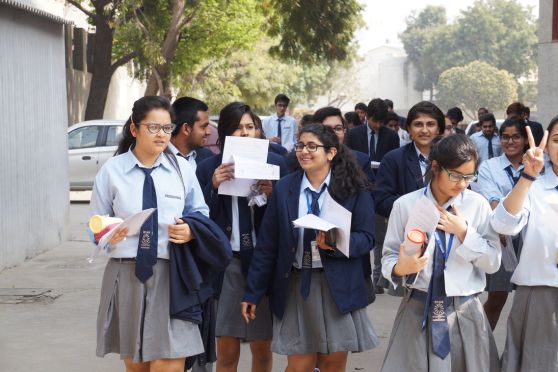
Come Sunday, and it will be decided who will become an IITian and who not. That the run-up to the qualifying exam puts pressure on candidates is an understatement. After all, who wouldn’t want to walk the hallowed portals of the Indian Institutes of Technology (IIT)? But don’t hit the panic button, lest your chances should suffer.

It’s true the IIT joint entrance examination (JEE) is one of the toughest entrance exams in India. Cracking it gives you a ticket to one of the IITs and other premier institutes. But good things don’t always come on a platter; you have to work hard for them. So those interested in getting the best of engineering education must begin preparing right from where it matters — just after the Class X board exam.

That’s what Rajiv Agarwal did. “I was interested in science, and had heard the IITs are the best place in the country for that. I began preparing soon after my Class X exam,” recounts the IIT, Kharagpur, alumnus and co-founder of Edudigm, a mentoring institute for IIT-JEE aspirants.

Most toppers believe that whatever the syllabus and situation, burning the midnight oil more than necessary will burn your chances of doing well. Says V. Prashant, who stood fifth in the all India ranking (2009) and is pursuing computer science at IIT, Madras, “A week before the exam, you do feel the pressure. But you shouldn’t burden yourself with the thought of securing a good rank or even clearing it. Rather, you should take it normally.”

But not all can cope with the pressure cooker situation. Experts and coaching institutes faculty members feel the right strategy, planning and execution can help one achieve the goal without a nervous breakdown. “With seven days remaining, students should just stop trying to cram new information. Instead, they should brush up on what they have learnt so far,” advises R.L. Trikha, faculty and head of the department, distance learning, FIITJEE, New Delhi.

In case of loss of concentration, mental fatigue or tension, don’t worry too much. Try a little meditation. “Close your eyes and concentrate on the centre of your eyes. Do this for 10-15 minutes. It is sure to help. A calm mind is a better performer than a chaotic one,” says Pankaj Vermani, co-founder and vice-president of www.goiit.com, a portal for online tutorials for IIT aspirants.

Many feel that when there are just a few days left it’s best to lead a relaxed life and brush up on lessons and numericals. “Don’t fret over not being able to master your mathematical skills. Remember you can’t master the subject overnight,” says Nishant Sah, co-partner of Edudigm. “Since the mathematical section is the toughest, try to understand the underlying concepts in the problems short listed by you. Revisit chapters like calculus, co-ordinate geometry, trigonometry (at least the formulae).” Sah also prescribes revising easier topics such as progressions, logarithms, and determinants and matrices. “There is no need to revise concept-oriented topics like permutation and combination, probability and binomial theorem if your concepts are already clear.”

For subjects like chemistry, where apart from clearing concepts one needs to master the theoretical knowledge, one should first complete all the chapters (classes XI and XII). And when the exam date is nearing, one can focus on just the minimum-effort-maximum-output chapters. Chapters like qualitative analysis, co-ordinate chemistry, chemical bonding, electrochemistry, thermodynamics and chemical equilibrium are good bets for scoring high, says Trikha.

Adds Agarwal, “Don’t forget to brush up on kinetics, radioactivity, gas laws, atomic structure, surface chemistry, isomerism, polymers and carbohydrates. And as for organic chemistry, it’s best to have a reaction map and to go through it instead of trying to grasp the reaction mechanism.”

In physics, if you are not confident in mechanics, then instead of wasting time on it master chapters like fluids, modern physics, waves, optics, surface tension and simple harmonic motions. These will help you score. Focusing on individual problems would not be the right thing to do.

And remember, “do not compare your preparation with others’ at this level,” warns Vermani. “Such comparisons will either make you over-confident or make a dent on your confidence, both of which are a death wish.”

Dos and don’ts for D-Day: Pramod Kumar, director, T.I.M.E. Pvt. Ltd, Cochin

DOs

Read the instructions for every type of question. Attempt all questions that carry no negative marks. Last year, multiple choice questions did not carry negative marks. Students who did not attempt those questions for fear of attracting a penalty missed out on an easy scoring opportunity

During the two-hour break after paper 1, the only analysis you should do is understanding the pattern of the paper

Use the restroom before entering the hall. Your mind needs to be completely focused.

DON’Ts

Don’t forget that the subject cut-off will be higher this year. So don’t hesitate to give more attention to a subject in paper 2 if you have not attempted that subject to your satisfaction in paper 1

Don’t spend more than 90 minutes on any single subject. It could hamper your chances of securing subject-wise cut-offs

Do not trade last minute tips with friends or strangers. Nothing is achieved on the last day.

A day in the life of a topper

I never followed a rigid routine. A week before the exam, I tried making it more relaxed. I would wake up around 7 am, freshen up and turn on the television. After surfing my favourite channels, I would go to my room and start revising or solving problems till I felt drained out. I must admit I never kept track of how many hours I studied. I studied till I enjoyed doing so, and once I felt bored or saturated I would go for a walk or do something else. Chemistry being my nemesis, I chose to deal with it in the early hours and devoted more hours to it than the other subjects. I refrained from learning new concepts and adhered to revising contents, chapters and numerical problems whose methodology I had mastered. The very fact that I didn’t take the exam too seriously perhaps made me score better.

Top
Email This Page