|
 |
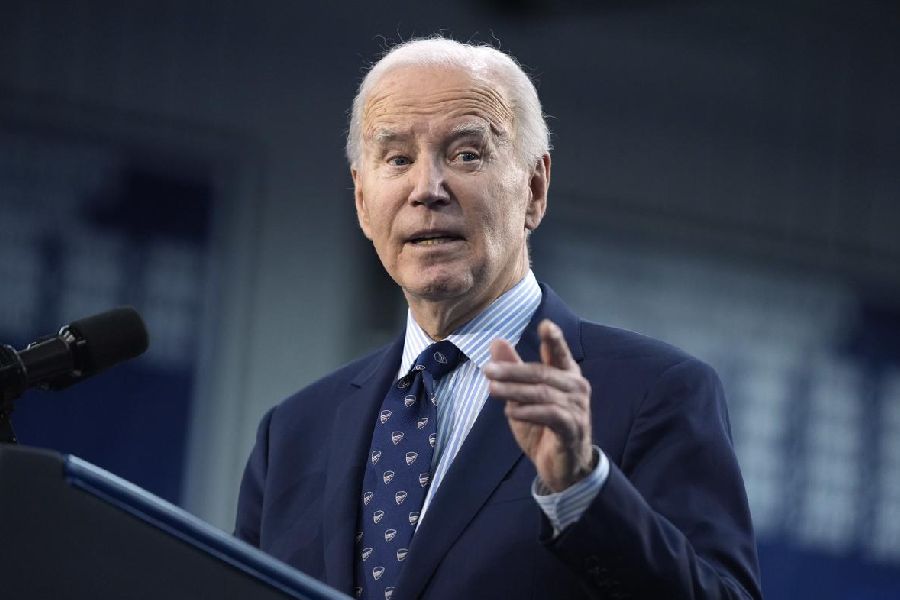
| Barack Obama (top) and Manmohan Singh at the Bella Centre in Copenhagen on Friday. (AFP) |
Copenhagen, Dec. 18: World leaders scrambled
to patch together a non-
binding political stateme-
nt late tonight after fail
ing to agree on the Copen
hagen summit’s key objec
tive of taking urgent ac
tion against climate
change.
A weak statement, touted
as the Copenhagen Accord, ap
peared on its way after Presi
dent Barack Obama’s meeting
with Prime Minister Manmo
han Singh and leaders of Ch-
ina, Brazil and South Africa.
“We are close to seeing a
legally non-binding Copen
hagen outcome after 36 hours
of gruelling, intensive negoti
ations,” environment minis
ter Jairam Ramesh said.
A US official claimed that
Obama had reached a deal
with India, China, Brazil and
South Africa.
“It is not sufficient to com
bat the threat of climate
change, but it’s an important
first step,” a late-night New
York Times report quoted the
official as saying.
The draft statement falls
far short of the aims with
which the leaders gathered
here: to set new and ambitious
emission cut targets for indus
trialised countries and for
malise financial and techno
logical assistance for develop
ing nations.
The draft, leaked to non-
government observers at the
summit, indicates that the de
veloping countries would have
to list their own domestic tar
gets through an international
process, a proposal India has
resisted in the past.
Sources said the political
pledge by the leaders is expect
ed to be accompanied by two
drafts from negotiating gr-ou-
ps — one on emission reduc
tions by the industrialised co-
u-ntries and the other involv
ing long-term cooperative ac
tion.
“I won’t say the Copen
hagen talks have completely
failed — there is certain
progress in discussions,” said
Shyam Saran, India’s special
envoy on climate change.
“However, as the Prime Mi-n-
ister said, we expected more
from Copenhagen.”
An appendix in the leaked
draft of the proposed political
statement suggests that the de-
veloping countries would have
to list their domestic emis
sion-curbing actions, known
as nationally appropriate mit
igation actions, just as the in
dustrialised countries would
have to list their own emission
reduction targets.
Senior Indian officials
have in the past argued that
this violates the principle of
the 12-year-old Kyoto Protocol
that imposed legally binding
targets only on the industri
alised countries. India has in
the past resisted attempts to
open domestic actions to inter
national scrutiny.
Despite compromises by
countries like India and China
over the issue of monitoring
review and verification and
the US pledging funds for poor
countries, there was no agree
ment on fundamental issues
like the fate of the Kyoto Pro
tocol and the Bali Action Plan
after Copenhagen.
There was no consensus on
common but differentiated
mechanisms of responsibility,
either.
Negotiators and ministers
from across the world sat thr-
ough the night seeking to sal
vage a meaningful agreement.
The position of India and
China had hardened as news
spread of a late-night meeting
involving 40 countries appar
ently to produce an umbrella
text to be signed by the lead
ers. Neither India nor China
was invited there. |