|
 |
 |
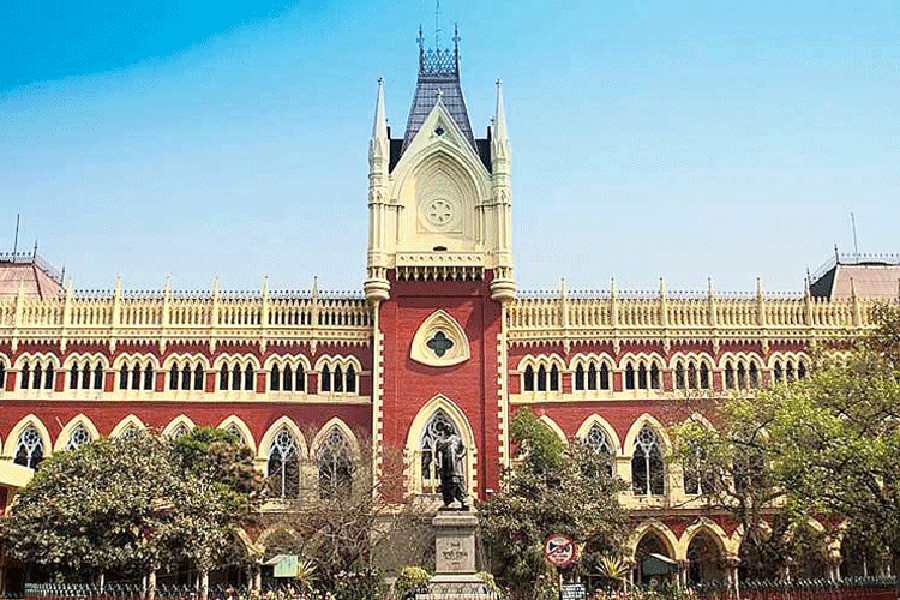
| The Metropolitan Building now (top) and before restoration (below);(above) the mansard roof of Writers’ Buildings. Pictures by Bishwarup Dutta |
The city needs well-laid plans and trained professionals to stop the destruction of heritage structures in the name of restoration
What would the Indian Museum look like if it wore a black hat? Hair-raising, no doubt! Such a strange question may not occur to us in normal circumstances, but when one has climbed the Shahid Minar and viewed the rarely-seen Indian Museum terrace, it is not impossible to think on such lines. Such a thought did cross the mind of a colleague, who had taken the trouble to climb all 223 steps of the Monument, while taking in the breathtaking view of the city. She was aware of the recent proposal to build a mansard roof on what is popularly known as “jadughar”, designated a Grade I heritage building by the Calcutta Municipal Corporation (CMC), a building whose exterior cannot be changed, and she felt it would be an affront to the almost 200-year-old building.
If a layperson recoils with horror at the thought of adding an environment-unfriendly roof on a venerable old building, one wonders how the state heritage commission and the CMC’s heritage conservation committee will react to this monstrous proposal already placed before the vision and development committee for Indian Museum.
There is more madness than method in the way Calcutta’s heritage buildings and structures are treated by empanelled “conservation architects”, and they are allowed to get away with it because it is not mandatory for them to undertake a thorough study of the structure before preparing a restoration/conservation plan, as they are required to in Mumbai and Delhi. In Calcutta one can conveniently forget step one — the study — and straightaway reach step two — the restoration plan.
Little wonder that the once-dilapidated Metropolitan Building, which was restored after years of campaigning, is back to square one, although its façade looks deceptively well-kept, and the developer concerned has been accused of behaving with the destructive ardour of a bull in a china shop at both the historic Great Eastern hotel and the stone-clad Mackinnon Mackenzie building near the strand.
Perhaps the damage would have been mitigated if thorough studies of these heritage buildings — whatever be their grade — were made. Even the unspectacular portal of the former bishop’s palace in Russell Street would have fared better if it were studied meticulously before an architect was allowed to touch it.
It is clear that the architect, like most architects, was more interested in rebuilding than restoration. It is cheaper to restore than to build, although it would have cost more to rebuild the vandalised Russell Street gate. According to conservation architect Shivashish Bose, Bernard Feilden, an authority on conservation architecture, has established that restoration cost is one-third less than that of constructing a new building of the same size and volume. Latest researches have proven this.
The Mumbai standard
Unfortunately, those on the heritage committee are not necessarily sensitised to do justice to the issues at stake. One need not be very imaginative to figure out what this leads to.
Sharada Dwivedi, a Mumbai-based writer interested in conservation, says although the heritage committee in that city is a “toothless tiger”, yet owners of Grade I and Grade IIA and Grade IIB buildings have to present restoration proposals to the heritage committee. The owner has to appoint both a qualified conservation architect and a structural engineer and a detailed study is undertaken so that original materials are used during the restoration process. Committee members visit the site itself. What needs to be done in Calcutta is understanding and stating the heritage quotient of a heritage structure/building/precinct.
“It is not for nothing that UNESCO has made such a study a prerequisite for all World Heritage Sites,” says conservation architect Nilina Deb Lal, who trained at the University of York in the UK.
Shivashish Bose, who did his post-doctoral research at the International Centre for the Study of the Preservation and Restoration of Cultural Property (ICCROM), Rome — an intergovernmental organisation set up by the UN — says there are codes of ethics for the entire process of works of conservation and restoration set by the Venice Charter (1964) and various charters thereafter. Declared and adopted by international and inter-governmental organisations and world organisations, these charters provide the norms for study and training on preservation and conservation issues.
Experts missing
It ought to be emphasised here that although the CMC has several empanelled “conservation architects” who are allowed to undertake restoration of heritage buildings, Calcutta has only three such architects with the necessary qualifications. They are Nilina Deb Lal, Shivashish Bose and Manish Chakraborti, who was also trained at the University of York. It is not to be disputed that Calcutta needs several more trained conservation architects.
With so few qualified architects and so much to do in Calcutta, little wonder that all empanelled conservation architects, under-qualified ones included, have a field day.
Mumbai, where the heritage conservation movement began in the late 1980s, when the demolition of Yacht Club and old Taj Mahal hotel was proposed, on the other hand, has several renowned conservation architects, says Sharada Dwivedi.
Why is it mandatory to make a thorough study of a heritage structure before drawing up a plan to save it? Says Nilina Deb Lal: “A large heritage structure undergoes stress and wear and tear for decades, if not centuries. The impact on such a structure is complex for it could be man-made and natural (weather, for example) as well. This has to be fully understood.”
The restoration proposal, she adds, leads from an understanding of what is significant about the building and what contributes to its heritage status. “Although such a study may seem obvious, it is often bypassed. Often an inventory of objects and artefacts in the building may be drawn up as part of the conservation plan.”
The understanding of the heritage status has to take into account tangible as well as intangible features. The tangibles are the building’s structural characteristics and features — even decorative ones like landscape. The intangibles are the building’s associations and its history, and views towards it and from it. The flyover, for example, has obscured the Indian Museum building, and the National Library can be viewed only from an angle from outside because the annexe stands in the way.
Toy train hope
“There is a proposal to restore the Darjeeling Himalayan Railway, better known as the toy train, and a major point of concern is, will passengers be able to see what they once would of the valley?” says Deb Lal.
Since old buildings won’t wait forever, and since more and more conservation architects will be required, both the CMC officials dealing with heritage as well as architects involved must be educated and sensitised through intensive workshops for a deeper understanding of issues involved.
And why leave out the central public works department (CPWD) officials? It was the CPWD that had wrecked the grand Currency Building in Dalhousie Square.
Conservation study must be made compulsory in architectural and civil engineering studies in bachelor and master programmes. One learns by trial and error, hit and miss, and the conservation architect must be able to adapt knowledge gained abroad for local applications.
One also hears that the Archaeological Survey of India (ASI) will be entrusted with the work of the National Library. ASI may have expertise in handling antiquity but does it have the necessary skills, sensitivity and understanding to deal with a complex, living heritage site?
|