|
|
|
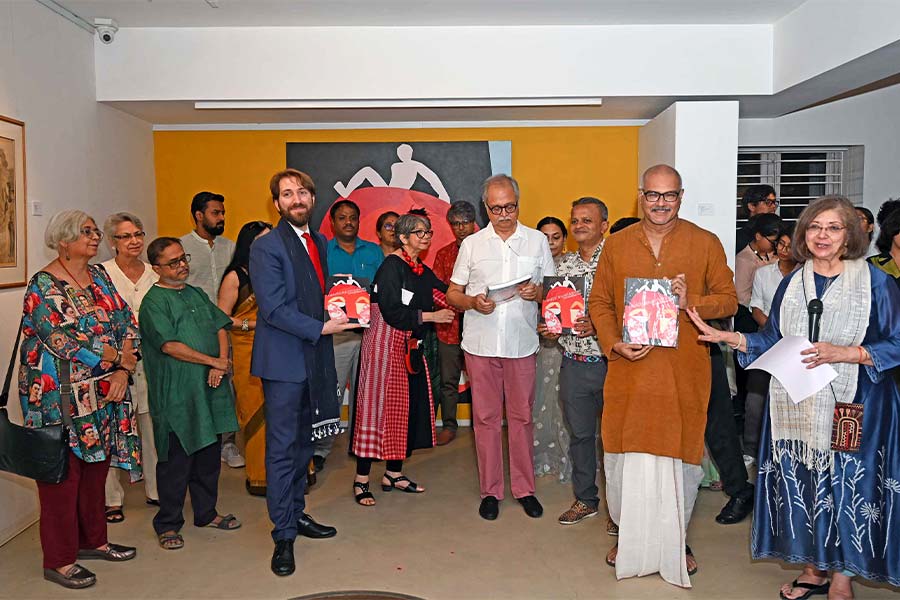
A photograph of Rabindranath Tagore and S Radhakrishnan that adorns the house in Chennai; (Below: From left) Lawyer
Milon Mukherjee looks on as CU registrar Basab Chaudhuri and vice-chancellor Suranjan Das hand over the
photographic reproductions to Radhakrishnan’s daughter-in-law Indira Gopal and great-granddaughter Chitra Shastri
in Chennai on Saturday
|
Chennai, Nov. 28: Calcutta gave Sarvepalli Radhakrishnan’s son his name eight decades ago and is now giving back the late President’s memories to his family.
Calcutta University today presented reproductions of its collection of Radhakrishnan’s photographs and books to Indira Gopal, the scholar-President’s daughter-in-law, at the family home in south Chennai that is to be turned into a museum.
CU even offered the services of its librarian and renowned archivist, Soumitra Sarkar, to help put together the museum’s exhibits that, Indira confessed, are in somewhat disarray now.
As Indira, 83, and Chitra Shastri, one of the great-granddaughters of Radhakrishnan, looked on, CU vice-chancellor Suranjan Das and registrar Basab Chaudhuri carefully unpacked a rectangular box containing the reprints of the photos. With them was lawyer Milon Mukherjee who had arranged the transport of the documents to Chennai.
“During this Teacher’s Day, our university had organised an exhibition of pictorial and textual reproductions of the life and work of Dr Radhakrishnan and also replicas of 27 books written by him. Today we are honoured to present them to you to be housed in the museum,” Das told Indira.
He recalled the 20-year association between Radhakrishnan and the university, where he was professor of philosophy and occupied the Chair of George V Professor of Mental and Moral Science between 1921 and 1941.
Indira revealed a nugget about her husband and only son of Radhakrishnan, historian S. Gopal, who died in 2002.
“He was actually named Ramachandra but his neighbours in Calcutta, where the family lived, always called this little boy ‘Gopal’ and the name stuck. I am so happy that the Calcutta connection continues to work to this day,” she said.
As she and Chitra thumbed through some of the poster-sized pictures, the younger woman pointed to one where Radhakrishnan (then Vice-President) was being received by Ho Chi Minh in Vietnam.
“That is a really rare one. Now it would join the rarer ones dotting this house like those of Sarvepalli with Tagore and with Gandhiji,” Indira said, pointing at framed photos on the wall.
The house, Girija, one of the few surviving art deco bungalows in the city, stands in splendid isolation among the glass-fronted office buildings on Dr Radhakrishnan Road. If you take away the TV set in the central covered courtyard, time virtually stands still in the house with its old-style pedestal lights, ageing ceiling fans and a pendulum clock that works.
“That is how this house, built in 1934-35, will remain for ever. A foundation formed by Sarvepalli’s grandchildren (there are 13 of them, he had five daughters) will set up a museum in this house where all his books, photos and mementoes will be displayed,” Indira said.
She said many of the books brought from Rashtrapati Bhavan were still lying in their boxes and dozens of mementoes presented by celebrities were spread out in the house.
Vice-chancellor Das, who offered Sarkar’s services at this point, recalled as he sipped the “typically Madras type of tea” that he had met Gopal during a train trip from London to Oxford, where both studied and researched. Das let on that at Oxford, he had been the recipient of the Dr Radhakrishnan Memorial Bequest.
The Ho Chi Minh photograph handed over today is a reproduction, and the original is probably in the university’s archives. “The photographs have been collected from various sources,” librarian Sarkar told The Telegraph.
Among the gifts were digitised copies of the principal works of Radhakrishnan, most of them written during his long tenure at CU. In between, he had stints at the University of Mysore and was Spalding Professor of Eastern Religions and Ethics at Oxford University from 1936 to 1952.
Sarkar said CU had dug out senate records of Radhakrishnan’s association with the university. One of the documents showed him setting the Telugu question paper for the Matriculate examination.
S. Gopal spent much of his boyhood in Calcutta where his father taught. After getting his DPhil from Oxford, he became a reader at St Anthony’s College, Oxford. He was among the founders of the Centre for Historical Studies at JNU.
|