|
|
Pranab Mukherjee with his ministry officials in New Delhi on Tuesday. Picture by Prem Singh
|
New Delhi, Nov. 3: India will continue with the tax cuts and other stimulus measures in the face of the monsoon harvest showing a 15-million-tonne shortfall in rice.
For the present I maintain that the fiscal stimulus will have to continue to allow its impact to fully run through the economy, finance minister Pranab Mukherjee told a conference of economic editors here today.
Mukherjee said he was open to short-term stimulus measures if the situation demanded such a move. It would depend on rabi (winter crop) estimates and the pick-up in exports, Mukherjee said. The finance ministers comments came a week after the Reserve Bank prepared a case for a phased exit from an easy interest-rate regime in its monetary policy update.
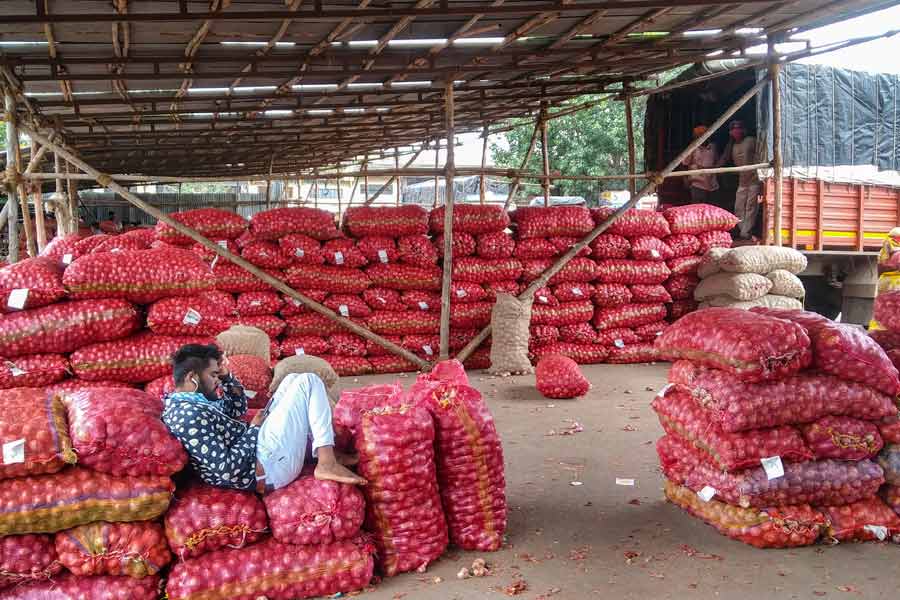
A separate announcement by the agriculture ministry today said kharif, or monsoon-sown rice, was likely to be 69.45 million tonnes, nearly 15 million tonnes less than last years output of the crop.
India, however, has foodgrain stocks of around 44.29 million tonnes (mt), including 15.35 mt of rice. Still, state run trading agencies have over the last week booked up to 30,000 tonnes of rice from abroad for delivery in November and December, perhaps with an eye to shore up reserves and check prices.
Though the drastic shortfall in grain production may not affect availability — stocks from the previous years and imports will be distributed through ration shops —the shortfall is expected to impact incomes and demand for consumer goods in rural areas. This in turn could see the pick-up in industrial growth getting checked. Indias factory output had grown 10.4 per cent in August.
Exports in September fell 13.8 per cent year-on-year to $13.6 billion and in the April-September period, they declined 28.5 per cent to $77.9 billion.
Though trade officials are optimistic about the trend getting reversed by December-January, they admit it will depend on economic recovery in the developed countries. Sixty-five per cent of Indias exports of textiles, handicrafts, gems and jewellery and other manufactures are meant for the US, Europe and Japan.
The government in a bid to reverse the economic slowdown which had set into the country on the back of failing exports came up with three economic stimulus packages since December 2008, involving a total tax giveaway of Rs 40,000 crore.
Excise rates, or factory gate taxes, were cut on most goods by at least 4 per cent and on some by as much as 6 per cent. Service taxes were slashed by a sixth to 10 per cent, while interest subsidy programmes were announced for small industry and exporters.
More than that, the central government started spending more on schemes such as a job programme that guarantees 100 days of employment in rural areas.
The government also invested heavily in job-intensive sectors, such as infrastructure. The spending programme was topped up by a budget passed in July, which estimated expenditure at Rs 10,20,838 crore, an increase of 36 per cent over 2008-09.
It is, however, an imperative to come back to the path of fiscal prudence, as soon as the current economic circumstances permit us to do so, Mukherjee said.
A return to 9-per-cent-growth would take more than a year, and would depend not only Indias ability to reverse the slowdown but also on the global economic recovery.
Mukherjee said banks have been told to boost lending as non-farm credit growth remained an area of concern.
Indias economic growth slowed to 6.7 per cent in the fiscal year through March after three straight years of at least 9 per cent expansion. A high powered panel set up by the Prime Minister has said growth in the current year will be around 6.5 per cent.
Meanwhile, because of a sharp drop in crude oil prices to $76 per barrel from a peak of $147 per barrel last year, the country's imports fell by a drastic 31.3 per cent in September to $21.3 billion.
As a result, the trade gap narrowed to $7.7 billion against $15.3 billion in the same month in 2008.
|