TT Epaper LHS
The Telegraph
TT Mobile
 
 
IN TODAY'S PAPER
WEEKLY FEATURES
CITY NEWSLINES
FEEDS
  RSS
  My Yahoo!
SEARCH
 
Archives Web
 
ARCHIVES
Since 1st March, 1999
 
THE TELEGRAPH
 
CIMA Gallary
 
Email This Page
With grating music and rickety rifle, mercenary looks which way to leap
THE MAOIST FRONTLINE

Green Hunt is actually red of hue and creed. Bluntly, bullet for bullet, blood for blood.

The Maoists have long waged violence as the central instrument of revolutionary overthrow; the state has now thrown all pretence to accommodation and is in the throes of angered retort. It’s grabbing at the mantle of hunter of these forests whose acknowledged overlord is still the outlaw: strike, don’t wait to be struck, blow before you’re blown, that’s the new credo.

This is going to be hunter versus hunter, each wearing victimhood as virtue, each casting the other in villainy, each promising the portents of its calling: body counts. Seven Maoists killed in the bushes of Kanker and Jagdalpur this gone week, and five men in uniform, four of them in a single press-button blast near the iron-ore mines of Bailadila further south of here.

Ah, wohi purana jangal aur nayi-naveli jang (ah, the same old forest and a brand new battle),” chuckles Aitu Muria with a provocative relish only someone with a gun in his lap can afford. “Par hamara kya hoga, Kaalia (but what will become of us)?”

Aitu — probably not his real name — is the lively splice of this paradoxical conflict between claimed good and proclaimed evil. He is victim or villain, depending on conditions applied — a Maoist who crossed fences and reversed aim — “uss paar se iss paar (from that side to this)” in his slick tongue.

Then recruited, armed and adorned by the state with a new title and a new task — special police officer (SPO), hitman. He is also a flash-forward of his past self — a Salwa Judum militiaman from the gory campaigns of 2006, but now that the Judum is a stained entity banished by the Supreme Court, an employee of Green Hunt, the ongoing Chhattisgarh operation against the Maoists. If Aitu is shivered at all by the prospect of what’s to come — the “nayi-naveli jang” — he’s trying not to put it on display.

For the moment, in fact, he is happy to be lost in his fourth adopted skin — Himesh Reshammiya, an abiding favourite, on the evidence of the stash of pirated CDs next to him. Sitting beside him in his beat-up Willys — a rattling carcass of a chariot, its torn canvas hood flapping in the high wind — is to woo nausea, the remixed blaze of “Ek haseeena thhhiiii” infinitely more oppressive than the plateau sun.

But Aitu is swung on Reshammiya, blaring from a portable player wired into the ignition; there’s a wooden speaker box nailed into the back of his seat. The Jeep is hurtling precariously down the wooded gorge; Aitu is blinded to everything by the song — “Ek haseeeena thhi, ek deeeewaaana thhhhaaa….”

His feet are dancing to the beat, jerking the controls, the Willys is a crescendo out of control. Aitu looks at me and breaks his song. “Don’t worry, this is my patch, I know each hole on the road.”

Then, sensing me rather unrelieved, he pats his bandolier and the weapon strapped to his torso: “Don’t worry, I have a gun.”

The Jeep is careening impossibly round a bend, its screech has become music too. “Don’t worry,” he says again, “I have a gun.” But can you shoot a road crash?

Can you shoot anything with that weapon he wears as a badge? A double-bore of dubious vintage and even more dubious ability.

“Never fired it,” Aitu says, “never needed to, the show of it has been enough.”

What if someone fires at him? Aitu smiles, baring a fine, full set of teeth. “They haven’t made a bullet with my name on it.”

Utterly filmi, utterly where Reshammiya comes from. A fantasy deeply, tragically, swigged in the reckless headiness of youth.

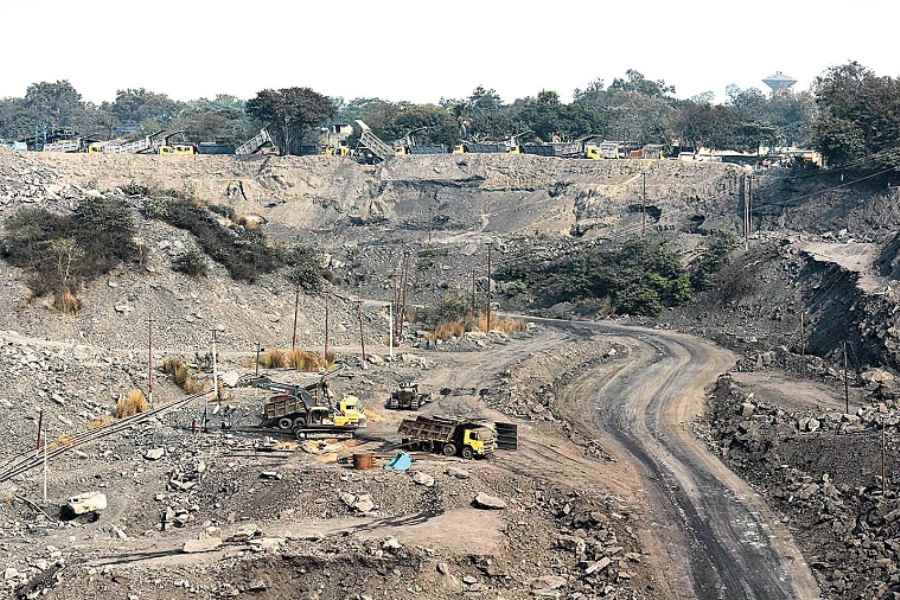
Pause the music a moment, give the Willys a break, and the fantasy of Aitu’s world can quickly evaporate. We are in the jungles of Dantewada, south Bastar, the country’s most blistered patch of land, smouldering hub of what Prime Minister Manmohan Singh calls the most serious threat to internal security, would-be theatre of bloody showdown between the state and its canny, belligerent challengers.

Aitu has few direct intimations of the battle blueprints being unscrolled in the control-rooms of New Delhi and Raipur, or of the slow massing of troop formations. But he does have a field rat’s sense of ominous ground-shifts. The sudden spike in killings, the jangling Maoist bush telegraph, perhaps the odd call to preparedness sounded by his anonymous bosses.

Kuchh bada bhari to hone wala hai, sirji (something big is in the works).”

But what if Green Hunt peters out the way of Salwa Judum? What if the body count doesn’t account for any change? What, very personally, if the Maoists get him?

Phir kya (what then)?” Aitu counters nonchalantly, “Iss paar se uss paar, aur kya? Darr to unko hai jinke paas yeh nahin (from this side to that, what else? They should be afraid who don’t have this).”

And he waves his rotten gun.

Top
Email This Page

 More stories in Front Page

  • With grating music and rickety rifle, mercenary looks which way to leap
  • Sourav shadow across Shashi field
  • Kissing developed to 'spread germs'
  • Church shift on suicide rites
  • 2 officials abducted in Assam
  • Trader killed in Manipur
  • Koda being grilled after raids
  • Fire lesson: Oil depots to shift