|
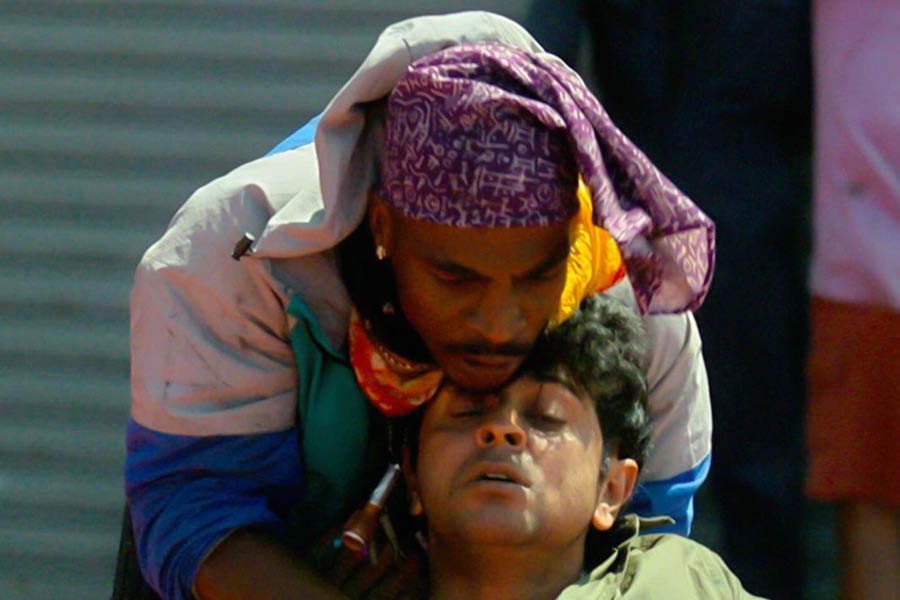
| Tour de force: Paresh Rawal in Road to Sangam |
Best Mahatma movie since Gandhi
The best Indian movie for years and I know absolutely no one will agree with me is Road to Sangam. Therefore, it is a matter of regret that it has not been included for the London Film Festival which begins on Wednesday, October 14.
Road to Sangam, I would go so far as to say, is the best Mahatma movie since Attenboroughs Gandhi in 1982. In some ways it has a rawness and an integrity which I found even more moving.
It is by Western and even contemporary Bollywood standards a small affair, shot on location in Allahabad on a budget of not even £1million.
It has been made by two relative newcomers, Amit Chheda, its producer, and Amit Rai, who scripted and directed the film using a lot of local folk in Allahabad.
The movies general release in India has been postponed but I was first tipped off about Road to Sangam in Cannes in May, saw a promotional DVD and then subsequently the full film.
It was just after Quentin Tarantino had boastfully told a press conference after a screening of Inglourious Basterds: I am not an American filmmaker I make movies for the planet Earth.
When it comes to touching the human soul, though, it is actually Indians who sometimes make movies of the kind of which Americans and Europeans appear incapable in todays technology-driven climate.
Such a film is Road to Sangam which is based on a real event the discovery of an urn containing Gandhis ashes in a bank vault in Orissa in 1997.
I cannot write highly enough about the central performance by Paresh Rawal who is cast as Hashmatullah, a motor mechanic by trade and a devout Muslim in his private life. He takes on the job of repairing an old V8 ford engine. But following a bomb blast in Allahabad and the round-up of innocent Muslims, there is a strike by members of the community who shut their shops. It is then that Hashmatullah learns that the engine he is repairing is for the truck which had been used once before to carry Gandhis ashes to the sangam of the holy rivers in Allahabad in 1948, and which is due to be rolled out again to transport the contents of the urn found in Orissa.
He resolves to go against his fellow Muslims, notably the leader of the community, Mohammad Ali Kasuri (Om Puri), and the hard line local mullah, Maulana Qureshi (Pawan Malhotra). Hashmatullah reopens his shop and sets about repairing the engine despite serious intimidation and violence.
The lone fight of one man recalls such classics as High Noon and Twelve Angry Men but Hashmatullah raises bigger issues: If we cannot honour Gandhi, a man who died for us, then what are we doing here in India?
Gandhis great-grandson, Tushar Gandhi, puts in a cameo appearance as himself. But it is Paresh Rawal as Hashmatullah who has turned in the performance of his life. Road to Sangam is Indian cinema at its best and it should have been here at the London Film Festival.
|
| Royal treatment: Nalin and Poonam Surie being escorted by Charles Gray |
Ticket to ride
Indian High Commissioners in London occasionally get taken for a ride but the 25-minute journey Nalin Surie made last week by horse drawn carriage from his residence in Kensington Palace Gardens to Buckingham Palace will be one of the more memorable Indias new man in London will make.
Accompanied by Charles Gray, Marshal of the Diplomatic Corps, Surie, with wife Poonam sitting beside him, went to present his credentials. The process was fast-tracked because of President Pratibha Patils impending state visit.
It was a delightful experience on a crisp, sunny day, the high commissioner told me later. The Queen was very warm.
|
| Old ties: M.F. Husain and S.H. Raza Spreading Magic: (From left) Nisha Paul, Matthew Spacie and Annanya Sarin |
Painters progress
The grand old men of Indian art, Maqbool Fida Husain, 94, and France-based Syed Haider Raza, 87, met in London last week for lunch and a good gossip.
The rare photograph of the two friends, who had not seen each other for a while, is perhaps worth more than one of their paintings.
A series of prints by Husain and Razas paintings are being previewed in London at Art London, one of Londons leading contemporary art fairs. This is being followed by The Five Rays of Raza, a major exhibition of the artists work organised by Tanya Baxter Contemporary, from December 3 until January 31 next year at the Kings Road Gallery.
Terence Rodrigues, an art historian and author, says that prices of Indian modern and contemporary art has risen a staggering 485 per cent in the last 10 years. But in the recession, younger, lesser contemporary artists have seen their prices collapse, whereas established blue-chip artists, such as Raza, have seen stability and even growth.
Raza told me that he last met Husain four or five years ago. We first met 60 to 70 years ago. It was good to see him. We talked about India it has so much to give the world: a message of love and understanding and ahimsa.
|
| Spreading Magic: (From left) Nisha Paul, Matthew Spacie and Annanya Sarin |
Sarin shocker
Annanya Sarin, who used to be press officer to Lakshmi Mittal and later Corus Steel, tells me the shocking story of how an Indian doctor in London kept giving her 70-year-old mother tablets for months on end for chest pains. Her mother is now seriously ill with cancer which remained criminally undiagnosed until Annanya had tests done privately.
Despite having to look after her mother, Annanya found time to support Magic Bus, a Mumbai-based charity set up 10 years ago by an Englishman, Matthew Spacie.
Magic Bus, which looks after 140,000 children at present through the medium of sport and hopes to boost the number to 600,000 by 2012, held a fundraising dinner in London last week. Annanya started working for Magic Bus two years ago at the instigation of Nisha Paul, Lord Swraj Pauls daughter-in-law.
My mother is now under the care of a very good specialist, says Annanya, who intends taking her daughter, 8, and son, 5, to see the inspirational Magic Bus children in December.
Annanya has dumped the Indian doctor, who is lucky not to be struck off.
Tittle tattle
It was a surprise to note from London Underground posters that a British Museum exhibition exploring the theme of power and empire Moctezuma: Aztec Ruler on the last elected Aztec emperor is being supported by ArcelorMittal.
This is the first time ArcelorMittal has sponsored anything at the British Museum, confirms a museum spokeswoman. The exhibition anticipates the anniversaries in 2010 of the Independence of Mexico (1810) and of the Mexican Revolution (1910).
I shouldnt have been surprised since Lakshmi Mittals son, Aditya, has been a British Museum patron for some years. Also, I should have remembered that Lakshmis father, Mohan Lal Mittal, had once described to me how the group began its global expansion with an acquisition in Mexico.
An ArcelorMittal spokesman explains: The reason why we chose to sponsor this particular exhibition was because of our long-standing presence in Mexico, going back to 1992, when we made our first international acquisition there. During this time Mr (Lakshmi) Mittal developed an affiliation to the country and to its people. As Mexicos largest steel producer, we have a real stake in the countrys continued development and success.
So maybe one day the Mittals will also sponsor Indian art.
|