|
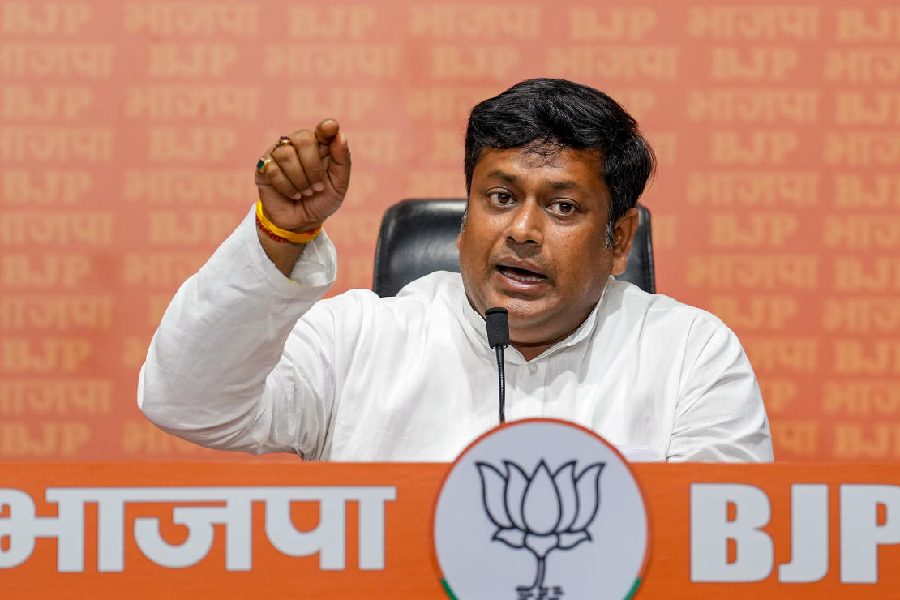
The serious aspect in the long-running comedy of the Bharatiya Janata Party committing hara-kiri by stabbing itself in both feet with its trishul is the expulsion of Jaswant Singh for his book on Jinnah and the banning of it by the BJP- governed state of Gujarat. The author must have known that his party had ‘form’ on such matters, and he should therefore hardly have been taken by surprise. The BJP was only acting in character: it is no stranger to the banning and burning of books.
An unflattering article in Time magazine in 2002 about the various physical infirmities of the former prime minister, Atal Bihari Vajpayee, resulted in the burning of the magazine by party activists and a volley of criticism from most of the same politicians and journalists who now deplore the action taken against Jaswant Singh. The reporter concerned was probably saved from expulsion from India by the fact that the former prime minister’s limitations were common knowledge, and a widely-held suspicion that the article was instigated by a pro-Advani lobby that wanted Advani to replace Vajpayee.
Speculation about Shivaji’s paternity — that too, by a foreigner —provoked the then BJP prime minister in 2004 to ‘warn’ the author, caused an oriental research institute in Pune to be looted by party loyalists, the book to be banned India-wide, and the Maharashtra government to ask for the author’s arrest through Interpol. The same state government, apparently on a legal complaint by a Shivaji descendant, banned yet another book by the same author in 2006. Jaswant Singh, along with Arun Shourie and others who have now apparently discovered the merits of free speech, was complicit through association at the time, and has been hoist with his own petard.
Despite the arguments of Amartya Sen and others, Indians are a far from tolerant people; the discriminations of the caste system are sufficient manifestation of that. But the Congress, being a big tent and unburdened by any obligatory ideology, can afford to show much more latitude than the BJP. Its record is by no means free of intolerance of the written word, allegedly on the grounds of ‘public order’, as in the case of The Satanic Verses, but it has prudently not resorted to bans on many works strongly critical of the lives and actions of Jawaharlal Nehru and Indira and Rajiv Gandhi, and the critics have been quietly rehabilitated in the bosom of the party.
A welcome discussion of the meaning of history has arisen as a consequence of Jaswant Singh’s predicament. History is the transmission of ideas about identity and common experience through the interpretation of the past in which perception and myth can play just as important a role in the construction of identity as do literal fact and reality.
It is argued that with 70 per cent of the Indian population under the age of 40, it is the future and not the past that should be of pressing concern, but this is gravely missing the point. History is now; we are all affected by incidents, stories and images of the past that, consciously or not, we carry over into our lives, and these perceptions may be disturbing or exalting. Nations, like people, are wounded or inspired by incidents at birth and early life, and reshape and enrich them as inherited myths to serve as warnings or exemplars. In this transmission of information and its interpretation, we learn not only about the past but about the present and ourselves. The past is not a dead subject but a continuum, a memory to which all of us belong. That is why revolutions have ultimately to rewrite history, because history has to make sense not only of the past but also of the future. This is what makes the events and personalities attending the Partition of India especially reverberative; and even more so to those whose ideological raison d’être rests upon a specific interpretation of such personalities and events.
However, in re-evaluating events and personages, there can be no room for nostalgia. In the historian’s retelling of even familiar episodes, there will be change, and nothing can ever be the same as it was before in the reinterpretation of our received assessments — otherwise there would be no purpose in the retelling.
India over the past millennia has hardly been a solid, unchanging entity, and it is good to revisit the interpretations of the past, however painful the exercise might prove. The English still debate the nature and extent of progress (as defined in modern terms) in landmark events like 1066 and the ‘Norman yoke’, Iranians deplore the Arab conquest which introduced Islam but destroyed their former civilization, and the French subject the 1789 revolution to repeated analyses and reconstructions.
Among the key elements in the formation of national identity is a sense of the achievements of a shared past, not necessarily of a literal past but often one that is at times selective and structured to serve a purpose. In such renderings, each new era sees itself as a reflection of the active mythology of the past. History written with this purpose is teleological and constructed with a view to invoking patriotism and continuity, which are its main themes. There is sadly a long tradition in the subcontinent of leaders rallying followers around historical symbols that unify adherents of one group in order to set them in opposition against another. To such leaders, political consensus resides in a shared and unquestioning sense of history, which lies at the core of allegiance. The BJP would have been more than happy if Jaswant Singh had stuck to this script.
As is the custom with myth and legend, our attitude to history is Manichean; the heroes are unblemished and the villains are irredeemable. So our political hero can do no wrong. To impugn his qualities is to commit heresy and betray the ideology. To show any sympathy for his antithesis is unacceptable. Indians associate political power with kingship, divine right and absolute authority, leading to infallibility and the hereditary principle. How else can one explain the legions of followers and hangers-on who wait patiently in corridors and lobbies for a glimpse of the neta, wishing for nothing except a namaskar or just a glance in their direction or not even as much as that. Just to be in the presence is sufficient; to participate in a darshan. Our politicos know better than to turn them away. That is why there is no popular outrage and, on the contrary, perhaps some political mileage to be made by the Maharashtra government by its decision to build a giant statue of Shivaji at a cost of Rs 350 crore and taller than the Statue of Liberty during a time of critical drought and farmer suicides,
The line between history and mythology in India is drawn too fine. The past is consciously invoked to legitimize aspects of the present and to strengthen the forces of cultural nationalism. History is used to promote ideology and the more the ideology is in the service of myth-making, the less relevant becomes the scientific approach. Totalitarian instincts need to harness history in their support, and to rewrite it according to the canon to serve their purposes. Non-specialists and politicians have intervened in a field that should be purely academic, not understanding that there is no such thing as ‘correct history’. There are only opinions based on evidence and analysis. History should not be written in the context of narrow nationalism; it is not intended to teach patriotism, loyalty or morality. If historiography in India is to be a rational study, its status must break free from hagiography and the malign influence of political interference.
History has to be contestable, but not in political party conclaves nor the law courts. Nor should it ever be determined or influenced by State violence, mob assault or government bans. Arbitrarily closing down proper historical debate is tantamount to closing down the mind.
What would be the public reaction if the characters and careers of iconic figures like Rabindranath Tagore, Maulana Azad or Subhas Chandra Bose were to be deconstructed and demolished? Will India be forever prone to emotional convulsions, and could our enemies be tempted deliberately to use historical biography to divide our society? |