|
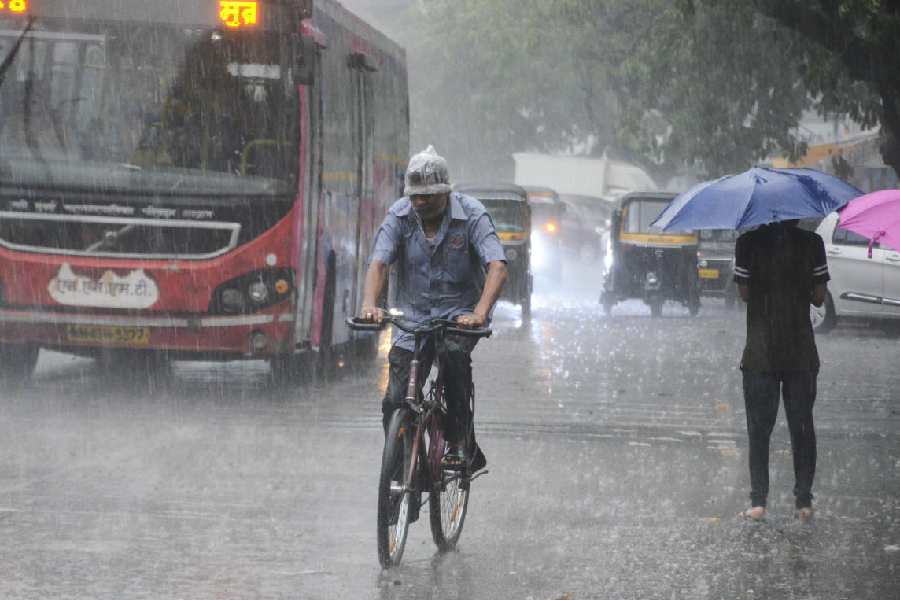
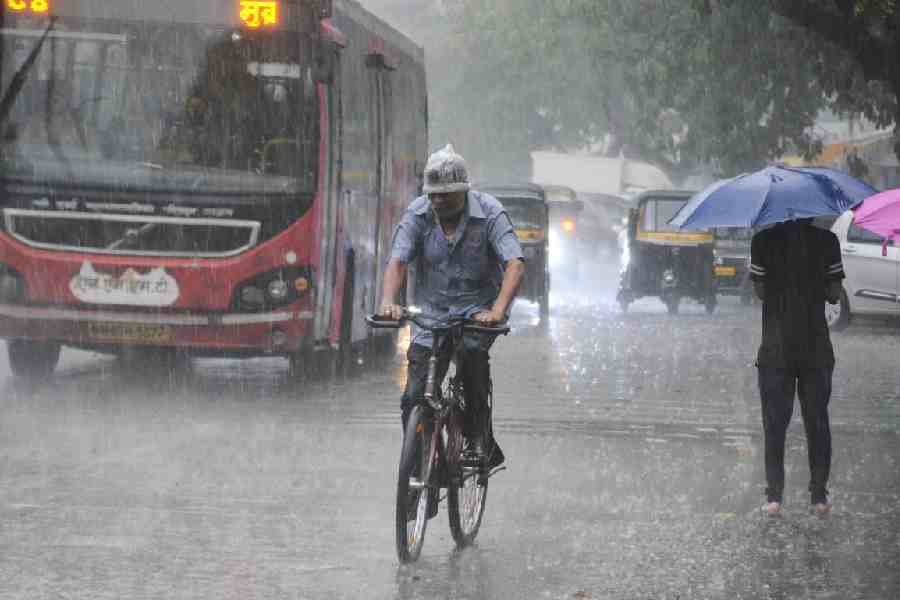
Residents of Delhi typically hate heavy downpours. Despite the annual claims of the Municipal Corporation that they have cleaned all rainwater pipes, Delhi’s streets get flooded every time it rains. This year, Delhi’s reaction to downpours has been unusual. It rained fairly heavily a couple of days ago, forcing cars to crawl along flooded streets. Nevertheless, we are all looking forward to more showers in order to get some respite from the sweltering heat.
Farmers in the northwest and several other parts of the country are waiting for torrential rains even more anxiously. This year’s monsoon has been conspicuous by its absence — the latest estimate from the meteorological department is that the deficiency in rainfall has been as much as 19 per cent. Despite quite large investments in agriculture over the years, irrigation facilities remain limited, and much of Indian agriculture remains dependent on adequate rainfall. So, the inadequate rainfall will ensure that this year’s kharif or summer-sown crop output will be much less than the output produced last year. Of course, the effect will not be uniform. In particular, the planting of rice and sugarcane has been lagging far behind the levels last year, while the wheat output, which is less dependent on rainfall, will be almost “normal”.
This has given rise to apprehensions that the shortfall in agricultural output this year may result in an increase in food prices. The possibility of a rise in food prices sends alarm bells ringing in government circles because even a slight rise in the price of basic food items puts the government on the defensive. It must appear to take firm and decisive steps to control any increase in food prices. Perhaps this explains the government’s decision to ban the export of wheat and non-basmati rice through diplomatic channels. While the private export of wheat and non-basmati had been banned long ago, the previous United Progressive Alliance government had earlier decided to allow the export of 2 million tonnes each of wheat and non-basmati rice to governments of developing countries essentially as a gesture of goodwill. Obviously, domestic pressures have been given higher priority than brownie points earned from foreign governments.
The latest ban on food exports is more of a knee-jerk reaction rather than a measured response to any impending crisis. We now have a comfortable buffer stock of food grains in the country. By the agricultural minister’s own reckoning, these stocks are enough for 13 months’ consumption. This suggests that the overall food situation is quite comfortable. The government can control the retail price of foodgrains by releasing sufficient quantities from its burgeoning stocks. Having said that, a word of caution is also in order. Prices of pulses may well go up if output dips alarmingly during the course of this year since the government does not hold sufficiently large stocks of these items.
Of course, we also need to consider the implications of the government’s decision to implement a “right to food act” on the food economy of the country. President Pratibha Patil’s inaugural speech mentioned the government’s intention to provide each below-the-poverty-line family with 25 kg of foodgrains a month at Rs 3 per kg. This pledge was reiterated during Pranab Mukherjee’s budget speech. It is not clear when the act will actually be presented in Parliament, at least partly because there is some controversy about whether the “right to food” should be narrowly defined to include just foodgrains alone. Many social activists would like to give a very broad meaning to the right to food, including within it food items other than just grain, childcare and clean drinking water. But, hopefully, the government and its critics will soon arrive at a workable definition of the right to food, and the BPL families will soon be issued their quota of food at subsidized prices. This will undoubtedly result in an increase in the aggregate demand for food. However, even this need not worry the government unduly given the stock of foodgrain available in the country.
The main problem once this act comes into being lies elsewhere. How will the government ensure that the foodgrains reach the target families? What is the delivery mechanism? This will pose the biggest challenge to the government. Apart from some stray articles, there has not been any discussion at all about the pros and cons of different delivery mechanisms. This is all the more surprising since the Right to Food Act, in whatever form, promises to be one of the most important redistributive schemes ever adopted in this country.
This virtual silence suggests, at least implicitly, that the government has already decided to rely, more or less completely, on the public distribution system. The PDS has become something of a sacred cow, with many people even refusing to consider that there can be credible alternatives to the PDS. Unfortunately, this view completely ignores the shortcomings of the PDS — of which there are many.
For instance, large sections of poor households do not benefit at all from the PDS — even from the targeted PDS whose principal beneficiaries are supposed to be the BPL families. Fairly large fractions of BPL families do not purchase any foodgrains from the PDS. This is due to a combination of factors. In the north and east, limited geographical coverage is the principal culprit. In other areas, there are institutional barriers such as the need to prove residence and buy ration entitlements only once a fortnight, the latter being difficult for BPL families.
There is also a huge cost of providing subsidies to the poor through the PDS. Indeed, some estimates suggest that it may cost the government more than three rupees to provide a rupee of subsidy to the target households.
The system of food stamps provides an alternative to the PDS. Under this scheme, the government issues coupons to the target families. These coupons can then be redeemed at any shop for specified quantities of foodgrains at stipulated prices. The effectiveness of food stamps obviously depends on how efficient it is in delivering foodgrains to the consumers relative to the PDS. There are good reasons to believe that the system of food stamps may be better than the PDS. For instance, there cannot be any chance of illegally diverting grains to the open market. Procurement and storage costs are also substantially higher in the PDS. All this suggests that the government experiment with this system in some areas. |