|
|
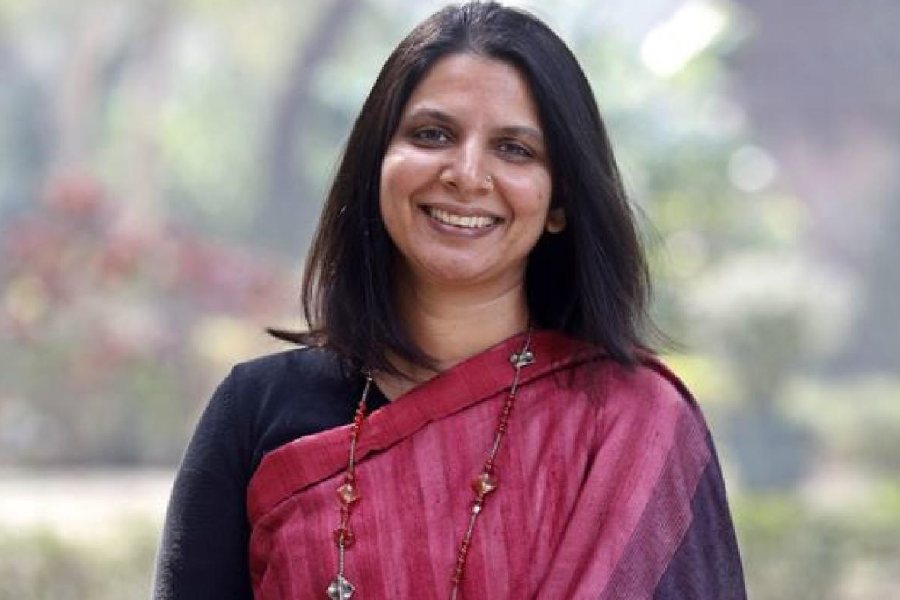
Monica Dematte' at Studio 21 on Tuesday evening before her lecture. Picture by Biswarup Datta
|
Chinese contemporary art is very much in the news but little is heard or read about landscape as an art form in China, where this genre used to be a quintessentially Sinic art form. Monica Dematte' from Italy, who has for the past 20 years lived and researched contemporary art in China, and is friends with many practitioners, gave an informative and lucid talk on landscape art in China today at Studio 21 on Tuesday evening. Her talk was accompanied by a slide show that provided illustrations of the various paintings, photographs and artists she talked about.
Dematte'’s talk brought to life a China after the depredations of the Cultural Revolution and continued to the present times when urbanisation and industrialisation at a breakneck speed have left in their wake a barren countryside and cities from which the older quarters have been erased to make way for faceless condominiums and other structures without any identity of their own.
Without naming and identifying the artists and photographers as Dematte' did, suffice it to say that she began her talk with the aftermath of the Cultural Revolution with its smashed up homes and possessions. A series of photographs focused on the garish landscapes with touristic and futuristic structures mushrooming everywhere. “They demonstrate the power of the government but they don’t make you feel warm,” she commented.
Porcelain — fired in the town where imperial porcelain was once produced — was still used for creating installations. One artist, who was invited to the Venice Biennale, created a map of Venice with porcelain moulds of real objects. He could not attend because of the SARS scare. A series of photographs focused on the no-man’s land on the outskirts of cities which were without cultural identity. In another blurred area, a shadowy monument loomed in the background, with a jet black dog dominating the background.
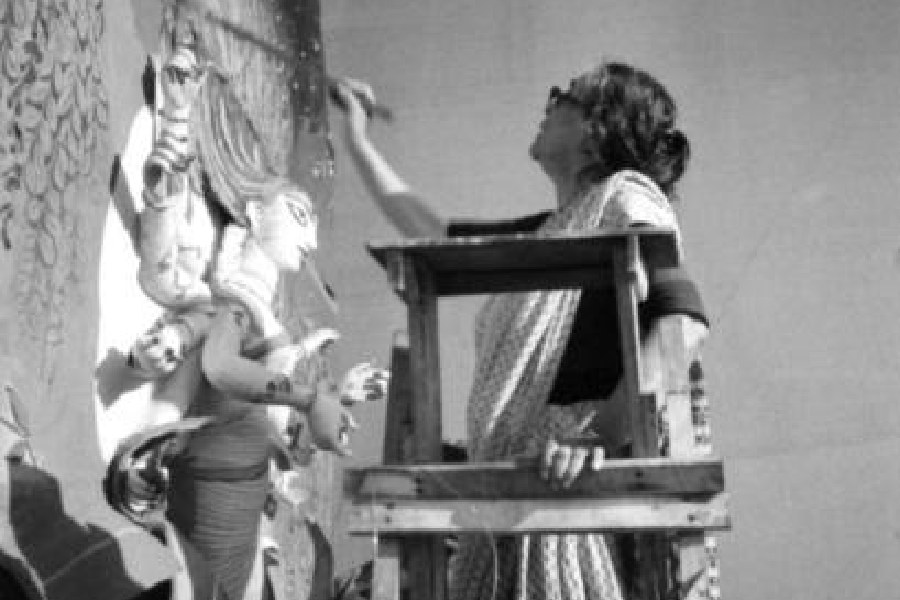
In the second section of her talk, Dematte' discussed human beings in Chinese landscapes which were always symbolic. In paintings in gloomy shades, chimneys stuck out of landscapes, signifying not industrialisation but the vacuum left by the ban on religion. One artist has set up a scaffolding in the middle of a village with a giant canvas with only peasants for viewers — a rare privilege for peasants at a time when artists rarely paint in public.
In Taiwan, Dematte' said, artists are much more keen on tradition as they are nostalgic about it. They use acrylic and oil, but do not use skills evident in traditional paintings. The most interesting were those artists who related to tradition in an ironic way. Dialogues on radio were scrawled across backgrounds, waterfalls sprang out of nowhere, parodying old work. Then there were conceptual paintings with calligraphy. Even an obvious admirer of Cezanne referenced traditional landscapes.
Gardens played an important part in traditional life and symbolised the macrocosm. Some works today were inspired by these. Another artist used a camera that rotated 140 degrees. So there were panoramic views of mountains and industrial landscapes. One artist painted landscapes with humans like specks of dust or even insects. But these were not appreciated in the international market, although as art works they were of a high quality. A tension between market demands and aesthetic sensibility exists everywhere.
|