|
|
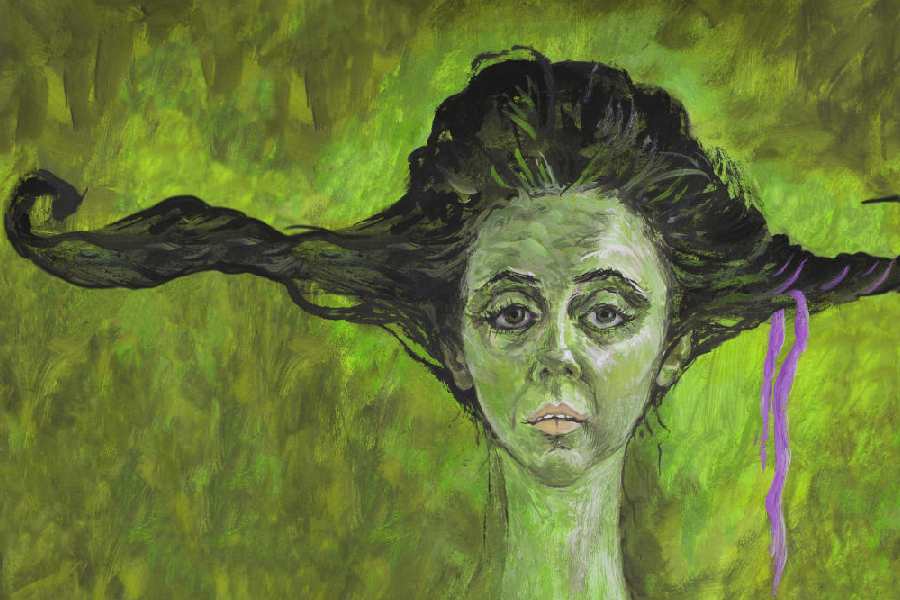
A work by Katayun Saklat. Picture by Aranya Sen |
Katayun Saklat’s exhibition at Gallery K2 comes as a revelation to those who have known her as a gentle and unassuming sort of a person who could have nothing to hide.
Here, in keeping with the title of the exhibition, An Inner Journey, Saklat has chosen to spill the beans on none else but herself, exposing her ability to distance herself from painful personal experiences and create somewhat disturbing though not morbid images of people with mental illness.
She depicts experiences that can only be described as mystical, and also a bizarre and dark personal world of puppets with a life of their own, a studio as a crucible of creativity, and a levitating doll in a work that is otherwise a skilfully painted but very run-of-the mill still life.
It is easy to detect the influence of the modernists in her early work but Saklat always adds something of her own in her paintings. This is particularly true of her drawings of her family in which sisters share a bed while sprites or fairies dance around them, an elderly woman seems to have visions, and another is absorbed in her daily chores or her painting, as the case may be.
Some of her paintings are heavy with symbolism, perhaps of Zoroastrian origin, but like the visitants, who figure prominently in her work, Saklat has the ability to present this with such directness and honesty that one accepts this unquestioningly.
Her recent works in which she portrays a victim of Alzheimer’s disease are so powerful for the same reason. The artist’s gaze is unflinching and one can feel the pain of the old and afflicted woman. But Saklat has a lot of time and patience for her.
Anindita Dutta was cooped up in a room in Santiniketan for several months and created overblown replicas of the pelvic bone and the spinal cord with resin and canvas cloth that she has displayed in Galerie 88, whose walls have been painted red.
The “bones”, stitched to perfection by the artist, become a striking metaphor of death as red “entrails” tumble out of their hollow, or, as in her paintings with water-based ink, a screaming head is inserted in that emptiness.
The bones, some resembling the relics of dinosaurs in museums and spread across the floor of the gallery, have the quality of sculpture, although the viewer may find them somewhat intimidating, like the portents of death. The most effective of these “sculptures” are the ones of the spinal cord with the heads dangling from them. These are compact forms that tell their story without any flourish.
This exhibition by Dutta, a young artist trained in Kala Bhavan and several prestigious institutes in the US, will possibly make a strong impact.
Galerie Karma is a new exhibition space in Keyatala Road and the group Ocular is holding its first show here.
All the four participants are newcomers and none was trained in any of the better-known art schools. They could easily have pursued careers in the subjects they studied in college and university, but were willing to take the risk by taking up art instead.
Prithwiraj Sen’s scribbles juxtaposed with figures, some of African and folk origin, look interesting enough coming from a relatively young artist. Sayak Mitra has painted photo-realist images of people who are actually more than what they seem to be.
The child labourer wearing peacock feathers could be Krishna himself. Kaushik Saha is not too bad so long as he sticks to simple images and primary colours.
Sabyasachi Saha paints like any other art graduate of his age, but even this quality is marred by his penchant for dragging in iconic names. As a matter fact, all these artists would do well to avoid pretentiousness at all cost. |