The Telegraph
 
 
IN TODAY'S PAPER
WEEKLY FEATURES
CITIES AND REGIONS
ARCHIVES
Since 1st March, 1999
 
THE TELEGRAPH
 
 
Email This Page

Mother India’s “welcome home” for her children

We all know there are over a billion Indians in India. What is sometimes forgotten is that there are also an estimated 30 million Indians scattered in 130 countries across the globe and last week it seemed most of them were in Chennai for the 7th Pravasi Bharatiya Divas.

The actual number of delegates was 1,500-2,000, with Malaysia, where Indians are apparently suffering a fair bit of discrimination, leading the attendance table with 270, and the United States, where Indians were influential in championing the nuclear deal with India, second with 217.

That Mother India should reach out to her children across the world by staging a divas for the diaspora seems a wholly laudable enterprise.

“The time has come for overseas Indians to benefit from the exciting opportunities that India provides,” enthused Vayalar Ravi, the energetic, Kerala-origin minister for overseas Indian affairs.

It would be even better if the countries where Indians are settled, could also see greater benefit from such opportunities. But the diaspora, it has to be said, is rather a mixed lot.

“We, in the UK, are not isolated,” remarked Baroness Shreela Flather, one of those honoured this year with the Pravasi Bharatiya Samman for services to India and Indians.

When her lawyer husband, Gary Flather, who is confined to a wheelchair, complained India does not make too many concessions to disabled folk, the audience applauded.

Some Indians now practically commute from the UK, especially if they are like Lakshmi Mittal, with access to a private jet. But what was especially moving was the encounter with fourth generation Indians, whose parents and grandparents were born in, say, South Africa, and whose forefathers might have left as indentured labourers 150 years ago from UP or Bihar and who were making their first visit to India.

It was touching that President Pratibha Patil was able to offer an intimate touch: “Let me begin by saying, ‘Welcome home.’”

It was humbling to meet journalists Monika Singh, from Fiji, and Fareeza Haniff, from Guyana, who, like quite a few others, were visiting Mother India for the first time.

Poor Monika had to be up in the air for nearly a day to get to Chennai via Sydney and Singapore.

“It’s the trip of a lifetime,” Monika said simply.

Tagore talk

We Indians are fond of literary references. In Chennai, Manmohan Singh referred to “my friend Prof. Amartya Sen” and argued: “We Indian people have been over the centuries an argumentative people. But I also say we have been a consensual…”

I thought he was going to say, “sex”, but he said, “civilisation”.

As chairman of one panel, the columnist and former UN spokesman Shashi Tharoor, was probably not being sarcastic when he expressed admiration for Pranab Mukherjee’s ability to quote from the poet whose work much exercises the corridors of power in Delhi.

The external affairs minister, addressing the diaspora as “members of my family”, observed: “In the words of the famous 16th century metaphysical poet John Donne, ‘no man is an island…every man’s death diminishes me’. When death is caused by terrorism, it diminishes mankind.”

He made a fair point about a possible conflict of loyalty between being, say, British and Indian: “We can all have multiple identities. None of these multiple identities needs to conflict with one another.”

To be sure, a Bengali academic, Sumit Ganguly, professor of political science from Indiana University, received a Pravasi Bharatiya Samman. But to compensate for the apparent lack of a Bengali diaspora, Professor Sugata Bose, from Harvard, quoted Tagore — naturally in Bengali. He provided an English translation to explain the poet’s already developed international outlook when he undertook a foreign pilgrimage in July 1927.

Sam Pitroda is a telecoms giant but, alas, he used the business-speak banned from the best British newspapers — “going forward”.

Boys from Bihar

Among several chief ministers or ministers from the states making their pitch for investment, the one who stole the show was Narendra Modi, who emphasised that he had attended every Pravasi Bharatiya Divas since the first in 2003. While other states were struggling to achieve growth rates of 7 per cent, Gujarat had been the only one “with more than 10 per cent”, he boasted.

Haryana’s power minister, Randeep Surjewala, sought to put Modi in his box by commenting that the tractors Modi was so thrilled to be using were all built in, where else, but in Haryana.

The Lt Governor of Andaman & Nicobar, Lt Gen (Retd) Bhopinder Singh, was fascinating about the marine life around his “572 islands, big and small”.

The one who won me over was Sushil Kumar Modi, Bihar’s deputy chief minister, who began: “Bihar has a population of 90 million and is one of the most backward states.”

Perhaps Bihar will now be successful in attracting sentimental investment from its numerous diaspora who can visit Bodh Gaya and Nalanda University and try and discover their villages of origin by registering with the newly-established “Bihar Foundation”.

My partiality for Bihar may not be entirely unconnected with a happy childhood at St Xavier’s in Patna, which was a peaceful, sleepy town with no law and order problems I can remember.

Taste of India

Visiting journalists were given a number of tours, led by Viraj Singh, an engaging official from the ministry of external affairs, who expressed the personal opinion that Bollywood stars had been quick to appreciate the financial benefits of cultivating the diaspora.

On one visit to Polaris, the biggest IT company in Tamil Nadu, the senior management was questioned about the Satyam Shivam Fraudam phenomenon but the firm’s head of marketing and communication, Padmini Sharath Kumar, intrigued her visitors with the disclosure that the chairman preferred to hold board meetings with everyone sitting cross-legged on his office floor.

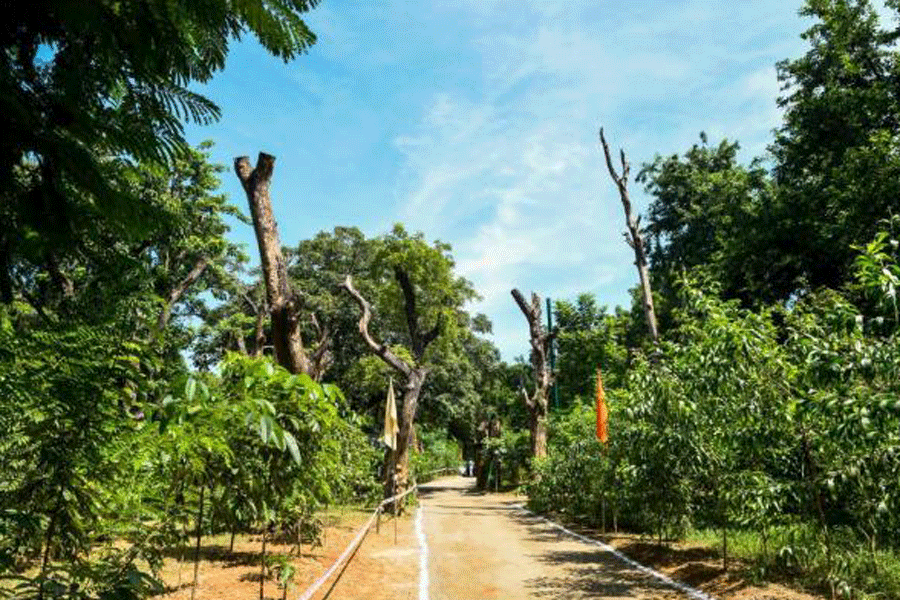
IIT Madras had an idyllic setting in forest land and plenty of exceptionally clever students. Even MIT students from the West would have difficulty in getting in, claimed Professor V. G. Idichandy, dean, students, with more honesty than arrogance. It was a place where I felt I could have spent three years though, of course, I wouldn’t have got in.

Tittle tattle

Manmohan Singh reminded me a little of President John F. Kennedy when he referred to the Indian satellite Chandrayaan, now orbiting the moon, and pledged: “I assure you, ladies and gentlemen, that one day an Indian, desi or pravasi, will complete that journey and we will be able to land on the moon from India.”

Clearly, India has come a long way for there were no jokes about the Gujarati diaspora opening the first corner shop on the moon.

Top
Email This Page