TT Epaper LHS
The Telegraph
TT Mobile
 
 
IN TODAY'S PAPER
WEEKLY FEATURES
CITY NEWSLINES
FEEDS
  RSS
  My Yahoo!
SEARCH
 
Archives Web
 
ARCHIVES
Since 1st March, 1999
 
THE TELEGRAPH
 
CIMA Gallary
 
Email This Page
The rite of strings
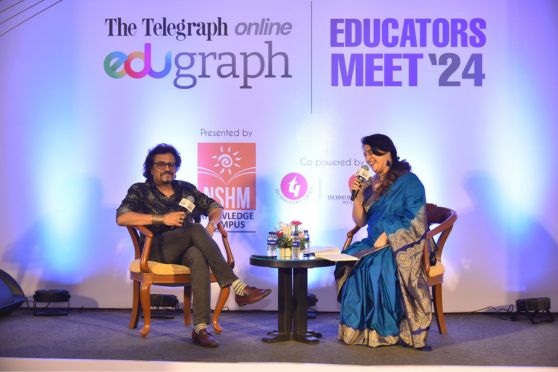
Pandit Debashish Bhattacharya performs with brother Subhashis Bhattacharya on tabla

Calcutta Chronicles: Indian Slide Guitar Odyssey, the 2008 solo album from Indian classical guitar maestro PANDIT DEBASHISH BHATTACHARYA has been nominated for a Grammy in the Best Traditional World Music Category.

It is an important nomination, since Bhattacharya is not just a master musician but an innovator par excellence, who has ushered in a new wave in the world of classical guitar with his trinity of custom-made, new generation slide guitars — the Chaturangi, the Gandharvi and the Anandi. The Chaturangi has 22 strings, which enable it to suggest the timbres of violin, sitar, sarod and veena. The Gandharvi is a 14-stringed guitar that can sound like a veena, sarangi, saz or even a flamenco guitar, while the much smaller four-stringed Anandi is quite like an ukulele, played with a slide.

A student of the guru of Indian classical guitar, the legendary Pandit Brij Bhushan Kabra, Bhattacharya has collaborated with luminaries across the jazz and fusion worlds, including guitar maestro John McLaughlin, guitarist and ‘ethnomusicologist’ Bob Brozman and bassist Jonas Hellborg. t2 catches up with the Pandit for a one-on-one, on trials, tribulations and the joy of making music...

Congratulations for the Grammy nomination for Calcutta Chronicles in the Best Traditional World Music category. What’s the first thought on your mind?

Thank you. Well, it’s a wonderful feeling that my work with guitar and Indian raga music has been seriously noted the world over. My nomination is for my solo album Calcutta Chronicles with my brother Subhashis on the tabla. I have also played on a track in my friend John McLaughlin’s album Floating Point, which has been nominated in the Best Contemporary Jazz category. I’ll be doubly happy if John wins the Grammy as well.

Tell us about the new album: the personnel, the sound, the milestone it signifies in your career thus far...

I feel happy that the guitar, which was essentially looked upon as an instrument used in “light music”, has become a serious instrument. I can proudly say that through my trinity of guitars, it has become an instrument capable of playing raag music in all its true colours; it is now a modern instrument deeply rooted in tradition.

Calcutta Chronicles: Indian Slide Guitar Odyssey is not another straight, concert-style performance of a long raga, but it is a showcase of my experiences while growing up with the guitar as my primary instrument, in the musical environment of Calcutta, which is largely classical but has global influences as well.

l the tracks on Calcutta Chronicles have a story to tell, thus the album title. It took three years of planing and recording to put in an album all that I experienced for nearly four decades. The music represents my happiness, sorrow, humiliation and challenges each day and infinite love from countless people who associate my music with my trinity of guitars.

My brother Subhashis has been playing with me ever since I started playing the guitar. My friends in India and overseas have been a constant source of support for creating this autobiographical album.

A nomination in the Grammy Awards, in my own capacity as a classical musician from Calcutta without anyone to emulate as far as the guitar is concerned, is going to help me do better work in serving my country’s traditional music for a contemporary audience worldwide.

What have been the reactions of your gurus?

Pt Ajoy Chakraborty and Pt Brij Bhushan Kabra have blessed me. I feel proud that I could carry forward the task of playing raga music on guitar, which was started by Pt Brij Bhushan Kabra.

How difficult has it been being a classical slide guitarist in the often rigid Indian classical world?

It was certainly a challenge and the recognitions are the rewards. When I started playing raga music, I was often sneered at. Connoisseurs and artistes both showed disrespect for playing raga on guitar. I still recall comments from great maestros who strongly opposed raga music on guitar. I had to change the guitar and the way of playing to excel. When I started playing raga music on the guitar, there was no set goal in front of me. Four decades later, I can humbly say that I have set a goal for others to follow.

By and large, Calcutta Chronicles comprises slower, more moving pieces created on moody raagas — like Ganga kinare and Rasika — than your previous records. Is there a reason for this turn in pace?

I think you should also listen to Aviskaar and Maya, pieces based on ragas like Charukeshi, Kalavati, Bhairavi and Pilu. Despite my reputation for speedy solos, this album has more variety, which excites the listener and not by speed alone. It has a lot of other stories to tell.

Who are your favourite slide guitarists?

I would mention names of guitarists of all styles, like Pt Brij Bhushan Kabra, John McLaughlin, Jerry Douglas, Derek Trucks, Joe Satriani, Gary Lucas, Bob Brozman, Martin Simpson, John Fahe, Ken Wessel, Led Kapana, Carlos Santana and many more. But my all time favourites are (Hawaiian guitar maestro) Tau Moe and (blues legend) B.B. King.

One of the most significant aspects of your sound is the combination of Hindustani and Carnatic classical elements. How do you go about creating this unique blend?

I see Indian classical as being one in principle. It is only my feelings that get translated into music.

It is also a now-celebrated fact that Pt Debashis Bhattacharya’s music is an “outward-looking take on tradition”. How does one respect tradition and yet move forward, especially in the context of classical music?

One has to be honest and truthful. I believe in a simple idiom: They conquer who believe they can. Our devotion to music has to be of prime importance. Perspectives in seeing music in constantly changing scenarios have to develop. Prejudice, back-biting and jealously have no place in the way I see music.

So what’s next? Any plans to cross over to the mainstream industry in India?

As of now, I plan to do more riyaaz and learn more from gurus. I also need to seriously find more time for my family.

There are no plans as yet about crossing over, but I always keep an open mind. I would definitely like to give anything possible musically to mainstream music lovers.

Arka Das

What do you think of Pandit Debashish Bhattacharya’s achievement? Tell t2@abpmail.com

Top
Email This Page

Comments
Be the first to post a comment!
Post a Comment
Name:

Email:

Emailid:

Comment:


By clicking on Submit you agree to abide by our Terms and Conditions. telegraphindia.com is not responsible for the contents posted by viewers.
Top