|
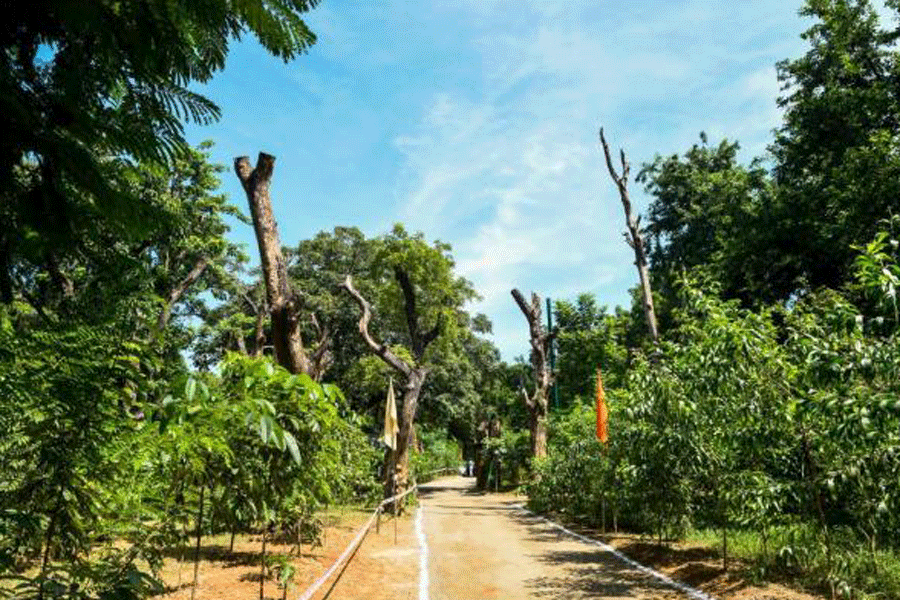
Once upon a time there were only rice fields and large ponds. I don’t remember those days because I wasn’t born then. I’ve heard it said clusters of huts dotted the fields. Sonar Bangla was this close. At times a lone man would sit under a tree with his fishing rod hoping to catch something from the pond — a couple of which, maybe more, are still there. But all this is part imagination and part hearsay.
The before never bothers us. It’s the after that’s the problem. I am a road. But I’m not just any road – there aren’t any any roads, really, each of us is unique. I’m a bypass. I was created to save a city, which I’ve never had the privilege to see. Visitors — there are many that crawl across my supine, unsmooth body every day — tell me, “Boy, you haven’t missed much”. There are some locals too who confirm in vervy vernacular the visitors’ view.
I’ve been told that I was conceived — on a drawing board — sometime in the early Sixties of the last century under what was called the Basic Development Plan, the first such for Calcutta, with funds from the Ford Foundation. Sometimes I feel in my dark moments that the source of all my suffering lies in my American-sponsored origin. “American” is a much-mauled word in this part of the world. Who doesn’t know no good can come of something American? Another word that’s hated in this neck of the woods is haste. People here prefer to study things over and over again, shelve them for a time allowing them to gather dust, and then dust them and shelve them again.
I can’t tell for sure if the story leading up to my birth in the Eighties — Calcutta had just come out of a not particularly happy decade, though a bypass wasn’t probably the healing touch it needed — had been nursed with such great deliberation. All I know is the push from shelf to shelfless existence for me came from Delhi in the crisp form of Rs 150 crore of cash for Calcutta.
Many hundred crores have flown down my now-scarred body since. I am now grown-up, at 16 kilometres long. But at no kilometre is my body perfect. The annual nips and tucks post the rains don’t help. I’m spilling out at the sides, not a bad thing for roads, though not so good for you of blood and flesh. Now I am a fat lot better than I was when I started my life in the narrow lane – two to be exact – from Ultadanga to the Park Circus connector. It took only a few years to gallop to the Kasba crossing but another decade to snail to Garia.
 |
NORMS ACCORDING
TO THE PLAN
1.Waste recycling region
(WRR), or Dhapa: No
land-use change, or development,
was allowed
2. S-1—Agriculture along
with business buildings,
assembly buildings
and mercantile buildings
and incidental facilities
permitted
3. RI—Residential and
industrial with
agriculture
4. T—Only CMDA
townships were allowed
5. R—Residential
REALITY CHECK
● In the last decade
and a half, a number
of commercial
establishments and
even an engineering
college have come up in
the waste recycling area
in violation of the plan
● Agriculture is permitted
in the entire zone, except
the township zone, but is
practised only in the
waste recycling area
● A large number
of commercial
establishments have
been constructed
next to residential
buildings in the R zone
● Height restrictions
are flouted
●There was a provision
for taking approval from
the CMDA for any project
within 500 metres on both
sides of the Bypass but
got swamped under the
real-estate boom |
My conceivers or conceptualisers had willed me to be 10 lanes broad. Alas, I’m yet to reach that scale of breadth, though there’s a stretch between the stadium and the Hyatt where I’m close to 10 lanes. My parents had thought of a 10-lane expressway, mind the terminology (EXPRESSWAY), with service roads on either side.
It’s with some sadness that I admit I don’t have any servants, which is what service roads are supposed to be, along any of my 16-km length. So I am master, servant rolled into one. I can’t, by force of circumstances, therefore, be the expressway you want me to be. When I was young or in my teens, it used to feel good, as if I, a piece of inert asphalt, were flying when you flew down in your cars unbridled by red and amber or by men strolling across. I was born to speed. But now it’s a forbidden taste, to be sampled on breezy late nights that carry the filmy-eyed young, at times to tragic ends.
Unhappily then I’m not as broad as I should be. Nor am I skirted on either side by the green verge that protects my brothers in cities like Hyderabad. I can’t also be the expressway that was to merge into another expressway vrooming the city to the airport before you could say VIP. From what I hear my expressway mate is in far worse state than I am. If I was meant to ferry wheels around at 100km an hour but can manage on some stretches half of that, VIP Road, better known as Kazi Najrul Islam Avenue, is happy the day it can make 20-30 without spilling blood.
Reminds me I too have a mouthfilling name, Eastern Metropolitan Bypass. I realised soon after birth how wrongly I was named. I was clogged with noxious smell rising from skin factories washing and sunning the sin off animal hides. Citizens would have an embarrassing time apologising to their foreign guests when they passed those spots. Some of the skin merchants have skedaddled to torment a spot farther south. But if the stink isn’t rising any more, something else is.
In my age of innocence, the world around was rice and vegetable fields, some of which flourished on the detritus of the city dumped at places near me.
I forgot to mention that what the city disgorges causes a hell-stink too. Filth trucks drop on me their unwrapped gifts on their way to the grounds that enfold in their embrace the city’s excrement.
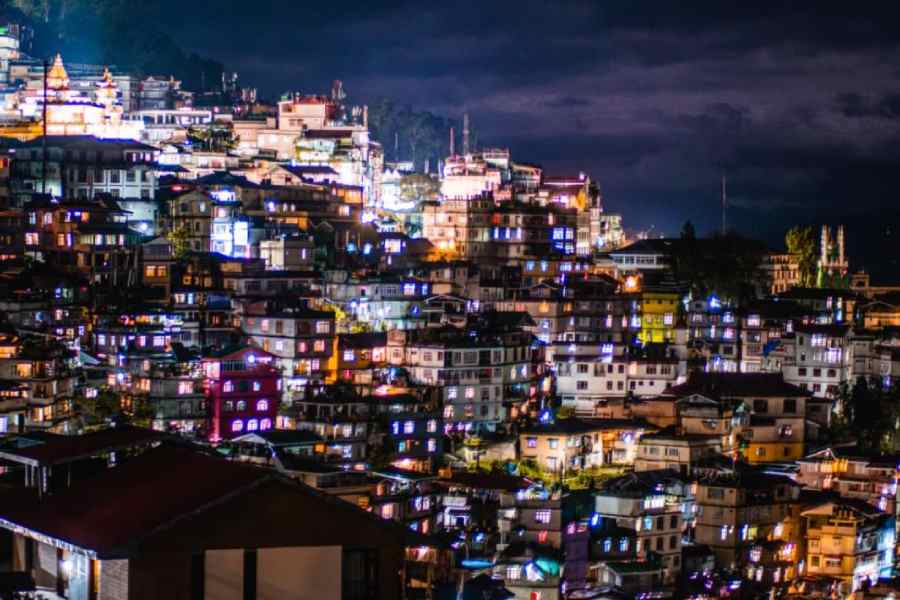
I had got used to the city’s stink. But had no idea its perfume would be suffocating. A giant development has come up offering high-priced living to the perfumed set. They’ve been thoughtful enough to provide lunching and dining-out options on the property itself, not to speak of five-star hospitality up and down the road. My view to the west, the way the city lies, has been blocked off all along the 16-km stretch by brick-and-mortar monsters, throwing height restrictions out of the window, I am told. As I’m forced to live with the dust of development, I hear there’s a rising cry that all this real estate is damming the flow of rainwater down the natural west-east slope, rushing Calcutta towards a waterlogged death.
I’m, however, more worried about predictions about my own demise sometime around 2015 by a representative (who prefers to remain anonymous) of my minder, the Calcutta Metropolitan Development Authority. A road doesn’t quite die, it subsists in a clogged-up deathlike existence. You know what I mean: like all of your roads — Chowringhee, Central Avenue. What you call arterial roads out of astonishing ignorance. If they functioned like arteries, I wouldn’t be needed.
I hear that my chances of survival in better conditions lie in the plan for another road that also starts its drawing-board life as an expressway — Eastern Expressway — through Rajarhat. A bypass to bypass the Bypass. But my younger brother will have a harder time getting from the blueprint to the ground because land has become tougher to acquire this first decade of the 21st than it was in the Sixties of the last century.
I ought to feel happy my rival, who will snatch my exalted bypass status, has such a dim possibility of seeing the light of day. But, despite being a crabby Bengali by birth, I don’t. Because in my rival’s birth depends my continued survival. Either way, however, I’m damned. I die a thousand deaths a day as another jammed-up artery or I live in the shadow of an expressway as a bypass that’s not the Bypass.
You know what I mean.
WHAT WENT WRONG
In a 1997 study, the architecture department of IIT Kharagpur said the Bypass is plagued by several ills. The report found:
- No section or intersection
provides service adequate
for an expressway
- Unlimited access at several
points along the road converts
it to a low-speed one
- In certain parts the land
use along the roads is
gradually changing into
shops and establishments
- Improper intersections
are causing delay
- Reduced capacity of
the road due to hindrances
- Mixing of slow and
fast-moving vehicles
- No defined lanes and
traffic discipline
- No properly defined bus bays
- Lack of pedestrian facilities
In the over 10 years since
the report, the problems have
got worse |