TT Epaper LHS
The Telegraph
TT Mobile
 
 
IN TODAY'S PAPER
WEEKLY FEATURES
CITY NEWSLINES
FEEDS
  RSS
  My Yahoo!
SEARCH
 
Archives Web
 
ARCHIVES
Since 1st March, 1999
 
THE TELEGRAPH
 
CIMA Gallary
 
Email This Page
Self help tips for mom and dad
book bazaar

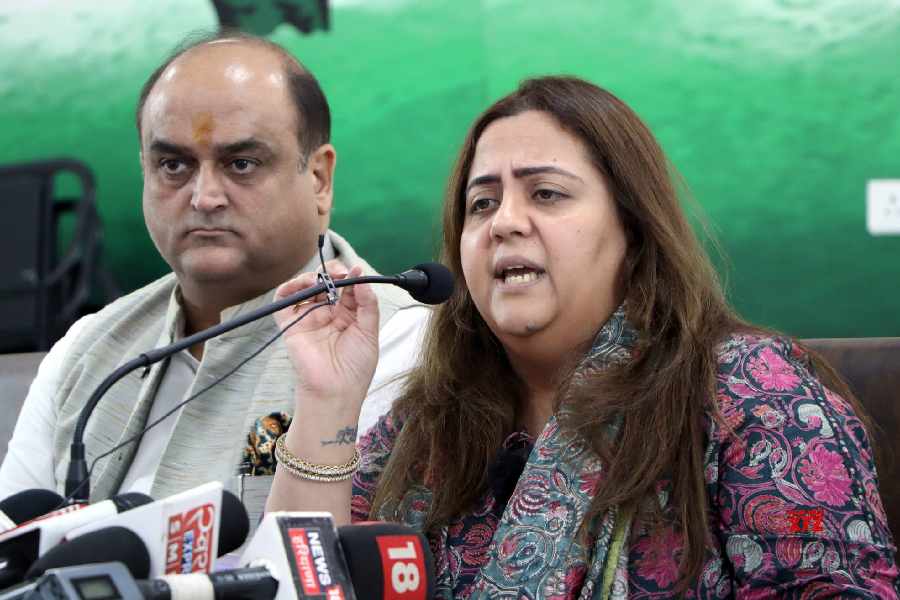
I’m always full of advice and lectures,” grins Raksha Bharadia, the author of self-help books like Me: A Handbook For Life and Chicken Soup for the Indian Soul.

Her third book, Roots and Wings, A Handbook for Parents, was launched last Tuesday at Crossword, Elgin Road. Raksha, with her curly hair, dusky skin, wide smile and that instantly approachable attitude reminds one of Arundhati Roy, if Roy could be cuddly.

Her book includes personal anecdotes by Kumar Mangalam Birla, Jaya Bachchan, Sachin Tendulkar, Jogen Chowdhury, Mrinal Sen and Hemant Trivedi.

Mother of two (“one 10 and the other 13”, she smiles), her greatest parental challenges are letting her children be and make their own decisions when she can see that she can help them do better.

“My husband and I were playing Scrabble with our daughter and she kept making three-four letter words. Good words may be, but she wasn’t making any points. Then she made a six-letter word. I pointed out that she could have gotten a triple word score with the word Bee. But in my zeal to be helpful I made my daughter lose something. She lost her first six-letter word,” she smiles.

So is it possible to teach something as personal and as hands-on as parenting through a book?

“I’m not preaching. I give statistics to point out common problems and state the experiences of common people and celebrities. I’ve interviewed 250 celebrities and 500 common people for the book,” she says.

P.G. Wodehouse once said: “I always advise people never to give advice.” Bharadia may not have heard.

Surfing vs reading

Are our kids reading enough? Most parents would answer that in the negative. But at Oxford Bookstore last Friday, panelists agreed that they were doing enough.

If children aren’t reading books, they are surfing the Net, which actually means that they might not be reading the printed word but reading whatever there is on the Net. Which is not such a bad thing altogether, pointed out Palash Baran Pal of the Saha Institute of Nuclear Physics.

Pal was part of a panel discussion organised by Scholastic India as part of their annual programme One Nation Reading Together, “a nationwide read-a-thon that celebrated the importance of reading” on November 28.

Apart from Pal, children’s author Sampurna Chattarji and clinical psychologist Rima Mukherjee put forth their views. While Sampurna thought that children should be allowed to read whatever they wanted to or liked, Rima thought parents should do more to inculcate reading habits among children.

Absent from the discussion was Malini Bhagat of Mahadevi Birla School. It would have been interesting to have a school principal’s insight on a key issue of children’s education.

To save the word

This was to save the book in the age of high consumerism. A week-long book festival concluded at the State Central Library in Ultadanga recently. The event was organised by National Book Trust (NBT), a ministry of human resources development wing, to celebrate National Book Week.

“Our target is book promotion. This event was held across 14 states to increase readership,” said Bratin Dey, assistant editor (Bengali), NBT.

At the inaugural session, writer Amalendu Chakraborty stressed on the need for such literary endeavours for books to survive in this age.

Six books were released, the biggest title among them the Bengali translation of Amrita Pritam’s Na Radha Na Rukmini. There were two foreign titles — John Kilaka’s Good Friends in German and a Japanese tale Prince and the Coral Sea.

On the last day, the book week celebration shifted to Sugandha, a village in Hooghly, for a neo-literate workshop.

“I believe that the reading habit will last till the end of the human race,” said writer Sanjib Chattopadhyay on a hopeful note.

Top
Email This Page