|
|
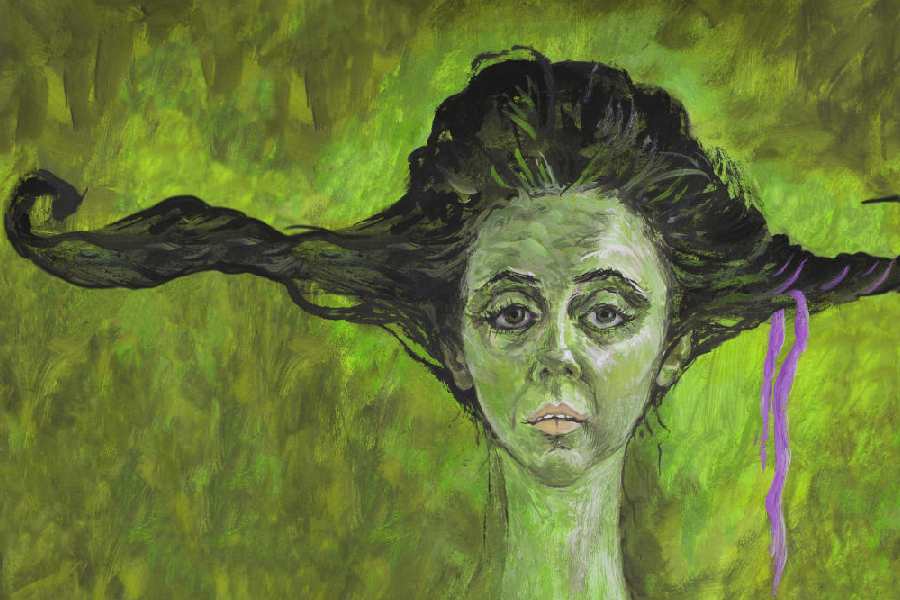
A water colour on paper by the artist that was shown at the recent ShContemporary art fair at Shanghai.Photo courtesy T.V. Santhosh |
Hes a quiet and thoughtful artist from Kerala who insists that he always paints at his own pace and wont be rushed. But that isnt stopping the biggest names in the international art world who are beating a path to the door of T.V. Santhoshs studio.
Hes so popular abroad that his recent shows have almost all been in different corners of the world. In France, a leading collector is showing Santhoshs work at a prestigious private show in Paris currently.
Before that, Gallery Avanthay Contemporary in Zurich held a solo of Santhoshs work, titled A Room To Pray, in collaboration with Mumbais The Guild Art Gallery. In September, The Guild also showed Santhoshs recent watercolours at ShContemporary, the Shanghai Art Fair.
His international popularity is being reflected in the vertiginously rising prices of his work. At Saffronarts Autumn auction of Contemporary Indian art, Santhoshs striking oil-on-canvas diptych When Your Target Cries For Mercy sold for a record Rs 2.8 crore.
The painting returns to a favourite Santhosh theme: its an image of a soldier. But is he a ruthless killer or is he just young and scared?
The Saffronart price tag was a big hike from just a few months early at Sothebys in London when his Advent of A Saviour sold for $226,653.
Ten bidders including British collector Frank Cohen tussled furiously for the work.
Santhosh, 40, is unmoved by his burgeoning popularity. For the last year or two, I have been primarily showing outside India. The thing is that European art critics and collectors are showing a greater interest in Indian art, he says depreciatingly.
|
 |
| (From top) Santhosh likes to explore the complexities of life and is known for his distinctive use of the negative image. In the background is his oil-on-canvas, Stitching An Undefined Border, from his solo show, Countdown,Photo courtesy: T.V. Santhosh; The sculptural installation A Room To Pray was part of a solo show at Gallery Avanthay Contemporary in Zurich recently,Photo courtesy: The Guild Art Gallery (c) The Guild |
In the world of art, hes recognised as a thinking artist. Shalini Sawhney, director, The Guild Art Gallery, who has represented him from his early days, says, Santhosh comes across as a deeply philosophical thinker.
That view is backed by Minal Vazirani, co-founder, Saffronart: Santhosh is very quiet and introspective. I think this personality comes through in his work for despite his gentleness, he forces the viewer to become an active participant in his work.
Indeed, Santhosh revels in the ironic and contradictions and duality are, Vazirani says, a powerful force in his work. His themes are war and terrorism, and hes constantly questioning everything: reality, the business of war, and the notion of technological progress.
Certainly, his work is cutting-edge and tuned to global trends. At the Zurich show, the centrepiece was a large steel, fibre glass and LED panel sculptural installation, A Room To Pray. The gallery also showed some of Santhoshs recent paintings done in his distinctive technique of inverting a positive image into a negative one, with its visually intense palette of neon green, orange and red.
He uses familiar images from the media — be it of a soldier or a hooded man — but in a different context. Says Vazirani: The reason why Santhoshs work resonates with such a wide audience is that he is able to appropriate and re-interpret images that have been repetitively shown on media.
He does this very simply and very cleverly, she says, for he takes the images out of context by using either monochromatic colours or his famed negative image.
|
|
Santhosh, who trained as a sculptor, also does
installations.
Here he leans against
a segment of his
fibre-glass installation,Thus, He
Disclosed The Secret of Destiny-II.Gajanan Dudhalkar |
So when the viewer sees the image in his painting, it forces him to stop and look and ask questions, she says. Like is the hooded man, or a freedom fighter or a terrorist.
Im basically trying to look at the complexity of life, Im not trying to resolve issues in my work, says Santhosh.
Indeed, Santhoshs chief concerns have remained the same over the years. My main concern is still the aspect of violence and terror, he says, seated in his quiet studio in Borivli.
Santhosh is drawn to these issues because hes concerned with what is the kind of reality in which we live. Another concern is the notion of technological progress — and the misuse of technology thats meant to benefit human life.
Actually, Santhoshs work can be divided into two distinct phases. His early work often drew references to wars between countries, especially World War II.
Take Metabolism Test, done in 2003, in which Santhosh took a scene from Ingmar Bergmans The Seventh Seal — he loves watching world cinema — where the protagonist plays chess with Death. The film was set against the plague epidemic in Europe.
|
| |
 |
| War and terrorism are
recurring themes in
Santhosh’s work as in Whose War Is It? II (top) and Your Terrorist, Our Freedom Fighter. Photo courtesy: T V Santhosh |
Santhosh used the scene but I subverted the whole notion of progress and the metaphor of death, he says. The painting has other images: theres a rat laboratory in the foreground and a mushroom cloud in the background.
In Bergmans movie, death is caused by a natural catastrophe. I wanted to convey the whole shift — that death is man-made. I was asking an ethical question about technological progress," he says.
Santhoshs earlier works like Metabolism Test are also monochromatic unlike his later use of intense colours. Also, the earlier paintings are almost photographic.
He says: My intention was to make them look like a photograph yet theyre not photographs. Because in a photograph, you capture a moment in history. Here, its a reconstruction of that history.
So he fused the images gathered from different sources into a single monochromatic canvas where history and fiction, reality and metaphor are fused in an indistinguishable whole.
Gradually, though, Santhoshs monochromatic palette acquired colour. He also began looking at current events, drawing on images from the news media.
|
| |
| When Your Target Cries For Mercy created an
auction record for the artist when it sold for
Rs 2.8 crore at
Saffronart’s Autumn
auction of Contemporary Indian art .Photo courtesy: Saffronart |
If earlier, I used a lot of metaphors, now, there were very direct images, he says. Yet, through them, he raised questions about reality, about the medias role in constructing reality, and who the real enemy is.
It was while manipulating a news image of a street protest on his laptop — he works out every painting on the computer first — that Santhosh accidentally converted a positive image into a negative one.
The result was the use of a device that has led to a distinctive body of work.
I realised that when you turn a positive into a negative, so many transformations take place. Since all the local specifi-cities of the image get obscured, it looks like it could have happened anywhere and anyone can identify with it, he explains.
Initially, Santhosh juxtaposed the positive and negative image alongside each other like in Your Terrorist, Our Freedom Fighter. Gradually he discarded the juxtaposition, including instead the positive and the negative within the same canvas.
Santhoshs artistic concerns can be traced to his early life in Kerala — he was the youngest child of a large family in Thrissur, and his elder brother, a commercial artist, encouraged his artistic pursuits.
But it was while studying at the Institute of Fine Arts at Thrissur in 1984-85 that Santhosh became involved with the Pratikarana Sangam, an eclectic reactionary group that drew together former Naxalites and even Gandhians.
The Sangams ideology of humanism, the need for ecological balance and the threat posed by technology drew Santhosh. He painted posters and even staged street protests at the Sangam.
The limited curriculum at Thrissur though prompted him to move to Santiniketan to pursue a bachelors degree in sculpture. I felt you could explore so many possibilities with sculpture, he says.
By the time he did his masters in sculpture at Baroda, though, he was bored with the medium. So after finishing in 1997, he pursued painting.
Of course, the early years were a struggle. It was very tough, he recalls. After college, he worked briefly for a ceramic factory, designing toys, in Baroda, and even painted dupattas for a mere Rs 35 a piece.
His initial years in Mumbai — he came to show his work at The Guild and stayed back in 2000 — werent easy either and he used to do illustrations for rediff.com for around Rs 100 each.
His first solo show, One Hand Clapping/Siren presented by The Guild in 2003 was a turning point though. Since then, he has participated in major group shows and art fairs overseas, besides doing solo shows like Countdown with The Guild and Nature Morte earlier this year.
All this has helped to develop a market for Santhoshs work, feels Vazirani. For instance, in the Saffronart December 2002 auction, his 3ft x 4ft black and white work, Act-I sold for Rs 39,375. A similarly sized black & white sold at the recent Saffronart Autumn auction for Rs 42.6 lakh.
His market has grown. He has done some interesting things in his career, he has a finely honed technique and he is not afraid to experiment, says Vazirani.
Now, he has a solo show in January at Grosvenor Gallery in London, and he will also do a public sculpture for the Vancouver Biennale. Plus hes participating in the Miami Basel art fair in December and with New Yorks Jack Shainman Gallery at the Armory Show, another art fair, in February.
Santhosh believes the art market boom is good because now artists can do the work they want, but material success doesnt mean much to him personally. Hed rather keep questioning the reality around him — and his works, as Vazirani says, will continue to be a voice of his times.
|
|
The artist’s
earlier works like
Metabolism Test , in which he used a scene from
Ingmar Bergman’s
The Seventh Seal, are monochromatic and almost photographic. Photo courtesy: The Guild Art Gallery (c) The Guild. |
|