|
Theres an interesting story about Subrata Mukherjee that often crops up in Bengals political chat rooms. In the early 1980s, when Indira Gandhi was the Prime Minister and Jyoti Basu was ruling the roost in Bengal, Mukherjee was once involved in a terrific brawl with his colleagues in the state Assembly. It ended with him getting severely beaten up. So much so that word spread that he had been killed. When the news reached Mrs Gandhi, she is said to have called up Basu and told him Do you think Ill keep your government after this? I heard you people have murdered Subrata. Apparently, Basu called Mukherjee to his office and made him speak to Mrs Gandhi on the phone to reassure her that he was alive. Only then was Mrs G mollified.
Is the story true, I ask Mukherjee. Its true enough, he replies, twinkling. Indiraji bhishon khepey gechhilen. (She was extremely angry).
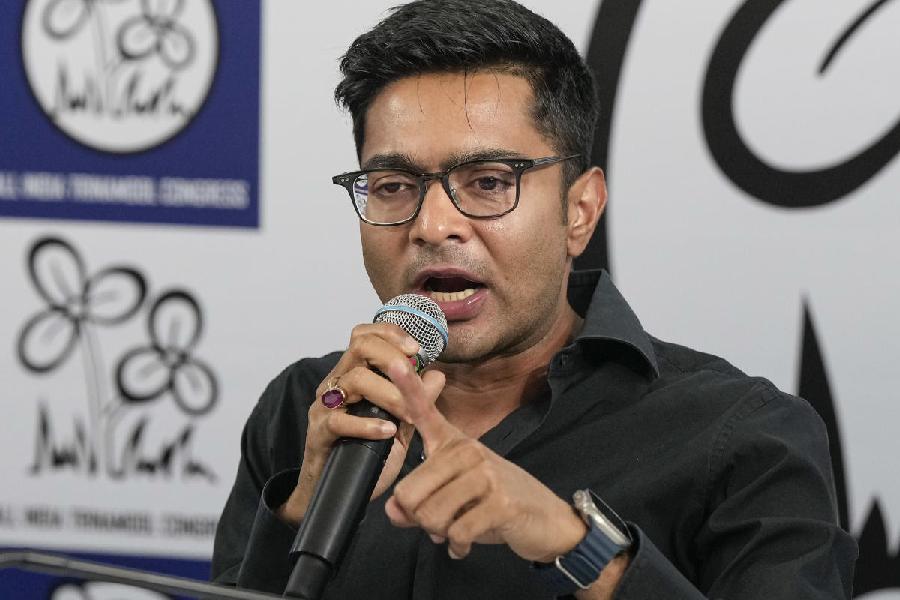
But Mukherjee, 60, has come a long way from those halcyon days when he was Indira Gandhis trusted lieutenant and the Congresss favourite warrior prince in Bengal. Last week, he seemed to have got himself into a political fog after he defied state Congress president Priya Ranjan Das Munshis orders and went to Singur to share the platform with Mamata Banerjee. Of course, the political grapevine immediately sizzled with rumours that Mukherjee was playing footsie with the Trinamul chief in the hope of joining her party and getting a ticket for the Lok Sabha elections next year. The Congress wasnt amused and hit back by removing him from the post of party spokesperson. Though Mukherjee continues to remain a working president of the state Congress, clearly, the knives are out for him in his party.
So is it bye bye Congress, then? Not at all. The question of leaving the Congress does not arise, says the feisty eight-time MLA and former mayor of Calcutta, as we chat in his third floor sitting room overlooking the Gariahat Road flyover. I take in Mukherjees photographs with Indira Gandhi, Rajiv Gandhi et al, and a framed panegyric to him that begins by hailing him as a Banga Byaghra (Bengal Tiger). A stones throw from his house, intricate bamboo structures are being erected as part of the decorations for the famous Ekdalia Evergreen Durga Puja — a puja with which Mukherjee has been associated for decades and one that has profited from his patronage and clout.
Witty and outspoken, Mukherjee is now in explanation mode. He insists that he went to Singur not as a Trinamul wannabe but merely as the president of the Indian National Trade Union Congress (he has been the Bengal president of INTUC for the last 30 years). We took up the issue of land being taken away from farmers over two years ago. So I have an emotional attachment with Singur. But maybe I could not make Priyada (Das Munshi) understand that, he says.
If Mukherjee were indeed to leave the Congress and join Mamata Banerjee, it would not be the first time. He quit his party and teamed up with Mamata back in 2000, soon after which the Trinamul Congress won Calcuttas civic polls and Mukherjee became the city mayor. But the two leaders began to have differences before long. I suggested fighting the next civic polls with the Congress. But she would not listen. Aar amio kichhu Ramkrishna Mission-er shadhu noi (I am no Ramakrishna Mission sadhu either). When I saw that she was reacting so violently, I also reacted, says Mukherjee, smiling.
So he dumped Mamata, floated his own front and decided to go it alone in the 2005 civic polls. Although he won, his outfit was routed, the Left Front retook the Calcutta Municipal Corporation (CMC), and a few months later, he clambered back into his mother ship — the Congress.
Mukherjee feels that switching parties — at least the way he has gone about it — does not really amount to opportunism. Changing parties is wrong when it involves a change in ideology. I have never changed mine since the Congress and Trinamul Congress have the same ideology, he says.
Its an ingenious line of argument. But it is a fact that Mukherjees political identity has been pretty much inseparable from the Congress. The son of a schoolmaster who taught in a village near Calcutta, Mukherjee came to the city in 1962 and enrolled in Bangabasi College for his graduation. He became involved with Chhatra Parishad (the student wing of the Congress) soon afterwards, along with Das Munshi who was his senior and mentor.
His rise through the state Congress ranks was nothing short of meteoric. By 1972, he had become the information minister in the cabinet of chief minister Siddhartha Shankar Ray. Mukherjee recalls with pride that Mrs Gandhi considered him the best information minister during the Emergency.
The affection I got from Indiraji is probably the greatest gift of my political life, he says. We had a relationship like a mother and son.
But the son was also a bit of an enfant terrible, prone to getting into fights and fisticuffs. And Mukherjee admits that blithely. The word compromise was never in my dictionary. I have had huge arguments with senior leaders, I have smashed Siddhartha Shankar Rays table-top glass, I smashed phones in Bijoy Singh Nahars (a senior Congress leader in the 1960s) office. When Indira Gandhi was on her comeback trail, riding on the ineptitude of the Janata government, Mukherjee once beat up someone because he had given her a room where the toilet had no geyser. Indiraji used to bathe in warm water even in summer. She later told me to express regret and sort it out with the man, he grins.
But age seems to have mellowed him to an extent. I had to practise the art of compromise after I became mayor, he admits. Most Calcuttans feel that he did good work during his tenure, bringing a can-do spirit to the job and improving roads and maximising the water supply. He couldnt get rid of the hawkers and neither could he launch his pet water tax scheme (Mamata opposed both), but he did try and make the system as efficient as possible, he says.
Another tale about him which sounds apocryphal but isnt, goes like this: while he was returning home with his wife Chhandabani one night, Mukherjee saw a man urinating on the roadside. Enraged, he promptly got out of his car, picked up a neem branch lying on the road, and thrashed the chap with it. But that incident made me realise that we need far more public toilets in the city, he says seriously. I built 2,100 public toilets during my mayorship. They have hardly added any since then.
Mukherjee is, in fact, quite scathing about the present mayor, Bikash Ranjan Bhattacharya. Its a 24-hour job — and he is busy being an advocate or is always going off on junkets. The man has no political ambition whatsoever, so he doesnt care whether he achieves anything or not.
Mukherjee wont reveal what his own political ambition is, though. I dont set a target and do politics. Whatever responsibility comes my way, I do it, he deadpans. But he does feel that all anti-CPM parties should come together in Bengal, which of course means that there should be an alliance between the Congress and the Trinamul. Will it happen? I hope so. But the problem is that the Congress is too full of heterogeneous elements. Ekhane hati achhe, ghora- achhe, race-er ghora- achhe, abar dhopar gadha- achhe (there are all sorts here — elephants, horses, race horses and also donkeys).
Perhaps it was his vexation with the Congress that made him cosy up to Mamata recently — which is why the vision of them supping on muri telebhaja together seemed so pregnant with possibilities. In any case, they do go back a long way. Mamatas induction into Congress took place under Mukherjee. And even when their relationship was at its nadir, Mukherjee says, his one-time protégé never showed him any disrespect personally.
Mukherjee has played mentor to another political luminary — none other than Samajwadi Party leader Amar Singh. Singh, who is a Calcutta boy — his father had a small lock business in Burrabazar — was active in Chhatra Parishad in the early 1970s. He used to be constantly by my side in those days. Even now I am very friendly with him, says Mukherjee, who often stays with Singh when he goes to Delhi.
But the capital is not really his space, he insists. Having done state politics all along, I dont get any kick out of national politics. Does that mean that he will never contest the Lok Sabha polls? Wily politician that he is, Mukherjee dodges that one easily. Anything can happen in politics, he retorts. But becoming an MP or an MLA is not everything. Its a plus point, thats all. But I work with people. I dont just wear khaddar, I have always been involved in a mass (trade union) movement.
Though politics consumes him, there are times when he does take a break. He loves watching football and has been to several World Cups. Otherwise a teetotaller, he doesnt mind the odd glass of good red wine. And he loves to go on long drives.
His drive up the political highway is, of course, looking a bit tricky now. If he does wish to stay on in the Congress — and no deal with Mamata is in the offing at present — he needs to do some serious damage control. He admits that he has been impetuous on occasion and is often led by emotion rather than cold reason. Maybe I shouldnt have continued in politics after Indiraji died. After her, I really cant think of anyone else as a leader, he says emotionally. And then he pauses, and adds, Only Priyada fills that void in me somewhat.
Is the state Congress president listening?
|