|
|
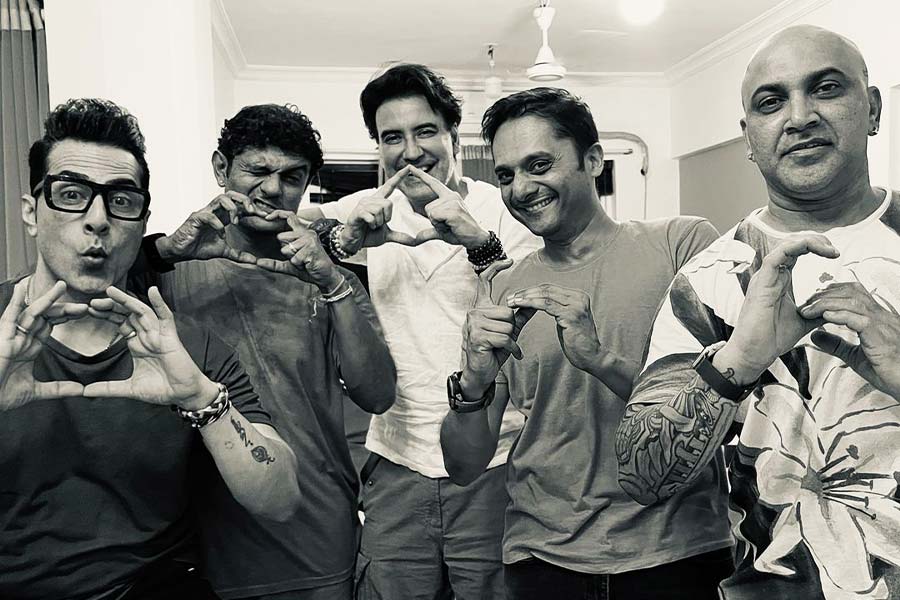
Rushdies sons Milan (extreme left) and Zafar listen to their fathers pre-recorded thank you message in London
|
London, July 10: Well done, Dad! said Salman Rushdies 11-year-old son, Milan, as he stolethe show when accepting the prize today in London on behalf of his father whose 1981 novel, Midnights Children, was chosen by readers to be the Best of the Bookers since the prize was first instituted 40 years ago.
Rushdie won by quite a large margin, said the biographer, novelist and critic Victoria Glendinning, chairman of the three-strong judging panel which reduced the 41 novels which have won the Booker Prize since 1969 to a shortlist of six.
Glendinning commented: The readers have spoken in their thousands. And we do believe that they have made the right choice.
The other judges involved in producing the shortlist — there were two Booker Prize winners in 1974 and 1992 — were writer and broadcaster Mariella Frostrup, and John Mullan, professor of English at University College London.
Frostrup, who read Midnights Children in the mid-1980s, said she was delighted with the shortlist.
Midnights Children is a pioneering book, she told The Telegraph.
Milan, who lives in London with Rushdies third wife, writer Elizabeth West, collected the prize accompanied by Zafar, 28, the authors son by his first wife, the late Clarissa Luard.
After Midnights Children, second place went to Disgrace (1999), the most recent title on the shortlist, by South African-born author J.M. Coetzee, whom bookies installed as second-favourite to win after Rushdie. Australian author Peter Carey was in the running for Oscar and Lucinda, which gave him the first of his two Booker prize wins in 1988.
The Siege of Krishnapur, which won the prize for the late Liverpool-born author J.G. Farrell in 1973; The Ghost Road, by Yorkshire-born author Pat Barker, a winner in 1995; and The Conservationist, a Booker winner in 1974 for South African writer Nadine Gordimer, were also shortlisted.
After Glendinning had announced the winner, it was Milan who brought the house down with his confident little speech: I am very grateful to everyone who voted for him and I am extremely honoured to be collecting the prize for my father and I am really looking forward to reading it when I am older.
Midnights Children, an example of Rushdies magical realism, follows Saleem Sinai who is born on the stroke of midnight on the day of Indias Independence in 1947 and whose life loosely parallels the fortunes of his nascent country.
Milan reminded his audience: I (too) was born eight minutes to midnight.
Midnights Children has certainly stood the test of time, all the literary experts are agreed. It won the Booker Prize in 1981 and the Booker of Bookers after 25 years in 1993.
Zafar said: It is a real honour to pick it up and it is fantastic that it was voted for by the public — that it came out on top. Now that its a hattrick of Booker Prizes, its even better.
The 61-year-old author, who was in Chicago on a tour to promote his latest novel, The Enchantress of Florence, sent a pre-recorded message to the award ceremony in London, saying: Marvellous news! Im absolutely delighted and would like to thank all those readers around the world who voted for Midnights Children.
He courteously paid his respects to the five other authors on this extraordinary shortlist of the best of the best. He ended on a personal note: If I cant be here, it is a wonderful alternative that my two sons can accept this award on my behalf. It is something quite wonderful to my mind about my real children accepting a prize for my imaginary children.
According to Man Booker, which sponsors the prize, when voting closed on July 8, a total of 7,801 people had voted, either online or via SMS. Midnights Children got 36 per cent, with the organisers taking precautions to ensure there was no cheating or desi double voting.
Votes came from all around the world with 37 per cent of online voters coming from the UK followed closely by 27 per cent of online voters from North America.
At least, half the voters were under 35 with the largest age group ranging between 25-34 years.
There was some criticism of the award, partly because the choice was narrowed to just six nominees.
Its an artificial exercise, simply because the general public only got to pick from six of the previous winners, argued Jonathan Ruppin, promotions manager at Foyles bookshop in London. Readers have not been able to vote for some of their most enduring favourites, he added, mentioning, among others, Arundhati Roys The God of Small Things and Kazuo Ishiguros The Remains of the Day.
But he conceded: Its (Midnights Children) a book which always appears on polls of peoples favourite books, so its no surprise to see it win. Hes (Rushdie) not to everyones taste, but from a booksellers point of view, authors who get books into the news are always welcome.
In declaring the winner, Glendinning stressed that readers — and not a judging panel — constituted a novelists true constituency.
William Hill stopped taking bets on the prize last week at odds of 6/4 because the bookmakers felt too much money was going on Midnights Children.
|