|
|
Subodh Gupta |
 |
| James Servier |
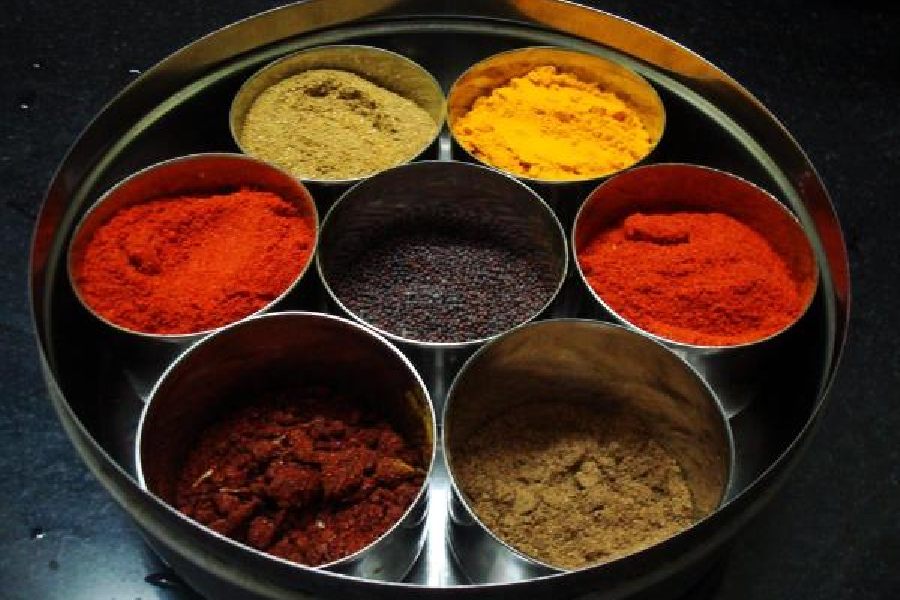
London, July 1: To you and me, Subodh Guptas Curry 2 may look like metal bartan bought from the local bazaar for a thousand rupees or thereabouts and stacked neatly on a metal rack but last night at Christies in London, this piece of installation art fetched £301,250.
In case you havent got a calculator handy, that is Rs 26,091,262 — which, as the author Bill Bryson, more used to writing about astronomy, would say, is a lot of rupees.
Back in Bihar, where Gupta hails from, the traders in bartan may be baffled by how their boy has suddenly become the darling of western art connoisseurs.
Another two of Guptas works, Dubai to Calcutta, a metal sculpture, and Idol Thief, an oil painting, fetched £313,250 and £337,250, respectively, at Christies Post War and Contemporary Art auction last night. That adds up to £951,750.
Gupta has explained his installation art thus: I am the idol thief. I steal from the drama of Hindu life. And from the kitchen — these pots, they are like stolen gods, smuggled out of the country. Hindu kitchens are as important as prayer rooms. These pots are something sacred, part of important rituals, and I buy them in a market. They think I have a shop, and I let them think it. I get them wholesale.
Christies has lauded his art: Methodically arranged according to type in a stainless steel cabinet that is part kitchen shelving, part display case and part cabinet of curiosities, the kitchen utensils — the balti, the lota, the thali, the kalasham, the kumbhaa and the pateela — that collectively form Curry 2 all combine in this work to form a dazzling, almost decadent sense of splendour.
Just in case you are tempted to wander down to Shyambazar as a prelude to offering Christies your own decadent sense of splendour, it is worth taking note of the views of a Christies spokesperson.
It is how the artist chooses to arrange the objects, otherwise you could say a painting is just canvas and some paint, he told The Telegraph.
Incidentally, at the same auction, Syed Haider Razas painting, La Terre, went for £1,273,250 while Anish Kapoors polished purple mirror greatly exceeded its reserve price of £600,000-800,000 and sold for £1,071,650.
The Christies spokesperson added: The market for modernist Indian artists such as (M.F.) Husain, Raza and (Francis Newton) Souza has seen prices regularly reaching into the dollar millions, driven by resident and non-resident Indian collectors at the outset, but now increasingly capturing a global consciousness.
Nor does the excitement around Gupta end with Christies. His works are included in an auction of contemporary art due to be held at Sothebys tonight and tomorrow.
As with the Christies sale, the Indian art works are being sold at Sothebys, not in some ethnic category, but mixed in with the best from around the world. Thus there is also art by Damien Hirst and Andy Warhol in the same auction.
The auction houses hope that Indian buyers, who are the main collectors of Indian art, will be tempted to pick up non-Indian paintings and sculptures, while non-Indians will be similarly persuaded to add Indian works to their shopping baskets.
 |
SOLD
£301,250
Subodh Gupta’s Curry 2
|
First, though, Indians have to develop a taste for the likes of Hirst who is given to chopping up animals and suspending them in formaldehyde — he has a piece on offer tonight composed entirely of dead flies dipped in black paint.
Sothebys experts are taking great heart that some artists in India are becoming inspired by Hirst. Among them is Guptas wife, who has produced a sculpture of a mean looking hyena. This will find a buyer but probably not from a middle class home in Calcutta.
An untitled sculpture by Kapoor, made from fine quality alabaster and with a reserve price of £1-1.5 million, is also on sale at Sothebys.
It will probably go to a private collector who will make it the centrepiece of his home, predicted James Servier, deputy director of contemporary art at Sothebys. In fact, he may build a house round it.
|