TT Epaper LHS
The Telegraph
TT Mobile
 
 
IN TODAY'S PAPER
WEEKLY FEATURES
CITY NEWSLINES
FEEDS
  RSS
  My Yahoo!
SEARCH
 
Archives Web
 
ARCHIVES
Since 1st March, 1999
 
THE TELEGRAPH
 
CIMA Gallary
 
Email This Page
ACTS OF EVASION
- The Karnataka election was fought on bread and butter issues

The British broadcaster and former MP, Sir Clement Freud, once narrated what he considered “the funniest joke” he had heard. A habitual drunkard, it seems, had promised his wife that he wouldn’t visit the pub again. Predictably, he broke his promise, went on a drinking binge with his mates and threw up all over himself. In a state of blue funk, he asked his friends: “What do I do now? My wife will throw me out.” “Don’t worry”, the friend replied, “just tell your wife that a passer-by threw up all over you and then, quite graciously, gave you £20 for the dry-cleaning.” The happy drunkard returned home and was promptly accosted by his wife. “No, no,” he protested, “it wasn’t me,” and then proceeded to spin the pre-rehearsed yarn. “That’s all very well”, replied his wife, “but why are you carrying two £20 notes?” Without any hesitation, the drunk retorted, “Oh that was from the man who shat in my pants.”

I was reminded of the drunkard’s furtive quest of innovative excuses on hearing Prithviraj Chauhan, the Congress in-charge of the Karnataka election, blame the “division in the secular vote” for the party’s failure to prevent a Bharatiya Janata Party victory. After a string of electoral reverses in the past two years, it is understandable that the Congress is running out of diversionary explanations, but the theory of secular fragmentation takes the cake.

Lest the explanation becomes conventional wisdom among pamphleteers, it is worthwhile recalling a few features of the recently-concluded election. First, at no stage of this election was there any preoccupation with sectarian issues. This was an election fought on bread-and-butter issues and the quality of governance. So great was the concern over rising prices that a beleaguered cabinet minister — Congress’s Kapil Sibal — proffered the intriguing argument that inflation shouldn’t become a theme of competitive politics. It prompted a BJP leader to quip: “In that case, should we debate the IPL matches?” Sibal’s understanding of the issues that dominated the election is interesting. Armed with facts and figures, he made a special trip to Bangalore to tell the media that Karnataka outshone Gujarat in higher education. To Sibal, this was a pertinent concern, not secularism.

Of course, the BJP did attack the Congress for being ‘soft’ on terrorism and the Congress did mention the BJP’s capitulation in Kandahar. But these were run-of-the-mill election banter — unless, of course, we believe the silly assertion of the minister of state for home affairs, Shakeel Ahmed, that terrorism and anti-terrorism are equally reprehensible. Blaming fragmented secularism for the BJP’s good performance is about as ridiculous as the BJP charging its opponents with undermining Hindu unity.

The only organized lobby that believed the election was remotely a test of secularism was the People’s Alliance for Democracy, an ‘alliance’ of 150 NGOs. They had a one-point agenda of fighting the BJP. According to K.L. Ashok, a PAD convener, as quoted in Tehelka magazine, “We have no doubt that the BJP is a communal party committed to treating Dalits, Muslims, women and the working masses as second-class citizens. We have seen what they did in 20 months they were in power in Karnataka. We are saying — never again!” After the results, one activist called it a “dark day” for Karnataka.

Secondly, it is clear that the theory of secular disunity was an attack on the former prime minister, H.D. Deve Gowda, for making the contest three-cornered. This again is a silly assertion. At no time since Independence has the Congress fought an election in Karnataka in alliance with any ‘secular’ party. Indeed, first the Janata Party under Ramakrishna Hegde and subsequently the Janata Dal under S.R. Bommai and Deve Gowda were the principal opponents of the Congress. The BJP entered after 1991.

The Congress and BJP both fought this election promising stability and promised an end to the ‘father and son’ blackmail of the state. The electorate attached considerable significance to the stability plank and reduced the JD(S) to a poor third. If the Congress now blames Gowda for facilitating a BJP victory, it could only imply two things: either the JD(S) should have withdrawn from the polls altogether or that the Congress should have entered into an anti-BJP alliance with Gowda. Both were not within the realms of possibility this election. Nor was there any guarantee that a grand anti-BJP alliance would have led to a secular landslide. There was one constituency — Shikaripura — where all parties ganged up against the BJP’s chief ministerial candidate. Yeddyurappa won, polling 66.2 per cent of the vote — a 16 per cent improvement over 2004, when there was a three-cornered fight and a division of the so-called secular vote.

Along with secular disunity, the Congress blamed the BJP for appealing to caste loyalties by projecting Yeddyurappa, a Lingayat. The Congress, it stated piously, “appeals to all castes and communities”. The argument is spurious at the conceptual level because any projected leader, apart from the Congress president, is born into some caste or community. In more practical terms, if the BJP had indeed played a Lingayat card, it would have generated a countervailing anti-Lingayat mobilization — as Devraj Urs managed in 1978 and 1980. However, the results suggested that, apart from securing a solid bloc of Lingayat votes, the BJP simultaneously made deep inroads into the Vokkaliga, Idiga and Dalit communities on the strength of imaginative candidate selection and a focussed campaign.

The Congress, on the other hand, tried to make a virtue out of its failure to name a chief ministerial candidate. It tried to mask its indecisiveness with the theory that having a galaxy of competing aspirants would lead to all of them mobilizing their respective castes. This worked in the case of the new entrant, A. Siddaramiah, and his Kuruba community and to some extent with the Dalit leader, Mallikarjun Kharge. It failed to cut ice with the Vokkaligas and Lingayats. The Congress candidate lost in S.M. Krishna’s old constituency and its Lingayat leader, M.P. Prakash, was also defeated.

Caste wasn’t the primary issue of this election. Caste representation mattered at the district and constituency level, but at a macro-level Karnataka voted on issues and were influenced by the campaign. The Congress’s biggest shortcoming was its incredibly shoddy and unfocussed campaign. It didn’t have enough to offer the state and its national record wasn’t sufficiently appealing.

It’s the unwillingness to admit that the Congress is no longer in a position to motivate sufficient number of voters on either a regional or national plank that has compelled its leaders to be disingenuous about the Karnataka results. Indian political parties, it is true, don’t have a glorious record of conducting clinically ruthless post-mortems either in public or behind closed doors. The BJP, for example, has still not debated its miserable showing in Uttar Pradesh two years ago. The Congress is further hamstrung by the tacit realization — never mind Rahul Gandhi’s well-meaning sermons on inner-party democracy — that the buck always stops at either a Prithviraj Chauhan or state leaders.

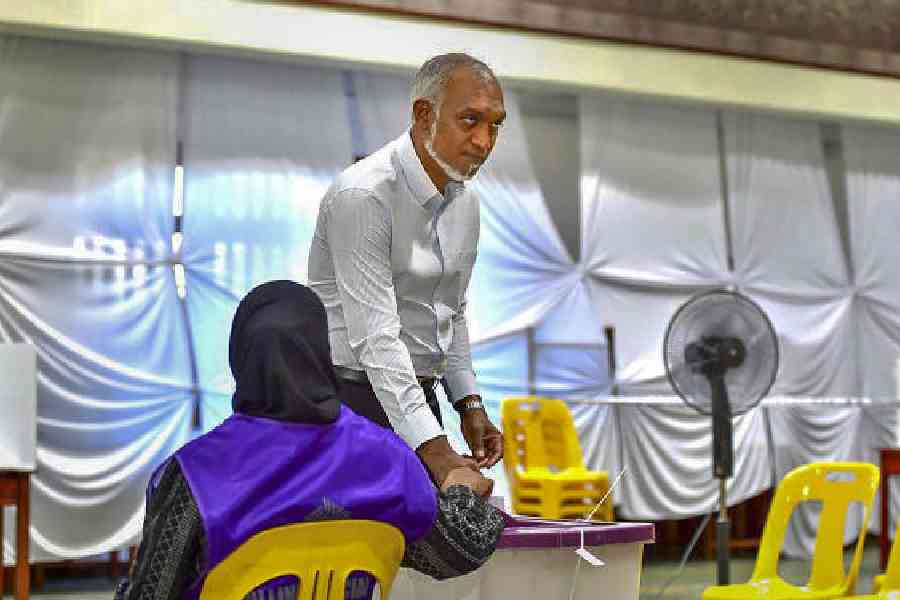
This may be why, as its ultimate act of evasion, it blamed a late swing in Karnataka on the hapless Dharam Singh’s eyesight. The unfortunate former chief minister was shown on TV as having to be assisted to the voting machine by his wife who pressed the button on his behalf. This, claimed an AICC spokesman in all seriousness at a formal briefing, became a metaphor for the Congress—the party that can’t look ahead.

Top
Email This Page