|
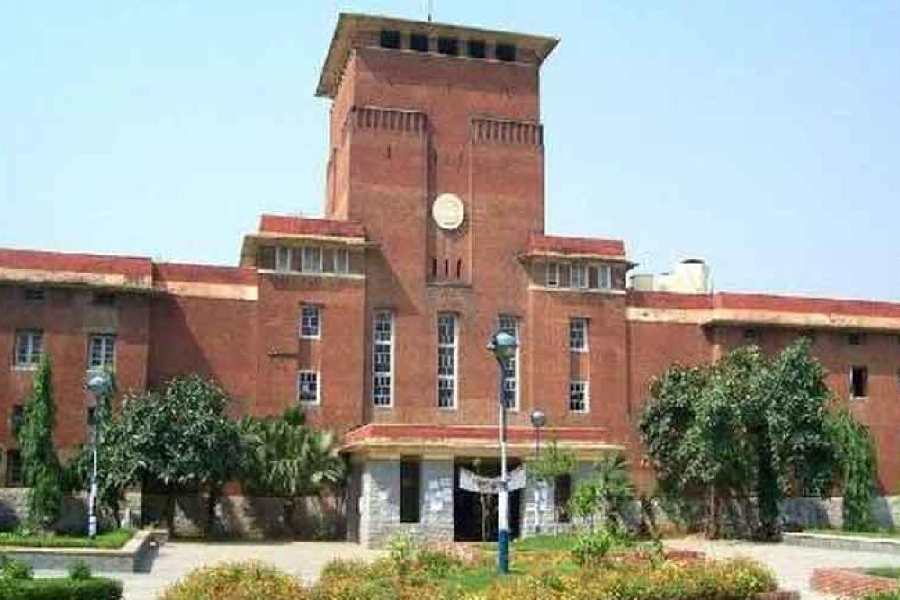
| Land of contrasts: The Czech Technical University and (below) the Czech royal jewels are put on display once in five years |
 |
Shantanu Pisharoty’s friends were rather surprised when he decided to go to the Czech Republic to study medicine. Many wondered why he opted for the small east European nation when his peers had chosen popular universities in the US and the UK.
But the teenager from Chennai had his reasons. The land of Jan Evangelista Purkinje, the 19th century author of cell theory, and Tomas Bata, the legendary shoemaker, is value for money for Indian students seeking quality higher education.
“The cost of living and the tuition fees are very high in the US and UK. The Czech koruna (currency) is not very strong, so studying here is almost on a par with, or perhaps a little costlier than, studying in India,” says Pisharoty, a first year medicine student at the Charles University, Prague.
In fact, the cost of education in the Czech Republic is less than half of that in many Western nations. Today, Indian students are searching for newer vistas that offer them quality education at affordable prices. “High quality education at a cost less than that in many western European countries is working in favour of the Czech Republic,” asserts Doris Kumarova, senior officer, Czech Embassy, Delhi.
The Czech Republic is a member of the European Union. The Programme for International Student Assessment, co-ordinated by the Organisation for Economic Co-operation and Development (OECD), currently ranks Czech education as the 15th best in the world.
There are 71 institutes of higher education — 26 public, two state and 43 private — in the country. One of the most significant educational institutions is the Charles University, established in 1348, with centres in Prague, Hradec Kralove, Pilzen and Brno. There are many other equally prestigious public and private colleges that prepare specialists in various fields. Some of the prominent ones are the Czech Technical University (engineering), Academy of Performing Arts (photography, drama, music), University of Economics, and Tomas Bata University (research).
“At present, out of 24,000 students in the Czech Technical University, there are as many as 2,050 foreign students and out of 42,400 students, there are 4,300 foreign students at Charles University,” says Kumarova.
Students also get financial aid from the universities. “I am getting 7,000 Czech Koruna per month (Rs 18,800) as a government scholarship. It is a nominal amount, but helps me meet some expenses,” says Ritesh Kumar, a second year student of business information systems, University of Economics, Prague.
Students don’t have to know the Czech language to study there, though international students who study in Czech get a tuition fee waiver in public and state universities. English is a medium of instruction in many of the universities. But Pisharoty holds that the local language is not very tough to learn. “That is because the teachers are well qualified and teaching techniques are excellent. So you can save on your tuition fee if you opt for the local language,” he says.
There are many private and public language schools that offer courses in Czech language for foreigners. “It is possible to take intensive courses — of 10 months to one year — in most institutions. This way the cost of education becomes much cheaper. It also helps you mingle better with the locals,” says Savita Yadav, who pursued her graduation, postgraduation and PhD from the Czech Republic. Yadav, who did a PhD in Czech and Slovak literature from the Charles University in 1991, recommends the country for two reasons — its low-cost quality education, and the absence of racial discrimination.
Admissions to public and state universities are through an entrance examination or through merit. Most universities have their own set of admission criteria. The details can be gathered from the Czech consulate or from their websites. You can log on to www.czech.cz/en, the official website of the Czech Republic, to gather information on courses and work options.
“In the last five years, I have seen a 30-35 per cent increase in the number of Indian students going to the Czech Republic to study,” says Raju J. Anthraper, managing director, Caxton Publications Pvt. Ltd, a body that represents Czech universities in India. Caxton, based in Cochin, Kerala, recruits and sends Indian students to the Czech Republic for higher studies in medicine and engineering.
The popular courses that a student can opt for, besides medicine and engineering, are architecture, economics, law and social sciences. “A degree from most private universities is valid all over the European Union, besides India and most parts of the world,” says Anthraper.
Apart from the tuition fee, a student may have to roughly shell out Rs 2-3 lakh a year. The tuition fee varies depending on the university and the course that a student wishes to pursue. “The average cost of living for a medical student, including the tuition fee, may roughly come to about Rs 9 lakh a year,” says Anthraper.
If a student is pursuing humanities or arts from a private university then the tuition fee will range between Rs 1.8 lakh and Rs 3 lakh per academic year. The living costs vary between Rs 2 lakh and Rs 3 lakh a year. “It is roughly about one-third the cost of studying in Germany, France or Australia,” Anthraper points out.
According to the Czech Consulate, the tuition fee for medicine at the Charles University is 11,000 euro (Rs 7.4 lakh) per academic year while at the Czech Technical University, it is between 3,000 and 6,000 euro (Rs 2-4 lakh) and at the Tomas Bata University the fee is 1,000 euro (Rs 67,000) per year. “There are very limited scholarships available and students have to check out with the respective universities for them,” says Kumarova.
After graduating from a Czech university, you can even apply for permanent residency in the Czech Republic. So if you have made up your mind for good education in an institute abroad, you could head for this land of pioneers, poets and painters.
|