|
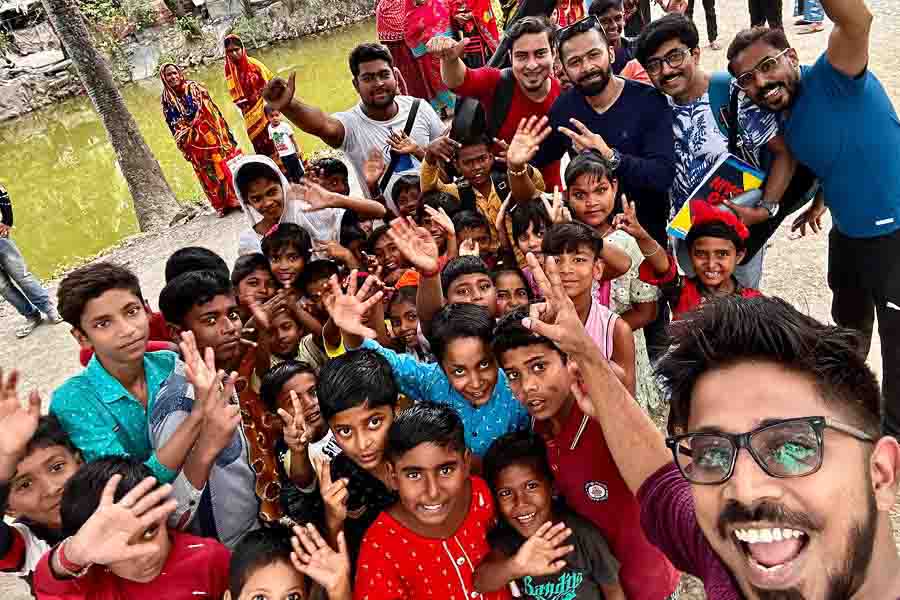
Para teachers working for schools in the southern suburbs of Calcutta have acquired the appellation of chheledhora in the surrounding villages. Entrusted with the responsibility of bringing children who have dropped out of schools back into the fold, the para teachers go from house to house trying to coax parents to let their children return to school. As evident from the title the teachers have attained, they are not considered kindly by the parents. Since the families the teachers have to work with belong to the poorest strata of society, they are quick to dismiss the assurances of the salaried teachers as rosy promises of the well-off who know nothing of reality. For most parents, education is a luxury they can ill afford.
But the teachers I talked to, all of whom work for a school in the south-western fringes of the city, emphasized that contrary to expectation, most of the children are eager to attend school. If their fathers are drunkards who beat them up while their mothers are away at work, they are reluctant to stay back home. Moreover, school offers them the coveted escape from household chores and from menial work such as bidi-binding or embroidery, which thrive in the villages. But the parents,who count their children among the earning members of the family, are averse to sacrificing a precious breadwinner to schoolwork.
In acknowledgment of this reality, the state government has various schemes to ensure basic education for every child. But as with most other policies in India, they seem promising on paper but prove to be ineffectual when applied. The government started the system of midday meals to lure students. According to stipulations, each child is to have vegetables worth Re 1, along with rice. The amount of vegetables that can be bought for the princely sum of Re 1 is anybody’s guess. Add to this the poor quality of the rice, which often has worms in it, and it is easy to deduce why most children would prefer to starve at home than eat at school and fall sick.
Moreover, children who come to school hungry have to wait till 1 pm to get the food. They find it difficult to concentrate on their studies in the first half of school hours, when the most difficult subjects are taught. And, the teachers complain, after the children have had their meal, they tend to doze off.
There are other difficulties that students have to contend with if they want to complete their education. Under the Sarva Shiksha Abhiyan started by the state government, students of state-aided schools are supposed to get books free of cost. But, on an average, most schools get only 60 per cent of the books they had requisitioned. And while the academic session starts in May, the books arrive only by September-October, forcing the students to go without textbooks for a considerable period of time. For those determined to make it to the Madhyamik, there is still another hurdle to cross. The grant of free books stops at Class VIII. In spite of having almost made it to the finishing line, poor students are often forced to quit school at this stage.
The para teachers say that their efforts at persuading parents and children are producing mixed results. While some children have returned, many have dropped out permanently. Sometimes the parents have no objection to their wards’ education but the children refuse to go back simply because they hate school. The teachers are of the opinion that girls are easier to convince than boys. Faced with the unequal alternatives of marriage, work, and sometimes both, on the one hand, and education on the other, girls would rather choose the latter if they can.
|