|
|
I have just finished reading China Road, a book by the journalist, Rob Gifford, about his journey by road from Shanghai to Urumchi in 2006. Gifford has lived in China for six years, first studying Mandarin, which he speaks, reads and writes fluently, and then as a correspondent for Independent News Network. The stories of his travels across the heart of China are indeed fascinating, but his exchanges with minority Tibetans and Muslims are of more contemporary interest. The disaffection of minorities in China is historical and well known. The Chinese leadership has tried to overcome the resistance of its minorities in three ways. First, by brutal suppression of any dissent. This is not surprising as there are reports that it does this with increasing regularity upon China’s own rural communities whenever people agitate or protest. Second, by massive development projects to integrate and ingratiate the minority communities. (The latest slogan is “Everyone must share the fruits of progress gradually.”) And third, by increasing the numbers of Han Chinese in the minority regions, partly by settling workers engaged in various development projects and partly by migration of Han Chinese families from other regions.
The latest episode of the uprising in Tibet is therefore not all that surprising. Naturally, such uprisings grab attention when the world is more focused on China, which seems to be the almost all the time nowadays, the forthcoming Olympics being the latest reason.
India has always been sensitive about China and Tibet. Providing refuge to the Dalai Lama and thousands of fleeing Tibetan refugees in 1958 was the biggest humanitarian statement any country could have ever made. The Chinese have never been reconciled to the gesture even after fifty years.
The Chinese consider politeness and sensitivity to be the foundation of their ancient civilization. However, the same traits in foreigners are considered to be a weakness and a sign of arrogance. In the heyday of “Hindi Chini Bhai-Bhai”, China saw India’s growing prominence in the non-aligned movement as arrogance, and Mao decided to “teach India a lesson”. The Chinese attitude towards India is no different today. When India kept scrupulously quiet about the recent uprising in Tibet, the Chinese prime minister gratuitously thanked India; and yet a few days later, the Indian ambassador was summoned in the middle of the night to receive a complaint regarding security of the Chinese embassy in Delhi. The Chinese have further threatened that they would re-route the Olympic flame in order to avoid its planned passage through India, since India may not be able to provide it safe passage.
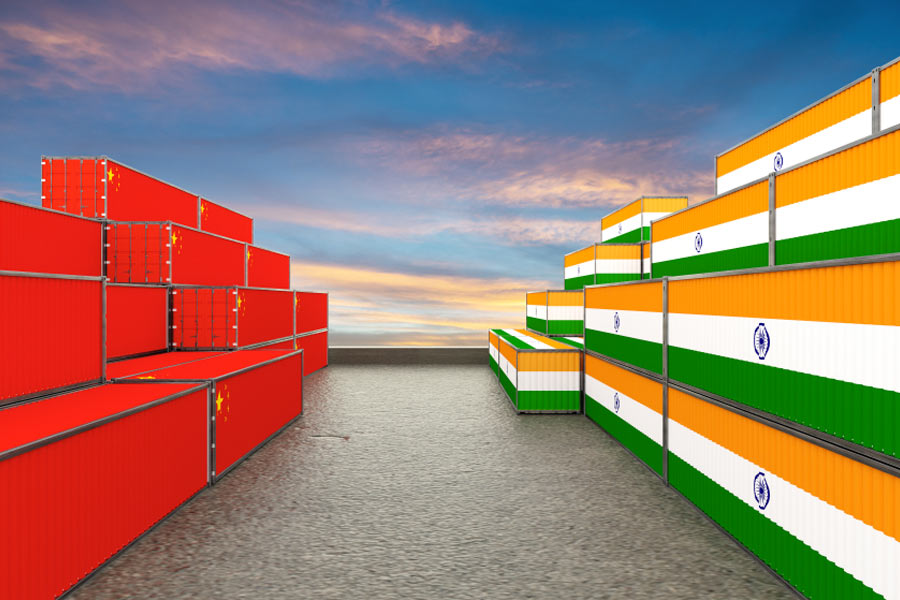
In its march towards global economic leadership, China does not wish to brook any opposition or competition. India is seen as an irritant in China’s pursuit of global economic leadership, as indeed the former Soviet Union was considered a rival by China in its pursuit of global communist leadership.
Whether it is the Dalai Lama, the McMahon Line or Arunachal Pradesh, no amount of acknowledgement by India of the sensitivities of these issues is going to appease the Chinese. China will continue to seek ways of creating trouble for India, either on its own or with the help of Pakistan and other neighbouring countries, as it has been doing for the last sixty years.
The Olympics is only a passing event. What India and other nations will continue to face is China’s growing belligerence as it becomes economically and militarily stronger and transforms itself into a principal contributor to global warming and climate change.
In a recent article published in Caijing (the term in Mandarin means ‘finance’), Wu Jinglian, an economist at the Development Research Centre of the State Council, writes, “While China’s economic growth continues to accelerate, fundamental problems such as resource consumption, environmental degradation, economic inequity, political corruption and the widening gap between the rich and the poor are becoming increasingly acute and attracting criticism from the public.” Large parts of China are experiencing acute water shortage. In spite of the tremendous developments all around China, its political leadership considers food and water security to be its highest priority. As and when it becomes necessary, and it may already be so, China will start diverting major rivers and glacier melts for its own use, without the slightest concern about the consequences for its neighbouring countries.
There are other ideological issues that continue to trouble China. In the same article in Caijing, Wu Jinglian writes that at the end of 2003 the voice of the “old guard” was suddenly heard, which declared that eliminating the planned economy and instituting marketization are equivalent to changing the socialist system and adapting capitalism. It went on to put the blame for China’s social problems on reform and on the opening up of its economy. In 2006, it even began publicly calling for the posthumous rehabilitation of the “Gang of Four”, the “continuation of the revolutionary line under the dictatorship of the proletariat” and a restart of the Cultural Revolution.
Such moves after thirty years of reforms were strongly countered at the 17th National Congress of the Communist Party of China, where the general secretary, Hu Jintao, unequivocally reaffirmed the success of the reforms and the opening up before the cultural committee of the CPC. His rebuttal declared that reforms brought about China’s transformation from a highly centralized planned economy to a robustly socialist market economy. He went on to say that reforms and opening up are the only ways of developing socialism with Chinese characteristics and of rejuvenating the Chinese nation. All this shows that arguments regarding reforms continue to simmer within China and, to an extent, explain its belligerent attitude to any criticism or dissent.
India is well aware of China’s growing belligerence and arrogance. Good neighbourly behaviour and diplomacy require nations to navigate the political minefields laid by unfriendly nations. In spite of its own success, China will continue to be dogged by internal problems and bothered by India’s growth and prosperity. China is paranoid about India’s good relations with the other countries of southeast Asia and the West. In the end, China’s own sense of internal insecurity will prevent it from developing mature and stable relations with countries like India.
The Beijing Olympics and the Tibetan uprising are but passing events in a long-drawn-out drama of the Chinese development conundrum. As Rob Gifford narrates in his travels, material prosperity cannot always erase centuries of insecurity and self-doubt. India has learnt to live with an insecure and belligerent neighbour, but it has not been, and will never be, a pleasant experience.
|