|
|
A poster on show at Seagull Arts and Media Resource Centre |
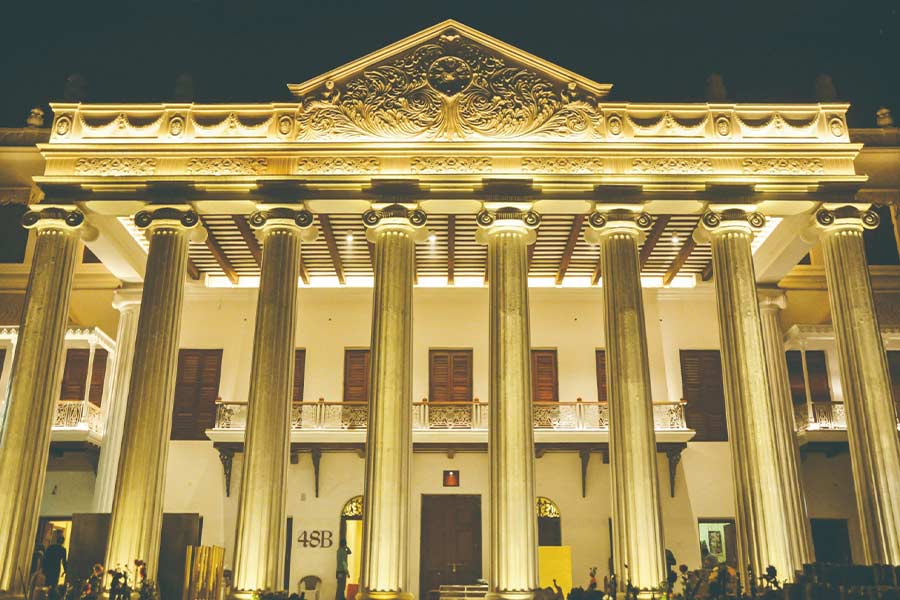
The exhibition of artists from Orissa titled Dimensions & Directions that has opened at Mon Art Gallerie is a refreshing change from the cliched works displayed over and over again at most city galleries nowadays.
To begin with, these young artists have a more heightened awareness of the political situation in the state and also of the degradation of environment as the direct fallout of some political decisions. Some of the works may seem a trifle crude but nobody can doubt their effectiveness despite that shortcoming.
In Debarchan Rout’s canvas a man on a scaffolding is painting a wall green, while ironically greenery has been erased from the terrain beneath him in the name of development. The world map has turned into a black umbrella stopping acid rain from destroying a sapling in Rajiblochan Pani’s canvas.
Traders would once set out from Bali from the Orissa coast, but now the rivers have turned dry and sand is carted away from it. Huge factories come up in background. The entire scene in this work by Sovan Kumar is painted on a piece of tarpaulin.
Birendra Pani once again focuses on the young cross-dressing dancers of Orissa, this time folk style. In Rohit Supakar’s painting, a brand new car emerges from the trunk of an anthropomorphic tree, in an obvious reference to the resistance put up by local people against forcible appropriation of farmland by the government.
 |
|
A work by Sovan Kumar being exhibited at Mon Art Gallerie
|
In Ramakrishna Behera’s wide-angle paintings of Ladakh, the dividing line between fact and fancy melt away. It must be mentioned that however well intentioned the installation on Ridley turtles may have been it ended up looking too obvious.
Both Maite Delteil and Maya Burman, mother and daughter, respectively, who live in Paris, seem to have a penchant for churning out light-hearted, innocuous images of birds, fruit trees and bevies of girls without a care in the world.
In their exhibition at Sanskriti Gallery, Maite uses strongly contrasting acid greens and reds in her canvases as the backdrop for her trees loaded with fruits and winging birds. Hoopoes occupy much space in one of these paintings. In another, they surround a woman resting in bed.
Maite has also done a series on pencil drawings seemingly inspired by scenes of Bengal. Her husband is after all a well-known Bengali artist living in Paris.
Her daughter Maya, on the other hand, draws pictures of young girls making merry, gamboling, flying kites, dancing, riding pink tigers and prancing with Ganesh. The lines are traced with black ink and these drawings are covered with a light wash. So they end up looking like nursery rhyme illustrations. Only nursery rhymes have strong links with real life. These paintings have none of that.
An exhibition of posters from women’s movement in India has been on view at the Seagull Arts and Media Resource Centre from March 1. A wide variety of women’s issues, from female foeticide to rape, dowry deaths or sexual harassment at the workplace are covered by these posters. There is even a poster proclaiming women’s right to leisure.
An interesting poster shows a woman, with the body of a cow, being tethered by a man, presumably her husband, to a post. The caption in Hindi reads: “Why do you keep me tied to the home like a cow?”
The exhibition, hosted jointly by Swayam, a women’s rights organisation, and Zubaan, a publishing house based in New Delhi, is on till March 10. |