TT Epaper
The Telegraph
TT Photogallery
 
 
IN TODAY'S PAPER
WEEKLY FEATURES
CITIES AND REGIONS
FEEDS
  RSS
  My Yahoo!
SEARCH
 
ARCHIVES
Since 1st March, 1999
 
THE TELEGRAPH
 
CIMA Gallary
 
Email This Page
ROLES AND MISSIONS
- Contentions among the services need legislative intervention

Indian army’s plans to expand its fledgling Army Aviation Corps were recently reported with projected requirements for the 11th (2007-2011) and subsequent 12th and 13th five-year plans. The projections call for air platforms to carry out tactical air missions like reconnaissance, utility and close air support. Since tactical air support encompassing the various missions included in these plans is the role of the Indian air force for which it is budgeted, equipped and manned, the question that comes to mind is whether there has been a major policy shift concerning roles and missions of the respective armed forces.

To one’s knowledge, no such policy change has even been consciously considered using modern tools of analyses. Clearly this is one more of those perennial inter-service turf wars. Since its pilots first started to fly light aircraft for air observation duties to direct artillery fire, the army has been eyeing the close air support role of the IAF. It has set about doing this through incremental encroachment into the IAF domain. The IAF has been reduced to a helpless bystander, as the following comment from the 1995 RAND study, The Indian Air Force: Trends and Prospects, would indicate: “Overall, army continues to dominate the consideration of Indian defence matters. The war in the Gulf has not appeared to improve the IAF’s political position in the Indian security community in spite of the demonstration of the importance of air power in modern war.”

That our security managers are either unwilling or unable to put an end to this inter-service turf battle reflects poorly on the higher defence management. The nation is paying a heavy price in terms of the credibility of our military establishment, resource wastage and indeed in war-fighting terms.

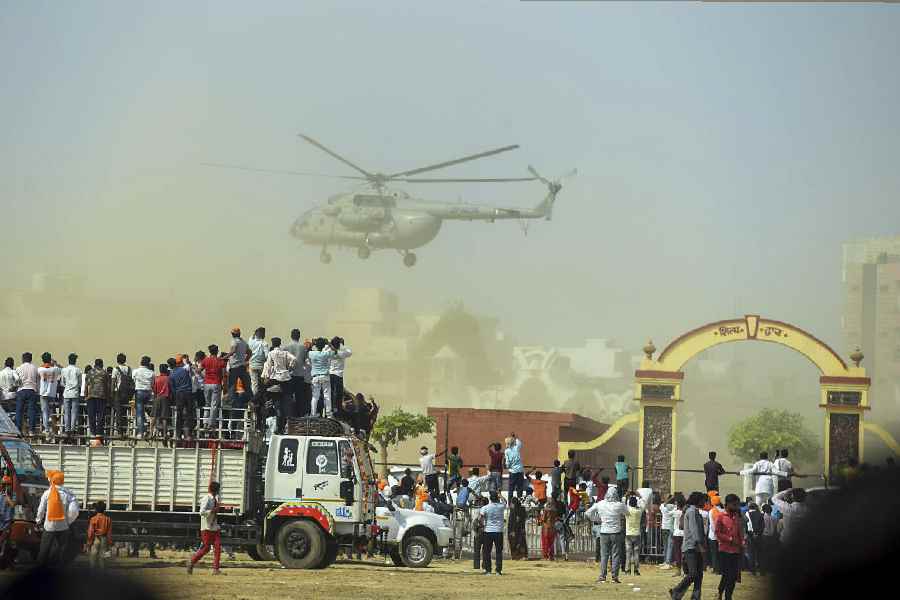
Today we have two helicopter forces (discounting the navy that has its specific requirements), which have duplicated infrastructure, training, spares support, repair and overhaul and so on, in addition to duplicated roles and missions. For the modest force levels, duplication of the above support activities is poor resource optimization and degrades overall security. Those desirous of emulating the American model would do well to remember that the annual defence budget in the United States of America is close to $620 billion as against our defence budget of around $ 23 billion.

Pakistani infiltrations into our territory in the Kargil sector, spread over many months, did not come to light by army aviation helicopter reconnaissance, but by lowly shepherds on the ground. The Kargil review committee accepted the army argument that hand-held cameras used by the army for reconnaissance from helicopters could not provide the requisite information owing to high levels of vibration. What was never explained by the KRC (at least in its open report) is why the army was attempting tactical reconnaissance with hand-held cameras in the first place, when this was not its task and when it was not equipped for it. Nor, indeed, is this the way to carry out tactical reconnaissance in the battle field. The KRC was also silent on why the IAF was not called upon by the army to carry out tactical reconnaissance, which is the IAF’s designated task and for which it is equipped with high technology photo and thermal imaging equipment. It is possible that had the Indian army used the IAF’s tactical recce capability on a routine basis, Pakistan army would not have dared to plan infiltration in the Kargil sector. So, the Pakistani military may have cleverly exploited an inter-service weakness that it saw within our fighting forces. That the army now aspires to take over the tactical air role only goes to show that no lessons have been learnt.

For an army that aspires to run a tactical air force, the recent fiasco regarding the halting of negotiations with the selected manufacturer for its much-anticipated 197 helicopter procurement programme, because of technical irregularities in the evaluation process, must come as a sobering reminder. Equally, it must be embarrassing for the ministry of defence to have representatives of the affected company differing in public. That such a spat comes after issuance of a formal defence procurement procedure, which was introduced to make procurement speedy, fair and transparent, makes us look like militaries of a banana republic.

It has been suggested that holding back of the current army helicopter deal will directly compromise security operations in Siachen. One wonders if the IAF shares this view. In this context, it is instructive to go back to 1979, when the IAF had first floated an air staff requirement for the advanced light helicopter. The requirement was for a light helicopter that would be a workhorse for support at high altitudes with the option of carrying limited armament load. The IAF had to face criticism from the industry for stipulating extremely stringent critical parameters for helicopter operations. IAF planners stood firm even though in 1979 our troops were not in Siachin.

At the time, the army played spoilsport and insisted on a bigger and heavier machine to carry a minimum number of soldiers, and was readily supported by the industry that was uncomfortable with the performance requirements laid down. The resultant indigenous Dhruv helicopter, though by all accounts an excellent machine in its class, in all likelihood cannot meet the original IAF staff requirements. If the army today is crying for light helicopters for its Siachen operations, there is need to look back in history and seek answers as to why the IAF staff requirements were diluted. Since development and procurement time frames far exceed individual tenures in service headquarters, it is important that institutional accountability is ensured in such decision-making. Now that we have egg on our face, this is as good a time to draw appropriate lessons from the ALH saga.

From reports, it appears that the recent cancellation calls into question the army’s flight evaluation processes. If it is so, it reflects poorly on its professionalism. The only military establishment set up by the government to test and evaluate aircraft, helicopters and airborne systems is the aircraft and systems testing establishment of the IAF. Had the task of evaluating the helicopters under consideration for the army been entrusted to this agency, the defence establishment would have been spared the current humiliation.

Considering that the security environment is worsening by the day, that there is already a huge backlog of modernization to catch up on, and with the cost of airborne platforms and systems mounting exponentially, the need for operational rationalization on a scientific basis rather than a subjective one, assumes significance. It is time, therefore, for the national security establishment to take a holistic look at the entire issue of roles and missions that are expected of the three services with reference to airborne assets. The study must look at not just the demands made by individual services, but also at how these can optimally be met. We must, however, be honest enough to accept that an objective study can not be executed within the framework of our existing ministry of defence and service organizations, where turfs are zealously protected and parochialism counts for more than the larger good. There is need to look beyond.

While world militaries are changing towards net-centric warfare, our armed forces remain unwilling to take a broader and integrated approach to vital issues like a chief of defence staff, rationalizing of roles and missions, and of space applications. Such attitudes may not be unique to our armed forces, but in the US, for example, such contentions were resolved through legislative intervention.

The time has come for our law-makers to legislate on the three crucial national security issues: the institutionalizing of a CDS, rationalizing of roles and missions of the three services, and identifying the service that will be responsible for military space applications. A look at the rapid changes taking place across our northern borders should warn us that time is of essence.

Top
Email This Page