|
The ongoing 17th Communist Party Congress in Beijing is all over the news space. For the first time, discussions on President Hu Jintao’s political report among the delegates are open to the media — at a designated time everyday. Question-answer sessions will also be “fed” to the media. This is a great leap forward, considering that till ten years ago, no foreign media-person was allowed to attend these five-yearly all-important conclaves. A few State media agencies were given handouts so that they could distribute them to everyone else.
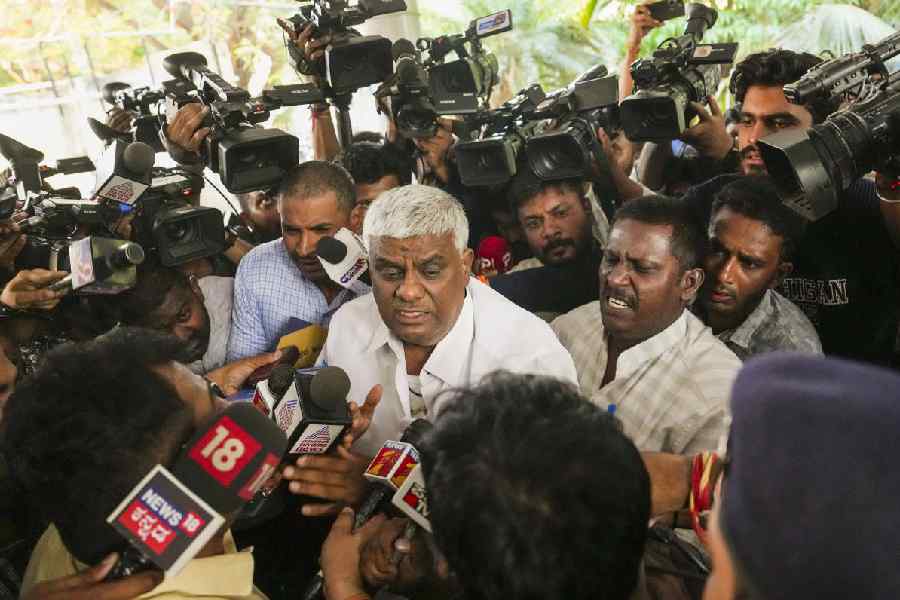
This time, 1,135 journalists from 55 countries are attending the event, with Japan’s Kyodo News Agency having sent as many as 15 correspondents. Certain provincial party committees have decided to leave half an hour in their group discussions to answer reporters’ questions. Such is the desire for communication that a few delegates have actually set up their own blogs to talk about their work directly to the people.
But just when everyone was hailing the new “openness and transparency” of the secretive party that has ruled China since 1949, the media got a taste of how little things have really changed for those in authority. A widely-attended press conference on the eve of the Congress had Li Dongshen, a former political correspondent with Central China TV, and now vice-chief of the Communist Party’s central committee publicity department , taking questions. Li, known in media circles as the propaganda deputy, had advised journalists to “go all out for articles that preserve social stability and avoid triggering social conflict,” and had even suggested to scribes, “We should sing high praises for socialism, to create a proper atmosphere for the 17th Party Congress.”
Different voices
At the end of the Congress-eve press conference, a Singapore reporter had this to ask of Li: “Pollution and land disputes in China are getting worse. Social conflicts appear to be escalating. Could you release the latest figures regarding these social conflicts?” He took some time to answer. What followed was a long explanation. Communist leaders, he said, “exercized power in the interests of the people. The core of our work is to ensure...the fundamental interest of the overwhelming majority of the people...the bad incidents taking place in some individual localities were appropriately solved. Now in China, the economy grows, there is social progress and the people enjoy higher and higher living standards. The people are satisfied. Thank you.” That signalled the end of the press conference.
The people are indeed satisfied, reports Xinhua, the official news agency. Be they retired Party members in Lhasa or Shanghai, medical students in Fujian or university professors in Tianjin, all of them were quoted by Xinhua as singing high praises for the Party. Why, on CCTV, a farmer in Fujian actually burst into song while praising the way the Party had changed the lives of the mountain folk for the better!
However, a Voice of America interview with a Beijing University student, featured on its website, told a different story. The student wasn’t too sure what Congress it was, calling it the “People’s Congress”. Significantly, when told that it was the Party’s Congress, he replied, “Isn’t it the same thing? Indeed, a survey conducted in major cities by the Social Survey Institute of China to find out people’s ideas about the 17th Congress showed that as many as 94.5 per cent were “very” or “rather interested” in the Congress. The top three concerns of the people surveyed were: finance, rising prices and social security.
However, the main themes of Hu Jintao’s political report were praise for ‘Socialism with Chinese characteristics’, the country’s phenomenal economic growth and its advances in democracy under the leadership of the Party.
|